
How to Practice with a Metronome (Without Getting Bored)
Learn how to practice with a metronome using simple routines, proven exercises, and expert tips to improve rhythm, timing, and speed without losing motivation.
Quick Answer
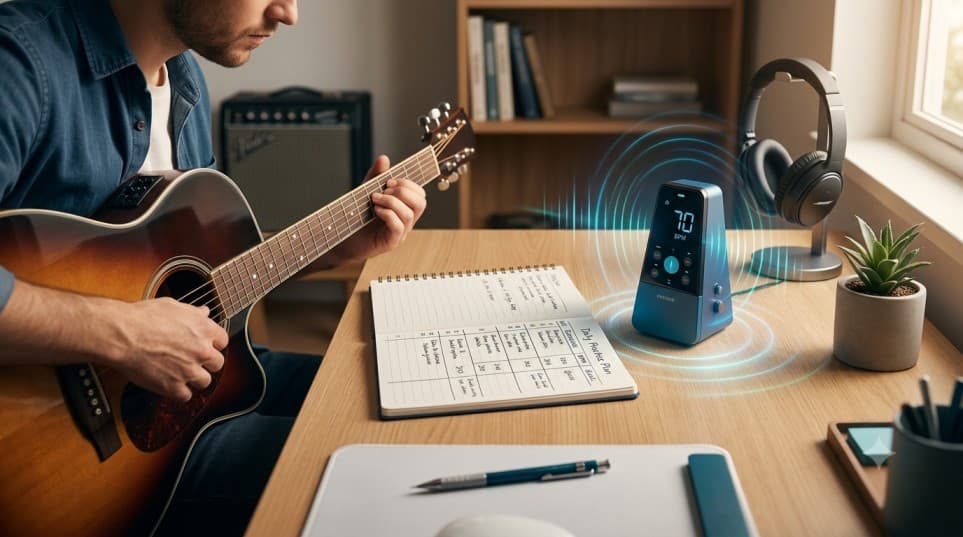
The most effective way to practice with a metronome is to start slowly, focus on accuracy before speed, and gradually increase the tempo as you become more consistent. Short, structured practice sessions of 20 to 30 minutes are usually more productive than long sessions spent repeating the same exercise. A metronome isn't there to rush your progress. It's there to help you develop reliable timing, stronger rhythm, and better control over your playing.
Introduction
Many musicians know they should practice with a metronome. The problem is that they often stop using one after a few days.
Some find the constant click frustrating. Others feel it interrupts their creativity or makes practice repetitive. In reality, the metronome isn't the reason practice becomes boring. It's usually because there's no clear plan.
Used correctly, a metronome can transform the way you practise. It helps you recognise timing mistakes that are difficult to notice on your own, builds rhythmic confidence, and makes gradual improvement easy to measure. More importantly, it teaches you to play with consistent timing instead of relying on guesswork.
Whether you're learning guitar, piano, drums, vocals, or another instrument, a structured metronome routine can help you improve more efficiently than simply repeating the same exercise without a clear goal.
In this guide, you'll learn practical routines for different skill levels, discover how to increase speed without sacrificing accuracy, and avoid the common mistakes that make metronome practice feel frustrating instead of rewarding.
Who Is This Guide For?
This guide is designed for musicians who want to improve their timing through structured practice rather than random repetition. It's especially useful for:
- Guitarists developing cleaner rhythm playing.
- Pianists building hand coordination.
- Drummers improving timing consistency.
- Vocalists practising rhythmic precision.
- Music students preparing for lessons, exams, or performances.
Whether you're picking up an instrument for the first time or refining advanced techniques, these practice methods can easily be adapted to your current skill level.
Why Practice with a Metronome?
A metronome doesn't improve your playing by itself. It helps you recognise timing mistakes that often go unnoticed.
Without a steady reference, it's easy to speed up during simple passages and slow down when something feels challenging. Practising with a consistent click helps you develop steady timing and better control over your playing.
Regular metronome practice can help you:
- Develop stronger internal timing.
- Improve accuracy before increasing speed.
- Build confidence when playing with others.
- Learn difficult passages more efficiently.
- Track measurable progress over time.
More importantly, it gives you a clear way to measure improvement. Instead of guessing whether you're getting better, you can gradually increase the tempo while maintaining clean, consistent playing.
When Should You Increase the Tempo?
Only increase the BPM after you can play an exercise cleanly several times in a row without losing timing or control. A good rule is to increase the tempo by 2–5 BPM at a time. If mistakes begin to appear, slow back down and master the current tempo before moving on.
Beginner Practice Routine
One of the biggest mistakes beginners make is trying to play at full speed too soon. Fast practice might feel more exciting, but it often reinforces mistakes instead of correcting them.
A better approach is to keep each session short, structured, and focused on accuracy. Once your timing becomes consistent, increasing the tempo becomes much easier.
A Simple 25-Minute Practice Routine
| Activity | Time | Goal |
|---|---|---|
| Warm-up | 5 minutes | Lock in with the click using simple notes or chords. |
| Technical Exercise | 10 minutes | Practise scales, chord changes, or basic patterns slowly. |
| Song Practice | 8 minutes | Apply the same tempo to a piece of music. |
| Review | 2 minutes | Repeat any difficult section before finishing. |
Don't worry about reaching a high BPM during your first few sessions. Your priority is to stay perfectly in time with the metronome, even if that means playing more slowly than usual. If you're unsure which practice tempo to start with, our Music Tempo Chart provides recommended BPM ranges for beginners, intermediate players, and different practice goals.
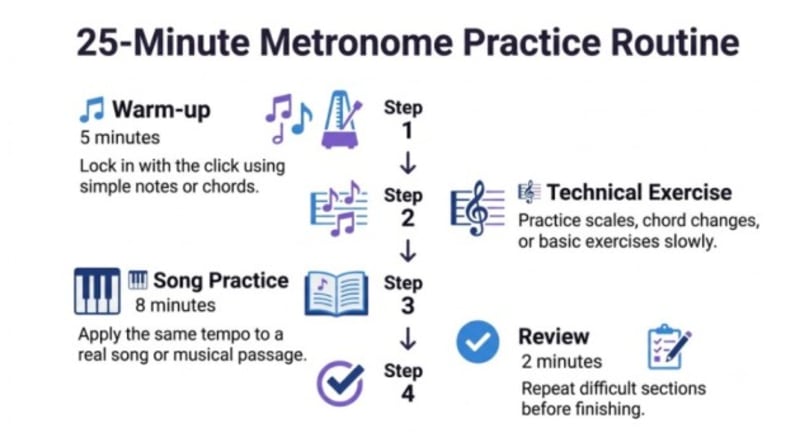
A structured practice routine helps beginners develop consistent timing without feeling overwhelmed.
How to Increase Speed
Improvement should happen gradually rather than all at once.
A simple rule many musicians follow is to increase the tempo by 2–5 BPM only after you can perform an exercise cleanly several times in a row. If mistakes begin to appear, lower the tempo again until your timing becomes consistent.
Think of tempo as a reward for accuracy, not a shortcut to improvement.
If you're gradually increasing your practice speed, a BPM Calculator can help you keep track of each tempo change and maintain a structured progression throughout your practice sessions.
Intermediate Practice Routine
Once basic timing feels comfortable, the goal shifts from simply following the click to developing stronger rhythmic control.
Instead of playing every note directly on each beat, begin experimenting with different note values and subdivisions while keeping the metronome at the same tempo. This forces you to maintain an internal sense of timing rather than depending entirely on the click.
A productive intermediate practice session might include:
- Playing scales using quarter notes, eighth notes, and triplets.
- Practising chord progressions with different rhythmic patterns.
- Starting exercises on different beats of the bar.
- Playing short phrases while leaving intentional rests.
These variations challenge your rhythmic awareness without making the exercises unnecessarily complicated.
At this stage, consistency becomes more important than duration. Twenty focused minutes with clear objectives will almost always produce better results than an hour of unfocused repetition.
The 4-Step Metronome Progression Method
One reason musicians lose interest in metronome practice is that every session feels exactly the same.
Instead of repeating exercises without a plan, follow this simple progression whenever you learn a new technique or piece of music.
| Step | Focus | Goal |
|---|---|---|
| Learn | Slow practice | Understand the notes and rhythm correctly. |
| Lock | Consistent timing | Stay perfectly aligned with the click. |
| Increase | Gradual BPM increases | Build speed without sacrificing accuracy. |
| Perform | Musical expression | Play confidently while maintaining steady timing. |
This approach keeps practice engaging because each stage has a clear objective. Rather than chasing speed from the beginning, you first establish reliable timing, then gradually build confidence until the exercise feels natural at performance tempo.
Advanced Metronome Exercises
Once you can play comfortably with a steady click, it's time to make the metronome work harder for you. Advanced practice isn't about using faster tempos. It's about reducing your dependence on the click while strengthening your internal sense of rhythm.
These exercises are commonly used by experienced musicians because they improve timing in real performance situations rather than just during practice.
1. Let the Click Feel Less Frequent
Instead of hearing a click on every beat, imagine the metronome clicking only on beats 2 and 4 or once every bar. This forces you to maintain the pulse internally rather than relying on constant guidance.
At first, this can feel uncomfortable, but it's one of the best ways to develop solid timing.
2. Practise Dynamic Control
Don't play every note at the same volume. Keep your timing steady while changing the dynamics of your performance.
For example:
- Play one phrase softly.
- Repeat it loudly.
- Add natural accents without changing the tempo.
This helps separate rhythmic control from expressive playing.
3. Challenge Your Coordination
If your instrument allows it, practise different rhythmic patterns simultaneously.
Examples include:
- Guitarists combining rhythm and melody.
- Pianists playing contrasting rhythms between both hands.
- Drummers using different sticking patterns.
- Vocalists clapping while singing.
The goal isn't complexity for its own sake. It's learning to stay perfectly in time while your brain manages multiple tasks.
Common Mistakes
Using a metronome doesn't automatically improve your timing. How you practise matters just as much as how often you practise.
Here are some of the most common mistakes musicians make and how to avoid them.
| Mistake | Better Approach |
|---|---|
| Starting too fast | Begin at a tempo where you can play accurately. |
| Ignoring mistakes | Stop, fix the problem, then continue. |
| Increasing BPM too quickly | Raise the tempo by only 2–5 BPM after consistent success. |
| Following the click instead of listening | Treat the click as a reference, not something to chase. |
| Practising for too long without breaks | Keep sessions focused and take short breaks to stay mentally fresh. |
Remember that accuracy should always come before speed. Every correctly played repetition builds stronger habits, while repeated mistakes become harder to correct later.
How to Stay Motivated During Metronome Practice
Metronome practice doesn't have to feel repetitive. Small changes to your routine can keep every session engaging while still improving your timing.
Try rotating between different exercises instead of repeating the same one throughout your practice session. Spend a few minutes on scales, switch to rhythm exercises, then finish with a song you're currently learning.
Setting small goals also helps. Instead of aiming to play faster, focus on completing one clean repetition or increasing the tempo by just a few BPM. These small wins build momentum and make long-term progress much more enjoyable.
Progress Tracking
One of the biggest advantages of practising with a metronome is that improvement becomes measurable.
Instead of guessing whether you're getting better, record your practice speed and increase it only when you're consistently accurate. Even small improvements become motivating when you can see them over time.
A simple practice log like the one below is often enough.
| Week | Exercise | Starting BPM | Current BPM | Ready to Increase? |
|---|---|---|---|---|
| 1 | Major Scale | 60 | 68 | ✅ |
| 2 | Chord Changes | 70 | 76 | ✅ |
| 3 | Practice Song | 80 | 84 | Nearly |
Don't compare your progress with other musicians.
Compare today's performance with last week's. Consistent improvement over time is far more valuable than chasing an arbitrary tempo.
If you reach a point where your playing becomes tense or inconsistent, reduce the BPM slightly and rebuild your confidence before increasing it again. Long-term progress is built through consistency, not rushing.
Using a Metronome during every practice session makes it much easier to follow this gradual progression because every improvement is based on measurable timing rather than guesswork.
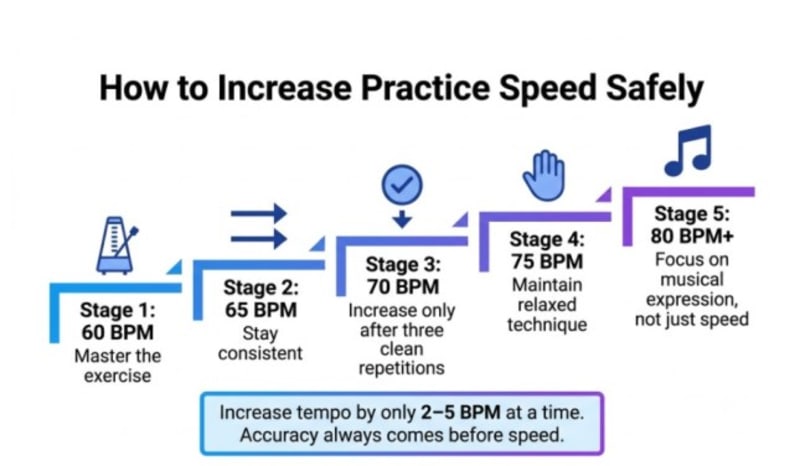
Tracking your BPM progression makes improvement measurable and keeps you motivated to continue.
Continue Learning
Continue building your rhythm and practice skills with these guides:
Common Metronome Mistakes That Slow Down Your Progress
Best BPM for Beginners: A Practical Practice Speed Guide
How DJs Calculate BPM Before Mixing Songs
Ready to Improve Your Timing?
Reading about rhythm is helpful, but consistent practice is what produces lasting results.
Open our free Metronome tool, follow today's practice routine, and track your progress one small tempo increase at a time. With regular, focused practice, you'll build stronger timing, cleaner technique, and greater confidence every time you play.
This article has been researched, written, and reviewed according to our Editorial Policy.
Frequently Asked Questions
Common questions about finding the BPM of a song.