
Common Metronome Mistakes That Slow Down Your Progress
Discover the 10 most common metronome mistakes musicians make, why they happen, and practical ways to fix them for faster rhythm improvement.

Learning to practice with a metronome is one of the fastest ways to develop reliable timing, but it can also be one of the most frustrating experiences for musicians. Many players assume the metronome is exposing a lack of talent when, in reality, it is simply revealing habits that often go unnoticed during normal practice.
Feeling uncomfortable with a metronome is completely normal. The click acts like an honest mirror, making every rushed note, dragged beat, and inconsistent rhythm impossible to ignore. That discomfort is not a sign that you're doing something wrong. It's a sign that you're finally hearing your timing accurately.
The good news is that most musicians struggle with the same predictable mistakes. Once you recognize them, they become much easier to correct, and your overall rhythm, consistency, and confidence improve much faster.
This guide explains the most common metronome practice mistakes, why they happen, and practical ways to fix them so every practice session becomes more productive.
Why Metronome Practice Feels Difficult
Many musicians expect a metronome to make practice easier, but the opposite usually happens during the first few sessions. That's because the metronome removes the flexibility your brain naturally gives itself when playing without external timing.
Without a steady reference, it's surprisingly easy to speed up during exciting passages, slow down during difficult sections, or unconsciously change tempo whenever your technique becomes uncomfortable. Since your ears adapt to these gradual changes, you often don't notice them.
A metronome doesn't create mistakes; it exposes them.
Another reason metronome practice feels challenging is that playing in perfect time requires several skills working together at once:
- Maintain a steady pulse
- Control your technique
- Anticipate upcoming notes
- Listen carefully to every click
When one of these skills weakens, your timing immediately begins to drift.
Professional musicians experience this process too. The difference is that they use the metronome as feedback instead of treating it as criticism. Rather than trying to fight the click, they learn to cooperate with it.
Once you understand the most common practice mistakes, metronome sessions become less frustrating and far more rewarding.
10 Common Mistakes
1. Starting at a Tempo That's Too Fast
One of the biggest reasons musicians struggle with a metronome is choosing an unrealistic starting tempo. Many players immediately jump to the speed of the original song because it feels more exciting than practicing slowly.
Unfortunately, fast practice often hides technical weaknesses instead of fixing them. Missed notes, uneven rhythm, and inconsistent timing become much harder to recognize, making every repetition reinforce the same mistakes.
Professional musicians understand that speed is the result of accuracy, not the starting point.
Why it happens
Most players associate improvement with higher BPM. They assume faster practice automatically means better practice.
What happens
Instead of developing a consistent rhythm, the brain learns inconsistent movements that become difficult to correct later.
How to fix it
Choose a tempo where you can play comfortably while maintaining complete control over every note and every beat. If the exercise feels almost too easy, you're probably practicing at the right speed.
Quick exercise
Reduce your current practice tempo by 20–30 BPM and play the same passage five consecutive times without timing errors before increasing the speed.
Professional tip
If you're wondering whether your tempo is too slow, it's probably not. Slow, accurate repetitions build speed much faster than rushed practice.
2. Treating the Click as Background Noise
Some musicians turn on the metronome but stop actively listening to it after only a few seconds. The click continues playing, yet their attention shifts entirely toward finger movements, picking technique, or reading music.
When this happens, the metronome becomes nothing more than background sound instead of an active timing reference.
Why it happens
Our brains naturally focus on technical challenges first. Once difficult passages demand more concentration, the click becomes easier to ignore.
What happens
Players begin drifting ahead of or behind the beat without realizing it until the rhythm noticeably falls apart.
How to fix it
Think of the metronome as another musician performing alongside you. Instead of simply hearing the click, actively compare every note you play against it.
Quick exercise
Play a simple scale while intentionally listening to every click before playing each note. Focus more on listening than performing.
Professional tip
Good rhythm begins with good listening. Many timing problems are actually listening problems.
3. Increasing BPM Too Quickly
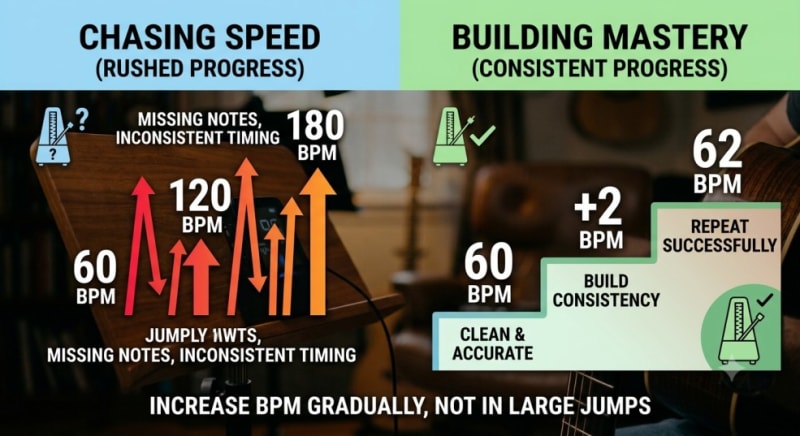
It feels satisfying to raise the tempo after one clean repetition. Unfortunately, one successful attempt rarely means a passage has become consistent.
Professional practice focuses on repeatability rather than isolated success.
| Poor Practice Habit | Better Practice Habit |
|---|---|
| Increase BPM after one clean run | Repeat the passage accurately several times first |
| Chase speed immediately | Build consistency before speed |
| Ignore small timing errors | Correct every timing issue before moving on |
Why it happens
Musicians often confuse one successful performance with genuine mastery.
What happens
Each tempo increase introduces new mistakes that quickly accumulate, forcing you to relearn the passage later.
How to fix it
Stay at the same BPM until you can perform the passage cleanly multiple times with relaxed technique and stable timing.
Quick exercise
Require five consecutive accurate repetitions before increasing the tempo by only 2–5 BPM.
Professional tip
Small BPM increases produce much larger long-term improvements than large jumps.
4. Ignoring Subdivisions
Many musicians only think about the main beats while forgetting everything that happens between them.
This becomes especially noticeable when playing eighth notes, sixteenth notes, triplets, syncopated rhythms, or longer rests. Even if the main beats remain accurate, the notes between them become uneven.
The result is a rhythm that technically stays in time but doesn't feel steady.
Why it happens
Players often rely entirely on the metronome's quarter-note pulse instead of developing an internal sense of subdivision.
What happens
Fast passages become inconsistent, grooves lose their feel, and difficult rhythms become much harder to control.
How to fix it
Mentally count subdivisions while practicing. Saying "1-and-2-and" or "1-e-and-a" helps divide every beat into equal parts and creates much more stable timing.
Quick exercise
Practice a simple scale while counting every subdivision aloud. Focus on making each note equally spaced between the clicks.
Professional tip
Most advanced musicians aren't counting the beats; they're feeling the subdivisions between them.
5. Practicing Inconsistently
Even the best metronome cannot improve your timing if you only use it occasionally. Many musicians practice with the click for one session, skip it for the next few days, and then wonder why their timing never seems to improve.
Rhythm is a skill that develops through repetition and consistency. Long practice sessions followed by several days without structured timing work rarely produce lasting results.
Small, regular sessions are far more effective than occasional marathon practices.
Why it happens
Many players view metronome practice as something they should do only when preparing difficult music rather than making it part of their daily routine.
What happens
Timing improves briefly but quickly returns to old habits because the brain never receives enough consistent reinforcement.
How to fix it
Include at least 10–15 minutes of focused metronome practice in every session, even if your overall practice time is short.
Quick exercise
Begin every practice session with one simple exercise using the metronome before moving on to songs or technical work.
Professional tip
Consistency beats intensity. Fifteen focused minutes every day will improve your timing much faster than two hours once a week.
6. Watching the Metronome Instead of Listening
Many digital metronomes include flashing lights or moving animations. While these visual cues can be helpful, some musicians become so focused on watching them that they stop developing their listening skills.
Music is ultimately an auditory experience. Your ears, not your eyes, should guide your timing.
Why it happens
Visual information is processed very quickly by the brain, making it tempting to rely on movement instead of sound.
What happens
Players struggle to maintain a steady rhythm whenever visual cues disappear during rehearsals or live performances.
How to fix it
Position the metronome where you can hear it clearly without constantly looking at the screen. Let your ears become the primary timing reference.
Quick exercise
Place the metronome slightly outside your direct line of sight and complete a familiar exercise using only the sound of the click.
Professional tip
If you can keep perfect time without watching the metronome, you're developing true internal rhythm.
7. Trying to Play Perfectly Instead of Playing Steadily
Many musicians stop every time they make a mistake. They restart the exercise repeatedly, chasing a flawless performance instead of maintaining a consistent pulse.
While accuracy is important, constantly restarting teaches interruption rather than continuity.
Professional performers continue through small mistakes while keeping the rhythm intact.
Why it happens
Players often believe every mistake immediately ruins the exercise.
What happens
Instead of developing reliable timing, they develop the habit of stopping whenever something feels uncomfortable.
| Practice Habit | Result |
|---|---|
| Stop after every mistake | Weak rhythmic consistency |
| Continue while maintaining tempo | Stronger timing and musical flow |
How to fix it
If you miss a note, keep the beat going. Finish the exercise, identify the problem afterward, then repeat it correctly.
Quick exercise
Play a familiar scale or short melody. If a wrong note occurs, continue without stopping until the exercise finishes.
Professional tip
In real performances, listeners notice broken rhythm far more than occasional wrong notes.
8. Depending on the Click Instead of Developing Internal Pulse
The purpose of a metronome is not to become permanent background noise. Its job is to help you build an internal sense of timing that remains steady even when the click disappears.
Some musicians become uncomfortable the moment they turn the metronome off because they've learned to follow the click instead of feeling the beat themselves.
Why it happens
The metronome becomes the only source of timing rather than a training partner.
What happens
Timing immediately becomes unstable whenever the click is removed.
How to fix it
Occasionally, alternate between playing with the metronome and without it. This allows you to compare your internal pulse against the external reference.
Quick exercise
Play eight measures with the metronome, then mute it for the next eight while maintaining the same tempo. Turn it back on and check whether you stayed synchronized.
Professional tip
The ultimate goal is not to follow the metronome forever; it's to become your own metronome.
9. Using the Same Practice Routine Every Day
Repeating identical exercises at the same tempo every day eventually leads to automatic playing rather than active learning.
Your brain adapts quickly to familiar routines, reducing the educational value of each session.
Why it happens
Familiar exercises feel comfortable and require less mental effort.
What happens
Timing improves more slowly because the brain is no longer being challenged.
How to fix it
Vary your practice by changing tempos, rhythms, note values, subdivisions, or exercises while keeping the metronome as the constant timing reference.
Quick exercise
Practice the same scale using quarter notes, then eighth notes, then triplets without changing the underlying tempo.
Professional tip
Small variations keep your attention high and strengthen timing in different musical situations.
10. Expecting Immediate Results
Perhaps the most common mistake of all is expecting noticeable improvement after only a few metronome sessions.
Developing reliable rhythm is similar to building strength or learning a new language. Progress happens gradually through thousands of accurate repetitions rather than dramatic overnight breakthroughs.
Professional musicians still practice with a metronome because timing is never truly "finished."
Why it happens
Modern learners often expect quick improvement because many skills can be learned rapidly through online tutorials.
What happens
Frustration builds quickly, causing musicians to abandon metronome practice before meaningful progress appears.
How to fix it
Measure progress over weeks instead of individual practice sessions. Celebrate consistency rather than immediate perfection.
Quick exercise
Record yourself practicing the same exercise once every week at the same BPM. Compare recordings after one month instead of judging daily performance.
Professional tip
Great timing isn't built by one perfect practice session. It's built by hundreds of ordinary sessions completed with patience and consistency.
How to Fix Each Mistake
Knowing what the mistakes are is only half the battle. The real improvement comes from replacing poor habits with a structured practice routine that builds accurate timing one session at a time.
Instead of trying to fix everything at once, focus on one improvement during each practice session. Small, consistent changes produce much better long-term results than attempting to eliminate every weakness immediately.
The table below summarizes the most effective corrections for each common mistake.
| Mistake | Why It Happens | Best Solution |
|---|---|---|
| Starting too fast | Chasing speed instead of accuracy | Begin at a comfortable tempo and increase gradually. If you're practicing a song by ear and aren't sure where to begin, first find the song's tempo with our Tap Tempo tool before selecting a slower practice speed. |
| Ignoring the click | Focusing only on technique | Treat the metronome as your practice partner |
| Raising BPM too quickly | Mistaking one good run for mastery | Require multiple clean repetitions before increasing tempo |
| Ignoring subdivisions | Feeling only the main beats | Count subdivisions aloud while practicing |
| Inconsistent practice | Irregular timing training | Practice with a metronome every session |
| Watching instead of listening | Relying on visual cues | Train your ears to follow the click |
| Restarting after mistakes | Fear of imperfections | Maintain a steady rhythm and correct mistakes afterward |
| Depending on the click | Weak internal pulse | Alternate between practicing with and without the metronome |
| Repeating identical routines | Lack of variety | Change rhythms, note values, and exercises regularly |
| Expecting instant results | Unrealistic expectations | Measure progress over weeks, not individual sessions |
A Simple Correction Strategy
If you're unsure where to begin, keep your metronome practice as simple as possible.
- Choose a tempo you can play comfortably.
- Focus on staying exactly with the click.
- Maintain relaxed technique.
- Repeat the exercise several times before increasing the tempo.
- Finish the session while you're still playing accurately.
Following these five steps consistently will improve your timing much faster than constantly chasing higher BPM numbers.
Practice Reminder
Slow, controlled repetitions build reliable rhythm. Fast, inconsistent repetitions usually reinforce mistakes.
A Better Metronome Practice Routine
A productive metronome session doesn't need to be long. In fact, short and focused practice is often more effective than practicing for extended periods without a clear objective.
The routine below can be completed in approximately 15–20 minutes and works well for most musicians.
| Time | Activity | Goal |
|---|---|---|
| 2–3 minutes | Warm up with simple notes or scales | Establish a steady pulse |
| 5 minutes | Practice one technical exercise | Focus on timing accuracy |
| 5 minutes | Work on a musical passage | Apply timing to real music |
| 3–5 minutes | Repeat the most challenging section | Reinforce consistent rhythm |
Before Every Session
Use this quick checklist before you begin:
- Start slower than you think you need to.
- Listen carefully to every click.
- Count subdivisions when necessary.
- Stay relaxed instead of forcing speed.
- Increase BPM only after several accurate repetitions.
- Finish with clean, confident playing rather than rushed practice.
Following the same preparation process every day helps create consistent practice habits and makes long-term progress much easier to measure.
Continue Learning
Improving your timing is an ongoing process, and every practice session builds on the previous one. Once you've corrected these common mistakes, continue developing your rhythm with more focused practice techniques.
How to Practice with a Metronome
How to Find the BPM of Any Song
Music Tempo Chart
Free Online Metronome
Final Thoughts
Every musician makes mistakes while practicing with a metronome. The difference between beginners and experienced players isn't the absence of mistakes; it's how quickly they recognize and correct them.
Don't measure success by how fast you can play. Measure it by how consistently you can stay on time.
When accuracy becomes your priority, speed naturally follows. If you're a guitarist or producer, keeping delay effects synchronized with your practice tempo can also improve rhythmic accuracy. Our Delay Time Calculator converts BPM into precise delay times for cleaner timing-based effects.
Practice With Our Free Metronome
Ready to put these corrections into action?
Open TheTapTempo Free Online Metronome and apply today's practice routine one step at a time. Start with a comfortable tempo, focus on staying with the click, and gradually build the consistent timing that every great musician depends on.
This article has been researched, written, and reviewed according to our Editorial Policy.
Frequently Asked Questions
Common questions about finding the BPM of a song.