
Semitones to BPM Shift: How Classic Hardware Samplers Change Track Speed
Why classic hardware samplers changed tempo when you changed pitch: the exact 2^(n/12) math behind semitone shifts, how it played out on the MPC60 and SP-1200, and the golden-era memory-saving hack.
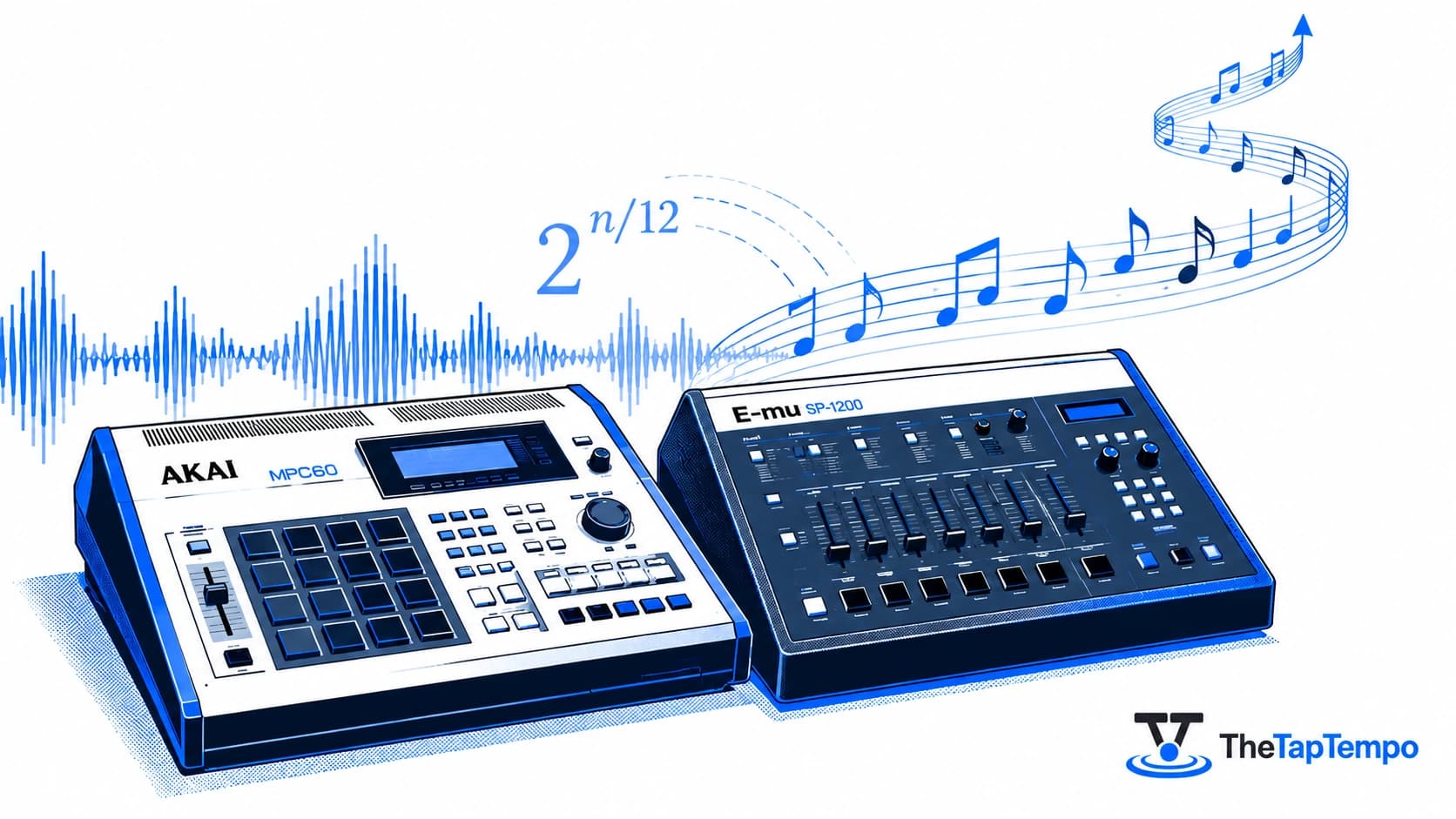
On a classic hardware sampler, shifting a sound up or down by semitones never just changed its pitch. It changed the tempo right along with it. Every unit of tuning multiplied the sample's playback speed by a fixed ratio, so nudging a break up by a few semitones sped up the whole beat, whether you wanted it to or not.
That single mechanical fact shaped how producers on machines like the Akai MPC60 and E-mu SP-1200 built entire records during hip-hop's golden era, and it's still the reason a vintage-style pitch shift behaves differently from a modern time-stretch. This guide walks through the math behind that relationship, how it played out on the hardware that defined the sound, and what it means for anyone trying to recreate that behavior today.
Why Classic Samplers Linked Pitch and Speed
Playback Rate: The Single Control
On vintage hardware samplers, pitch and tempo were never independent controls. They were two symptoms of the same underlying operation: playback rate. Raise a sample's tuning and the sampler reads its stored data out faster; lower it and playback slows down.
Because both pitch and duration depend directly on how fast that data streams out, tuning a sound automatically changed how long it took to play, and therefore its effective tempo.
Resampling vs. Time-Stretching
This is fundamentally different from how modern production software usually works. Today's DAWs typically separate pitch and tempo through algorithmic time-stretching, which recalculates audio so tempo can change independently of pitch, or the reverse. Classic samplers had no such separation. Changing one variable, tuning, moved the other, speed, because there was only one dial being turned: how quickly the sampler played back what it had recorded.
The E-mu SP-1200's own service documentation makes this explicit. Its playback rate was fixed at 26.04 kHz with no internal sample-rate conversion, so pitch adjustments were achieved by literally replaying the stored waveform data faster or slower rather than through any separate pitch-processing stage. The Akai MPC60 worked on the same underlying principle at a higher, also-fixed sample rate.
Some later samplers in the same family, such as the Akai S1000, added genuine variable sample-rate conversion, which is part of why not every "vintage sampler" behaved identically. That distinction matters more than it might seem, and it comes back later in this guide.
Quick answer: Vintage samplers didn't have separate pitch and tempo controls. Tuning a sample changed how fast its stored data played back, and playback rate governed both pitch and speed at the same time.
For producers, this meant every tuning decision was really a tempo decision. Pitch a drum break down two semitones to fit a slower groove, and you'd also slowed the break's internal timing. Pitch a vocal chop up to brighten it, and you'd sped it up whether the arrangement called for that or not. Understanding exactly how much speed change came with each semitone was, in practice, part of understanding the instrument.
The Mathematics of Semitone Transposition
The Formula: 2^(n/12)
The relationship between semitones and playback speed follows one exact formula: New BPM equals Base BPM multiplied by 2 raised to the power of semitones divided by 12. The number behind this, 2^(1/12), is the twelfth root of two, an irrational constant equal to approximately 1.0594630943592952646.
Why 5.95% Is Approximate
That constant is where the commonly cited "5.95% per semitone" figure comes from. Subtract 1 from 1.05946309... and you get 0.05946309..., or roughly 5.946%.
Rounding that to "6%" is close enough for a rough guess, but it introduces real error the moment you're stacking multiple semitones, because the relationship is multiplicative, not additive.
Multiplicative, Not Additive
Here's why that distinction matters. If you pitch a sample up 12 semitones, a full octave, the correct math gives you exactly 2× the original speed, a 100% increase. If you instead multiplied "6% per semitone" twelve times as simple addition, you'd land at 72%, nowhere close to the true doubling. Each semitone compounds on the last rather than stacking in a straight line.
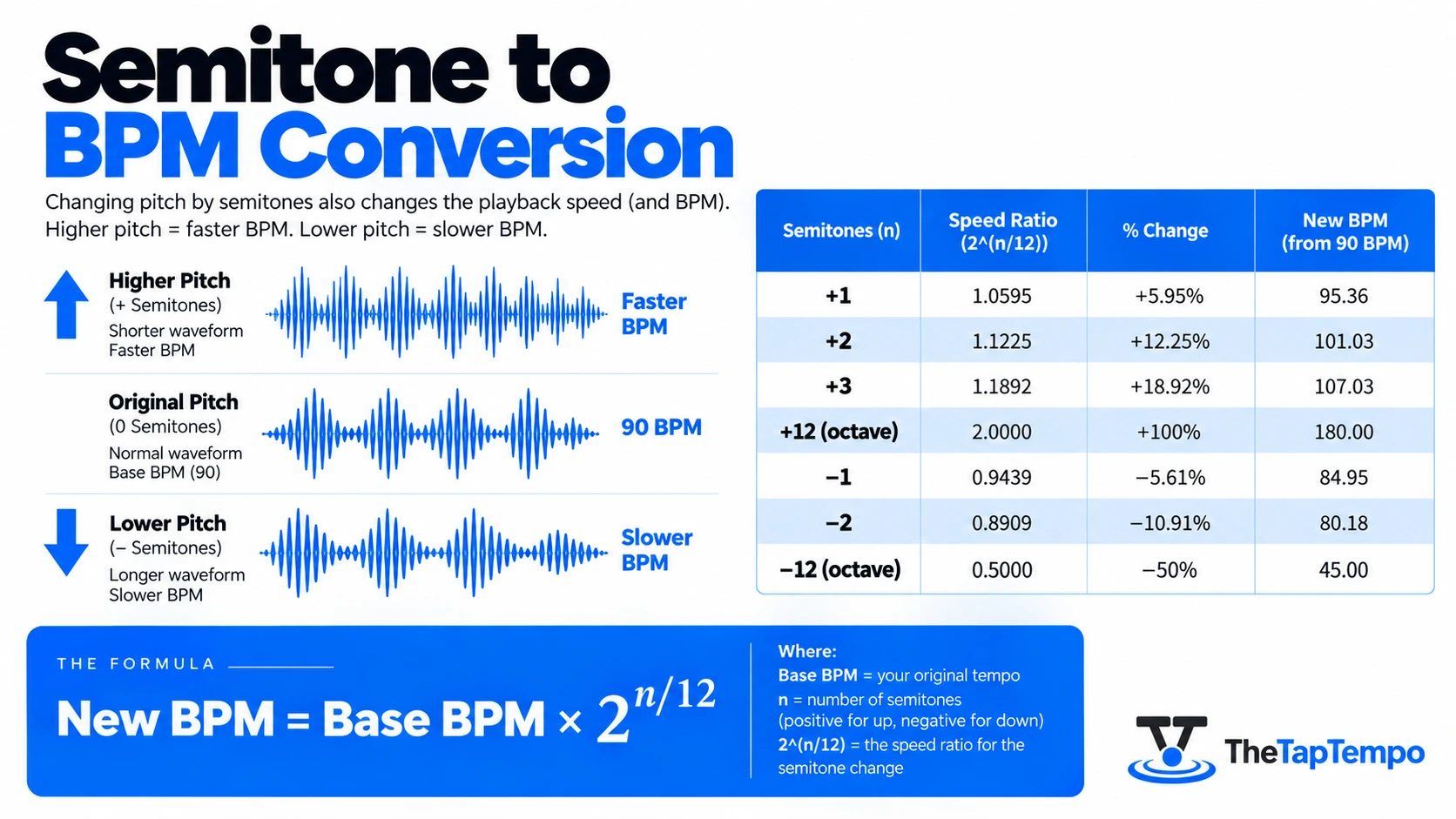
Worked examples starting from 90 BPM:
| Semitones | Speed Ratio | % Change | New BPM |
|---|---|---|---|
| +1 | 1.0595 | +5.95% | 95.35 BPM |
| +2 | 1.1225 | +12.25% | 101.02 BPM |
| +3 | 1.1892 | +18.92% | 107.03 BPM |
| +12 (octave up) | 2.0000 | +100% | 180.00 BPM |
| −1 | 0.9439 | −5.61% | 84.95 BPM |
| −2 | 0.8909 | −10.91% | 80.18 BPM |
| −12 (octave down) | 0.5000 | −50% | 45.00 BPM |
Notice that pitching down by a semitone loses less speed, percentage-wise, than pitching up by a semitone gains, 5.61% versus 5.95%. That asymmetry is a direct result of the exponential relationship, and it's a detail most simplified explanations skip entirely.
If you're working out a specific transposition for your own sample, the Pitch Tempo Calculator applies this exact 2^(n/12) formula and returns the resulting BPM instantly, which is faster and more reliable than doing the exponent math by hand on a session deadline. For matching that result back to a target tempo or checking a sample's duration against a bar count, the BPM Calculator covers the underlying tempo math this section builds on.
Quick answer: One semitone changes playback speed by a factor of 2^(1/12), about 5.946%. Because the relationship is exponential, semitone changes multiply rather than add, which is why 12 semitones always equals exactly double or half speed, never 72% or 28%.
The Golden Era Hack: Pitching Up Samples to Save Memory
The Memory-Saving Technique
Sampling memory in the late 1980s was measured in seconds, not gigabytes, and pitching a sample up before recording it was one documented way producers stretched that limited space further. The technique relied on a straightforward consequence of the speed-pitch relationship: a sample played back faster takes less time, and less time means less stored data for the same musical content.
The clearest primary-source description of this comes from a January 1993 Sound On Sound feature on sampling techniques, which laid out sample-rate conversion specifically as a way to conserve RAM and included calculation tables built around the 1.0595 conversion factor. The logic works like this: transpose a sample up one full octave, 12 semitones, and resample it at the same rate, and its length is cut exactly in half.
A four-second phrase becomes a two-second phrase, freeing up an equivalent chunk of memory for other sounds.
Which Samplers Supported This?
This wasn't a universal trick available on every machine, though, and it's important not to overstate it. It required a sampler capable of genuine variable sample-rate conversion, something like the Akai S1000, which could resample anywhere between 8 kHz and 65,535 Hz internally. The E-mu SP-1200, by contrast, had a single fixed 26.04 kHz playback rate with no internal resampling engine at all, so producers working on that machine couldn't perform this trick after the fact inside the sampler itself.
What SP-1200 users did instead, based on documented forum accounts among long-time users of the machine, was handle the pitch-up externally before sampling. A common method was recording a source at 45 RPM on a turntable instead of the standard 33⅓, which pitches material up by roughly five semitones, then tuning it back down inside the sampler afterward to match the target. That external step achieved a similar memory-saving result without requiring the sampler to do any resampling of its own.
Quick answer: Pitching a sample up an octave and resampling halves its stored length, a real technique documented in early-1990s sampling literature. But it required a sampler with variable sample-rate conversion, like the Akai S1000. Fixed-rate machines such as the SP-1200 needed the pitch-up done externally, often via 45 RPM playback, before sampling.
Producer accounts from the era back up how central these constraints were to the workflow, even without every account describing the octave trick specifically. Pete Rock has described working around the SP-1200's roughly ten seconds of total sampling time by deliberately planning what he sampled rather than sampling everything and hoping it fit. Constraints like this weren't just technical footnotes, they actively shaped the chopping, layering, and arrangement decisions that came to define the sound of the era.
Classic Hardware Workflow: MPC60 vs. SP-1200 Resampling
The MPC60 and SP-1200 are often name-checked together as the twin pillars of golden-era sampling, but their resampling behavior wasn't interchangeable, and their specifications explain why.
The Akai MPC60 sampled at a fixed 40 kHz with 12-bit non-linear encoding, giving it roughly 18 kHz of frequency response. Standard memory offered 750 KB, about 13.1 seconds of sample time, expandable to 1.5 MB for 26.2 seconds. Tuning ran from +7 to -12 semitones in fine 0.1-semitone steps, and crucially, that tuning could be set independently per pad, so the same sample could sit at multiple pitches across the pad grid without duplicating any of the underlying data in memory.
The E-mu SP-1200 sampled at a fixed 26.04 kHz, also 12-bit, with total sample time capped at 10 seconds spread across four banks of 2.5 seconds each, holding up to 32 individual samples. Its tuning worked through a slider offering roughly a fifth of range in either direction, with no fine-tune stepping.
The SP-1200's own service documentation notes plainly that the machine had only one playback rate and achieved pitch shifts through what's often called drop-sample pitch-shifting, essentially replaying stored data at a different rate without the smoothing that finer interpolation would provide, which produced more audible artifacts than a higher-resolution approach would.
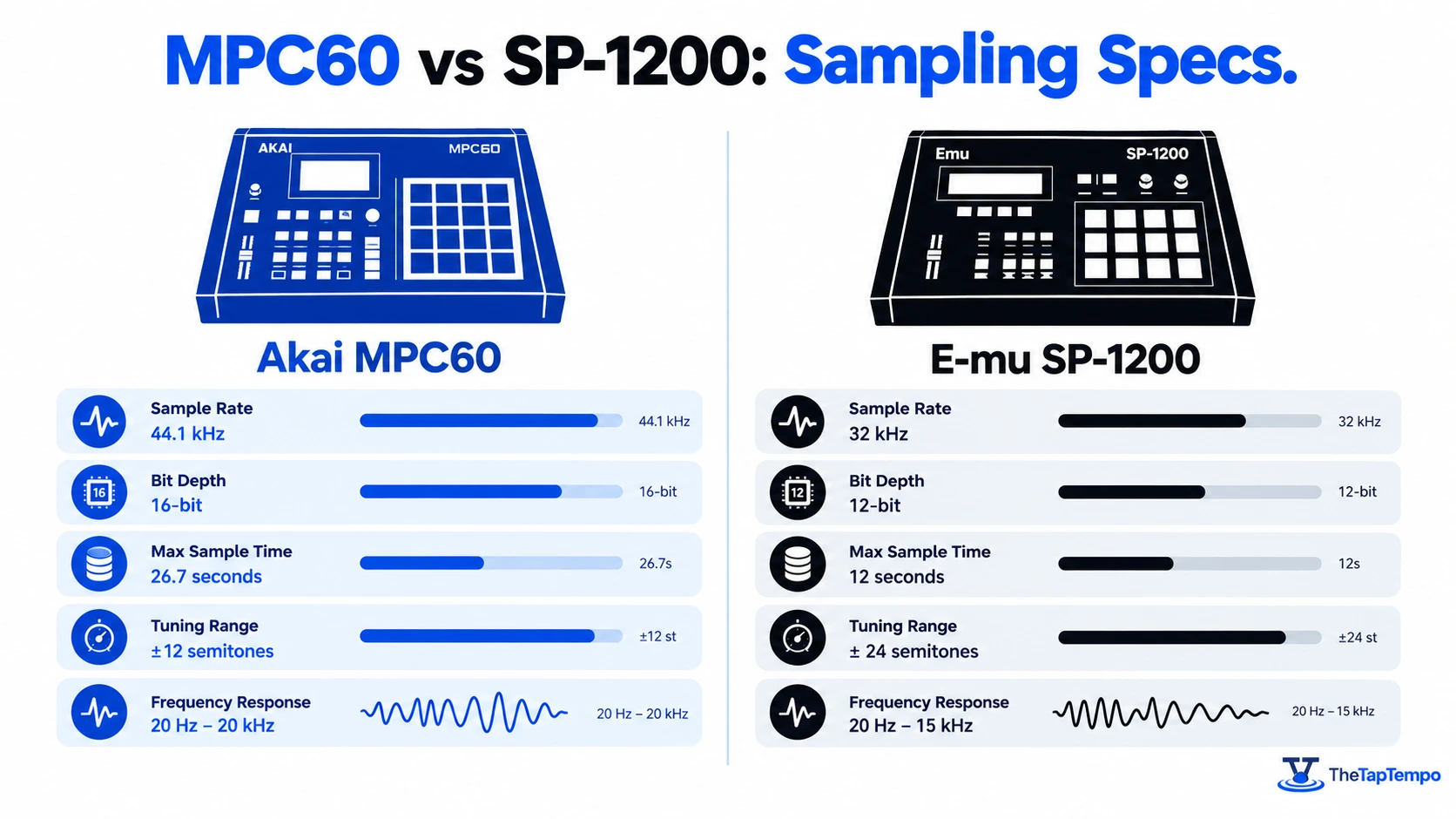
Side-by-side comparison:
| Spec | Akai MPC60 | E-mu SP-1200 |
|---|---|---|
| Sample rate | 40 kHz (fixed) | 26.04 kHz (fixed) |
| Bit depth | 12-bit non-linear | 12-bit |
| Max sample time | 13.1s standard / 26.2s expanded | 10s total (4 x 2.5s banks) |
| Tuning range | +7 to −12 semitones, 0.1-semitone steps | Approx. ±1 fifth, slider only |
| Per-voice tuning | Independent per pad | Per bank/sample |
| Frequency response | Approx. 18 kHz | Approx. 10–12 kHz |
The practical upshot is that these two machines, despite showing up on the same records constantly, were not sonically or operationally identical when it came to pitch shifting. The MPC60's higher sample rate and finer tuning resolution gave it a cleaner, more precise transposition. The SP-1200's lower rate and coarser slider tuning gave it the grittier, more heavily colored character it's remembered for, partly because of its resampling method and partly because of everything covered in the next section.
Audio Quality: What Happens When You Resample
Resampling a sound through playback-rate manipulation isn't a lossless operation, and vintage hardware makes the tradeoffs audible in specific, measurable ways rather than through vague "vintage magic."
Four Measurable Effects
Bandwidth. A sampler's sample rate sets a hard ceiling on the frequencies it can represent, roughly half the sample rate, known as the Nyquist limit. The SP-1200's 26.04 kHz rate caps usable bandwidth at somewhere around 10 to 12 kHz, which is plenty for punchy drums but noticeably rolled off compared to full-range material. The MPC60's 40 kHz rate pushes that ceiling closer to 18 kHz, a meaningfully wider window.
Aliasing. When a sample is pitched down, its playback rate slows and its effective frequency content can exceed what the system's filtering was designed to handle cleanly, causing high frequencies to fold back into the audible range as inharmonic distortion. Anti-aliasing filters exist specifically to control this, and the SP-1200 used fairly steep filtering, on the order of 42 dB per octave, to manage it. That filtering shapes the tone as much as it protects against artifacts.
Drop-sample artifacts. Because the SP-1200 had no internal interpolation between its fixed-rate samples during pitch shifting, transposition produced additional artifacts beyond simple bandwidth loss, an effect the machine's own documentation and later technical analyses both describe as adding audible distortion, particularly at more extreme pitch settings.
12-bit quantization. Both machines encoded audio at 12-bit resolution, which offers roughly 72 dB of dynamic range and introduces its own quantization noise, especially audible at lower signal levels.
Quick answer: Resampling on vintage hardware introduces bandwidth limits from the sample rate, aliasing from pitch shifts exceeding the filtering design, drop-sample artifacts from the lack of interpolation, and 12-bit quantization noise. These are measurable engineering tradeoffs, not just a "warm" aesthetic choice.
Producers and engineers often describe the resulting sound with words like warm, crunchy, or gritty, and those descriptions aren't wrong, they're just subjective labels for the objective effects above. The actual sonic signature is the sum of a limited sample rate, coarse bit depth, and non-interpolated pitch shifting working together, which is a very different chain of events from a modern high-resolution time-stretch algorithm.
How Modern Producers Recreate Classic Pitch Shifts
Recreating this character in a modern setup starts with understanding which specific ingredient you're trying to reproduce, since bandwidth loss, aliasing, and quantization noise each sound a little different and each responds to a different tool.
For the bandwidth and quantization character, a bit-crusher or downsampler plugin set to reduce bit depth toward 12-bit and sample rate toward the 26 to 40 kHz range approximates the ceiling those original machines imposed. For the drop-sample pitch-shifting artifact specifically, using a plugin's "no interpolation" or basic resampling mode, rather than a high-quality algorithmic pitch shifter, gets closer to how the SP-1200 actually behaved when transposing.
The bigger workflow choice is deciding whether you want resampling behavior or time-stretching behavior in the first place, since they solve different problems. If you want a sample's pitch and tempo to move together the way they did on original hardware, classic resampling is the accurate choice. If you want to change tempo while keeping pitch fixed, or vice versa, that's what modern time-stretching algorithms are built for, and it's a different technical process worth exploring on its own rather than folding into a resampling workflow.
Either way, calculating the target numbers before you commit removes the guesswork. Feeding a sample's original tempo and your intended semitone shift into the Pitch Tempo Calculator gives you the resulting BPM using the same 2^(n/12) math covered earlier, so you know exactly what tempo you're landing on before you print the resample. If you're also tracking how that new duration lines up against bars and beats, converting the result with a BPM to Milliseconds calculation shows you exactly how much time each beat now occupies, which matters when you're fitting a resampled break back into a grid.
Common Misconceptions and Myths
A few claims about this topic circulate often enough that they're worth addressing directly, since some of them are simply inaccurate and others are true but frequently overstated.
"Each semitone adds exactly 6% speed."
Not quite. The real figure is 5.946%, and because the relationship compounds rather than adds, treating it as a flat 6% per semitone produces increasingly wrong numbers the more semitones you stack.
"Every vintage sampler pitched up to save memory."
This describes a real and documented technique, but not a universal one. It required internal variable sample-rate conversion, which machines like the Akai S1000 had and the fixed-rate SP-1200 did not. On fixed-rate hardware, producers achieved the same result externally, not through an internal function of the sampler itself.
"The MPC60 and SP-1200 handled pitch identically."
Their specifications say otherwise. Different fixed sample rates, different tuning resolution, and different pitch-shifting implementations gave the two machines distinctly different sonic results, even when used on similar material for similar purposes.
"Vintage samplers used time-stretching."
They didn't, and the term is anachronistic here. Every pitch change on this era of hardware moved tempo along with it because playback-rate manipulation was the only mechanism available. Algorithmic time-stretching, which can decouple pitch from tempo, came later.
Continue Learning
Keep exploring tempo, pitch, and sampler workflows:
- Pitch Percentage to BPM: What the Numbers Actually Mean
- How Tempo Affects Emotion in Music
- Why Slow Practice Makes You a Better Musician
Ready to work out your own numbers? The Pitch Tempo Calculator applies the exact formula from this guide so you can find the resulting BPM for any semitone shift before you commit to a resample.
This article has been researched, written, and reviewed according to our Editorial Policy.
Frequently Asked Questions
Common questions about finding the BPM of a song.