
How Tempo Markings Influence Emotion in Music
Discover how tempo affects emotion in music, shaping tension, energy, and reflection. Learn how composers and performers use pacing to tell a story.
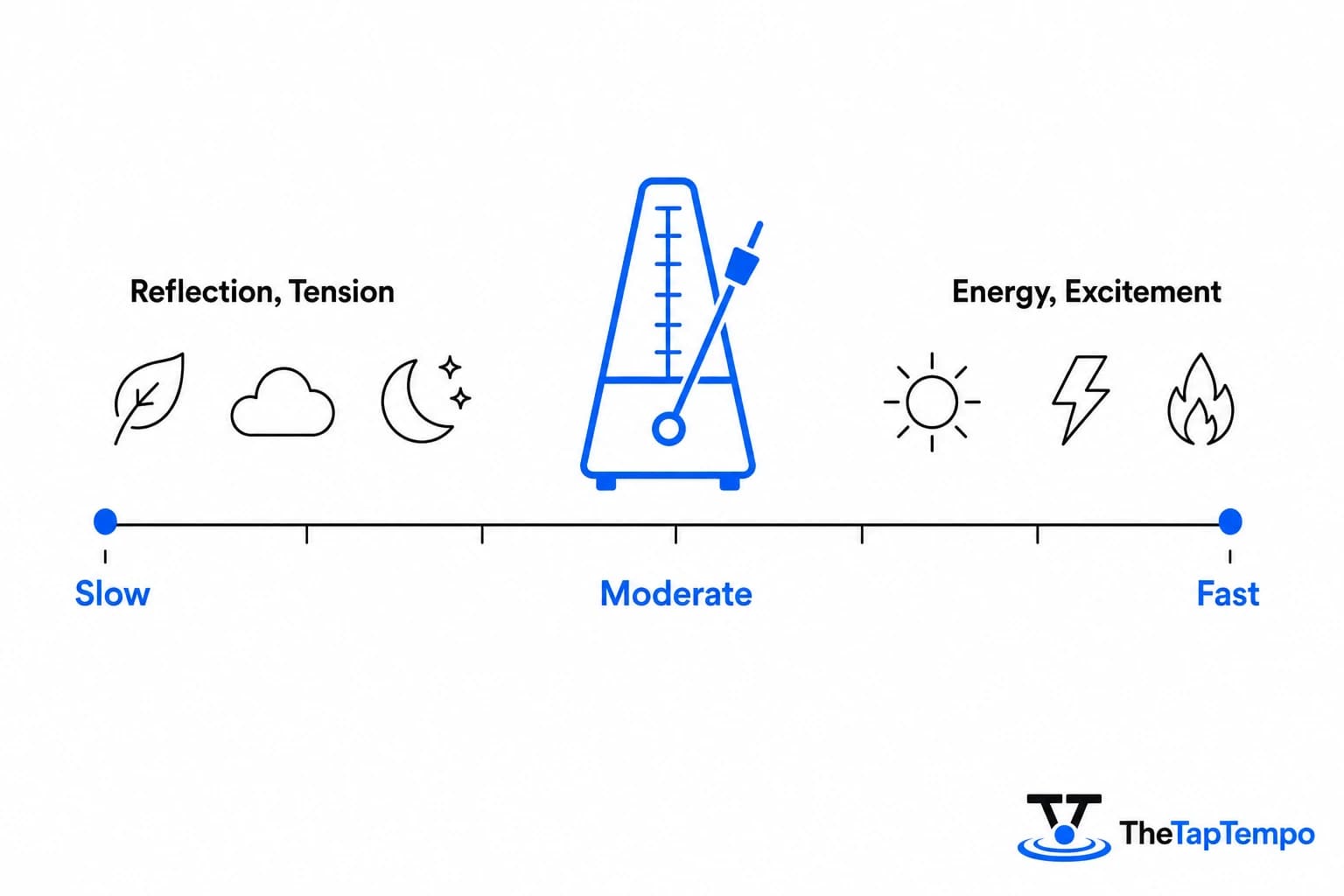
A tempo marking looks like a simple instruction, but it carries far more than speed. It shapes tension, urgency, intimacy, and release, and it starts telling a story before a single dynamic marking or phrase direction enters the picture. Understanding how tempo affects emotion in music is one of the clearest ways to move from playing notes accurately to performing with genuine expressive intent.
This guide looks at tempo as a tool for emotional interpretation. It explains why slow and fast pacing tend to produce different emotional impressions, how tempo interacts with harmony, texture, dynamics, and phrasing, and how composers and performers have used pacing to communicate feeling in several well-known works from the classical repertoire.
Why Tempo Is More Than Musical Speed
A tempo marking sets the notated pace, but not the perceived pace; the same marking can feel like it's standing still or pushing forward depending on the texture underneath it. Emotional pacing, phrase-level motion, and small timing adjustments all shape character within that marking rather than being fixed by the number itself.
Tempo as an Emotional Signal
A tempo marking establishes a notated tempo: the pace the composer wrote on the page. It does not fully determine the perceived tempo, which is how fast or slow the music actually feels once it is played. A passage marked slow can still feel like it is moving forward if it is built from continuous, subdivided figuration underneath a sustained melody. A passage marked fast can feel suspended rather than urgent if the harmony barely moves and the same rhythmic cell repeats without development.
This gap between what is written and what is felt is where interpretation begins. A performer who treats the marking as the entire instruction will often produce a technically accurate but emotionally inert result, because the notated tempo says nothing about how weight, breath, and direction should be distributed within it.
Overall Tempo and Emotional Pacing
It helps to separate several ideas that are easy to blur together. The overall tempo is the broad pace a passage is performed at, chosen within the range the marking allows. A metronome tool can help you find and test that exact range before shaping the emotional pacing around it. Emotional pacing is different: it is how tension, motion, suspension, climax, and release unfold across that overall tempo, shaped by harmonic rhythm, dynamic contour, and texture.
Phrase-level pacing narrows the focus further, describing forward motion toward a musical goal, such as a cadence or a melodic high point, followed by relaxation once that goal is reached. Local expressive timing is the smallest layer: brief lingering on an important note, or a slight easing into a resolution, applied within an otherwise steady pulse.
A single overall tempo can support very different emotional pacing depending on how a performer handles these smaller layers. Two pianists can choose an identical broad tempo for the same passage and still shape it into entirely different emotional arcs, because the overall tempo only sets the outer boundary within which phrasing, dynamics, and timing operate.
How Slow Tempos Create Reflection and Tension
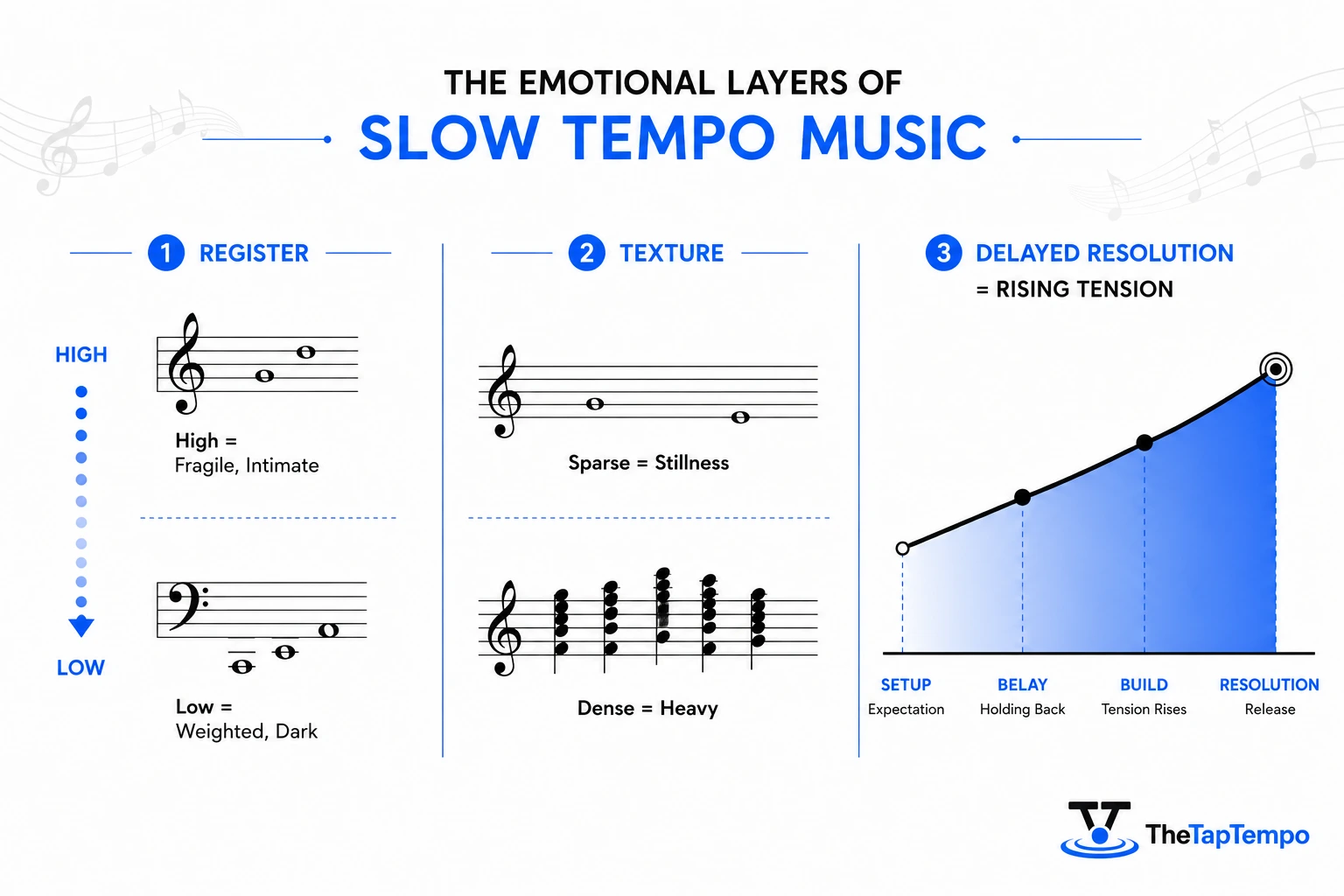
A slow tempo isn't automatically sad; it exposes harmonic detail, register, and texture that a faster pace would rush past, which can create tenderness, dignity, or suspense just as easily as sorrow. The extra time also lets tension build, since a delayed resolution feels more significant the longer the listener has to anticipate it.
Why Slow Music Feels Reflective
A slow tempo gives the listener time to notice harmonic detail that would pass quickly at a faster pace. Delayed resolutions, extended dissonances, and unhurried voice leading become audible events in their own right rather than transitional moments. Register plays a direct role here: a slow melody sustained in a high, exposed register tends to read as fragile or intimate, while the same melodic shape in a low register can feel weighted, dark, or resigned.
Texture matters just as much. A slow passage built from sparse, widely spaced writing creates a sense of open space and stillness, while a slow passage built from dense, sustained harmony can feel heavy or oppressive rather than calm. Slow music is often described simply as sad, but that label overlooks how much the harmonic language, register, and texture actually determine the character of a given passage. The same slow tempo can support tenderness, dignity, suspense, or grief, and the difference lies in these musical details rather than in the pace alone.
How Slower Pacing Builds Tension
Tension is one of the more overlooked emotional effects of a slow tempo. When a phrase moves slowly toward an expected harmonic resolution, the listener has time to anticipate that arrival, and a delayed cadence can feel more consequential than a quick one simply because there was more time to expect it.
A slow tempo can create suspense in much the same way a long pause before an important statement increases its impact. That tension comes less from the slow speed itself and more from what happens harmonically and texturally during the extra time a slower pace provides. A performer who understands this treats a slow passage as a container for harmonic motion rather than as an empty stretch of time to be filled.
How Faster Tempos Build Energy and Excitement
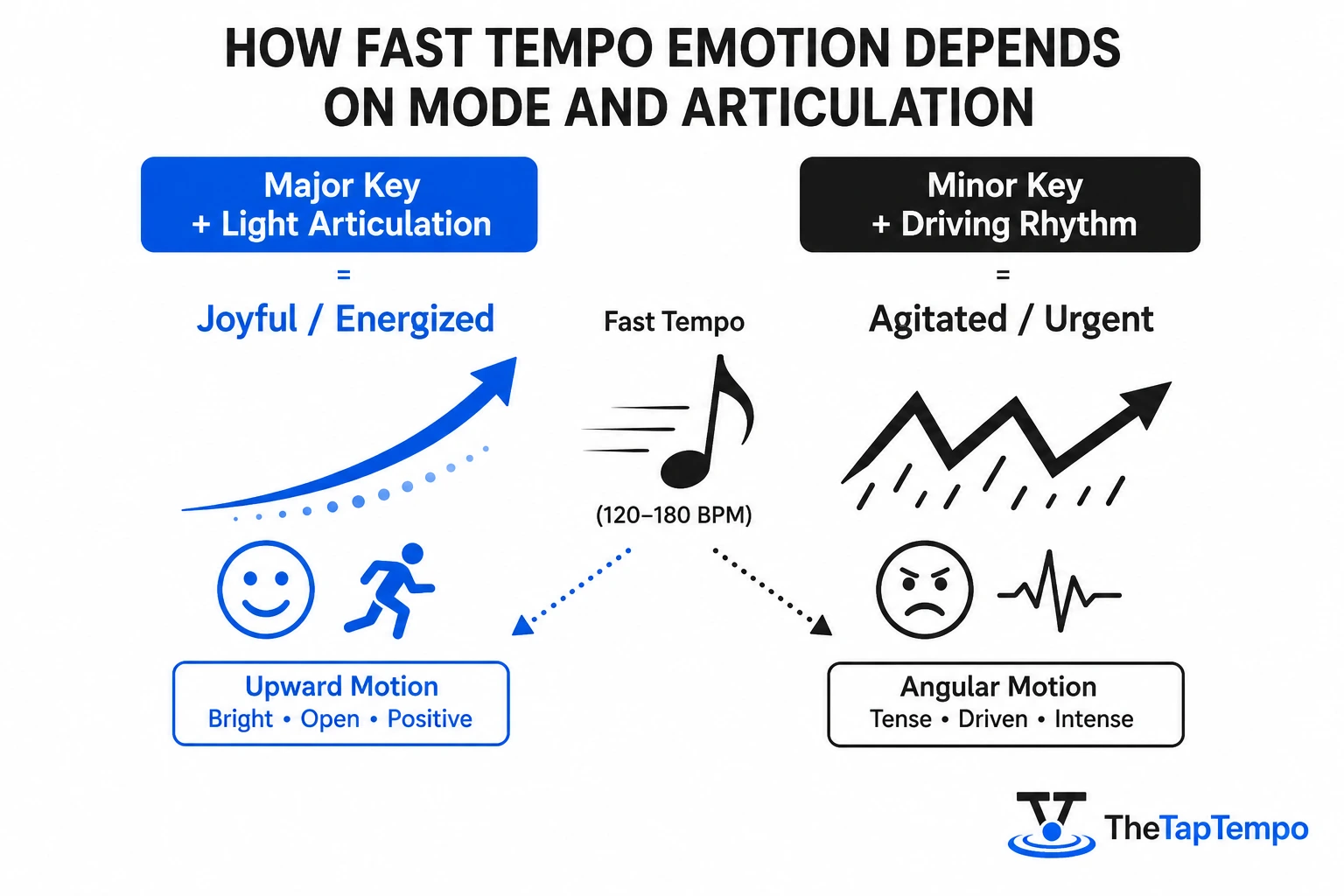
A fast tempo raises perceived energy and forward motion, but it doesn't decide the emotion on its own; mode and articulation do that work. The same quick pulse can read as joyful in a major key with light articulation, or agitated and urgent in a minor key with driving rhythm.
Why Faster Tempos Increase Energy
A faster tempo raises perceived energy by compressing the time between musical events and increasing the density of rhythmic activity the listener processes per second. Articulation reinforces this effect directly: detached, accented notes at a fast tempo intensify the sense of drive, while smooth, connected phrasing at the same tempo can soften it into something closer to buoyancy than urgency.
Faster pacing commonly increases a listener's sense of forward motion and activation, but it does not determine whether that activation is experienced as joy, urgency, anxiety, or triumph. That reading depends on what surrounds the tempo, particularly harmony and articulation.
Why Fast Music Is Not Always Happy
Mode has a strong influence on how a fast tempo is interpreted, though it does not lock in one fixed emotional outcome. A fast passage in a major key, built from stepwise melodic movement and light articulation, tends to read as playful or energized. A fast passage in a minor key, built from angular intervals, close imitation between voices, or persistent rhythmic drive, can instead read as agitated, unstable, or urgent.
A technically fast passage played without harmonic or dynamic direction can feel chaotic rather than exciting. Speed alone rarely satisfies a listener; the energy needs a destination, whether that is a climactic dynamic peak, a long-awaited cadence, or a sudden change in texture that resolves the built-up motion.
How Tempo Works Together with Dynamics and Phrasing
Tempo rarely creates emotional meaning on its own. It works in combination with dynamics and phrasing, and separating the three is one of the most common mistakes performers make when trying to sound more expressive.
How Dynamics Change Tempo's Emotional Effect
A tempo choice tells the listener how quickly time is moving, but dynamics tell them how much weight each moment carries. A fast passage played softly often feels light, secretive, or nervous rather than triumphant, because the quiet dynamic works against the boldness usually associated with speed. A slow passage played forcefully, by contrast, can feel monumental or threatening rather than gentle, because the loud dynamic overrides the calm typically associated with a relaxed pace.
A gradual crescendo across an otherwise steady tempo can generate a strong sense of arrival even without any change in pace, which shows how much of the perceived intensity in a passage comes from dynamic shaping rather than from tempo itself.
How Phrasing Creates Forward Motion
Phrasing shapes where the ear expects motion and where it expects rest. A phrase that pushes toward a cadence, particularly an authentic cadence that resolves cleanly, creates anticipation, while a phrase that eases after that arrival creates release. A deceptive cadence, where the expected resolution is avoided, can extend tension by denying the arrival the listener anticipated.
Two performers can use an identical overall tempo and still produce noticeably different emotional readings of the same passage. One may shape the phrase with subtle forward motion toward the climax, while the other maintains a more even pace throughout, and a listener experiences those two choices as different emotional journeys even though the underlying tempo marking never changed. This is the distinction between overall tempo, which stays fixed, and phrase-level pacing, which is built from how dynamics and direction move within it.
The Role of Local Expressive Timing
Some of that shaping comes from small, controlled adjustments to timing within an established tempo, an expressive practice broadly known as rubato. A performer might lean slightly into a melodic peak, or ease into a cadence a fraction later than the strict pulse would suggest, without altering the overall tempo of the passage.
Used with restraint, this kind of local timing flexibility can highlight a phrase's emotional peak without abandoning the pacing the composer intended. Used without control, it can blur the underlying pulse and weaken the expression it was meant to support. The important point here is that local timing flexibility shapes emotional pacing without replacing the overall tempo framework.
Examples of Emotional Tempo Choices in Classical Music
Specific repertoire makes these ideas concrete. In each case, the composer's tempo indication establishes a frame, and the emotional result comes from how performers fill that frame using harmony, texture, dynamics, and phrasing.
Beethoven's Moonlight Sonata
Beethoven's Piano Sonata No. 14 in C-sharp minor, commonly known as the Moonlight Sonata, opens with a movement marked Adagio sostenuto. Continuous triplet figuration runs through the texture from the first bar to the last, while a simple, restrained melodic line unfolds above it and a sparse, low-lying bass moves only occasionally beneath.
This combination illustrates the gap between notated and perceived tempo directly. The marking is slow, but the continuous triplet subdivision keeps the music in constant quiet motion rather than stillness, which is part of what gives the movement its suspended, inward character. The low register of the bass contributes weight and darkness, while the restrained dynamic range and the harmonic shading beneath the melody allow tension to accumulate gradually rather than dramatically. The emotional effect comes from this interaction of tempo, texture, register, and harmony, not from slowness by itself.
Chopin's Nocturnes
Chopin's Nocturne in E-flat major, Op. 9, No. 2, is built around a singing melodic line that becomes more ornamented each time it returns, supported by a flowing, broken-chord accompaniment in the left hand. The written tempo stays broadly consistent, but the melody's increasing ornamentation invites the performer to shape each restatement with slightly different phrasing and timing.
Pianists can differ noticeably in how they lean into a melodic peak, ease into a decorated cadence, or give an ornamental turn extra breathing room, even while keeping a similar overall tempo throughout. These choices change the emotional character of the piece without changing its identity: the composition remains the same, but the balance between forward motion and lingering shifts from performer to performer. This is a clear demonstration that overall tempo and local timing flexibility are not the same decision.
Mozart's Symphonies
The finale of Mozart's Symphony No. 40 in G minor is marked Allegro assai and moves quickly, but its character is turbulent rather than light. The minor key, the close imitation between orchestral voices, and the persistent rhythmic drive combine with the fast tempo to create urgency and instability rather than buoyancy.
This example is useful precisely because it resists the assumption that a Mozart Allegro is automatically cheerful. Tempo contributes to the finale's intensity, but the mode, the orchestration, the articulation, and the tightly woven counterpoint are what give the movement its unsettled character. A different fast Mozart movement in a major key, with lighter orchestration and more spaced-out phrasing, can sound buoyant at a similar tempo, which shows that speed alone does not fix the emotional outcome.
Tchaikovsky's Orchestral Music
Tchaikovsky's Symphony No. 6 offers two contrasting demonstrations within a single work. The third movement, a march-like Allegro, builds through layered orchestration, increasing dynamic intensity, and rhythmic drive to a forceful, triumphant-sounding climax. The finale that follows, marked Adagio lamentoso, reverses that momentum entirely, closing the symphony with a slow, thinning texture that fades rather than resolves triumphantly.
That closing choice, ending a symphony slowly instead of with a fast final movement, is itself part of the emotional design. The conductor's role in both movements involves far more than setting a tempo: balancing sections, shaping the buildup of the march, and controlling the gradual disappearance of sound in the finale all contribute to how the large-scale emotional arc reaches the listener. Tempo provides the outer frame for both movements, but the coordinated handling of orchestration, dynamics, and balance is what carries their opposite emotional effects.
Using Tempo Markings as Emotional Performance Guides
Treating a Marking as an Interpretive Frame
A tempo marking works best when it is treated as an emotional starting point rather than a rigid instruction. The word a composer chose, whether it suggests a flowing, walking, or driving character, carries interpretive information that a number alone cannot fully capture.
Reading tempo this way changes the question a performer asks before starting a piece, moving from “how fast should this go” toward “what character does this tempo need to support.” Before interpreting a marking, performers can use the Tempo Markings Tool to review the expressive guidance associated with the term. That context provides a starting point for decisions about phrasing, dynamics, and local timing.
Balancing Stability and Expressive Freedom
This approach helps performers avoid two common mistakes. The first is playing in a way that is technically correct but emotionally flat, where the tempo is accurate but the phrasing and dynamics never respond to what that tempo is meant to convey. The second is taking so much expressive freedom that the underlying pulse becomes unclear, leaving the music without rhythmic coherence.
The goal sits between these extremes: a stable overall tempo shaped by informed, purposeful expressive choices, drawing on the score, harmonic context, and an understanding of the piece's character rather than on the tempo marking in isolation. Once that expressive interpretation is settled, a metronome can help keep it consistent across repeated practice sessions.
Continue Learning
- Why Composers Use Tempo Markings Instead of BPM Numbers – explore why composers write tempo in words instead of numbers and what that choice communicates.
- Why the Same Tempo Marking Can Sound Different – learn why the same tempo marking can sound different in two performances even when the written pace matches exactly.
- How to Increase Speed Without Losing Accuracy – learn the structured method to build playing speed with a metronome safely, maintain accuracy, and break through limits.
Tempo markings communicate far more than speed. They help shape the emotional direction of a performance, guiding how a piece breathes, builds, and resolves. Explore common tempo markings and better understand the expressive guidance behind your sheet music.
This article has been researched, written, and reviewed according to our Editorial Policy.
Frequently Asked Questions
Common questions about finding the BPM of a song.