
Why Slow Practice Makes You a Better Musician
Discover why slow practice builds real skill faster than rushing. Learn the science behind muscle memory, timing accuracy, and how to structure a slow practice routine.
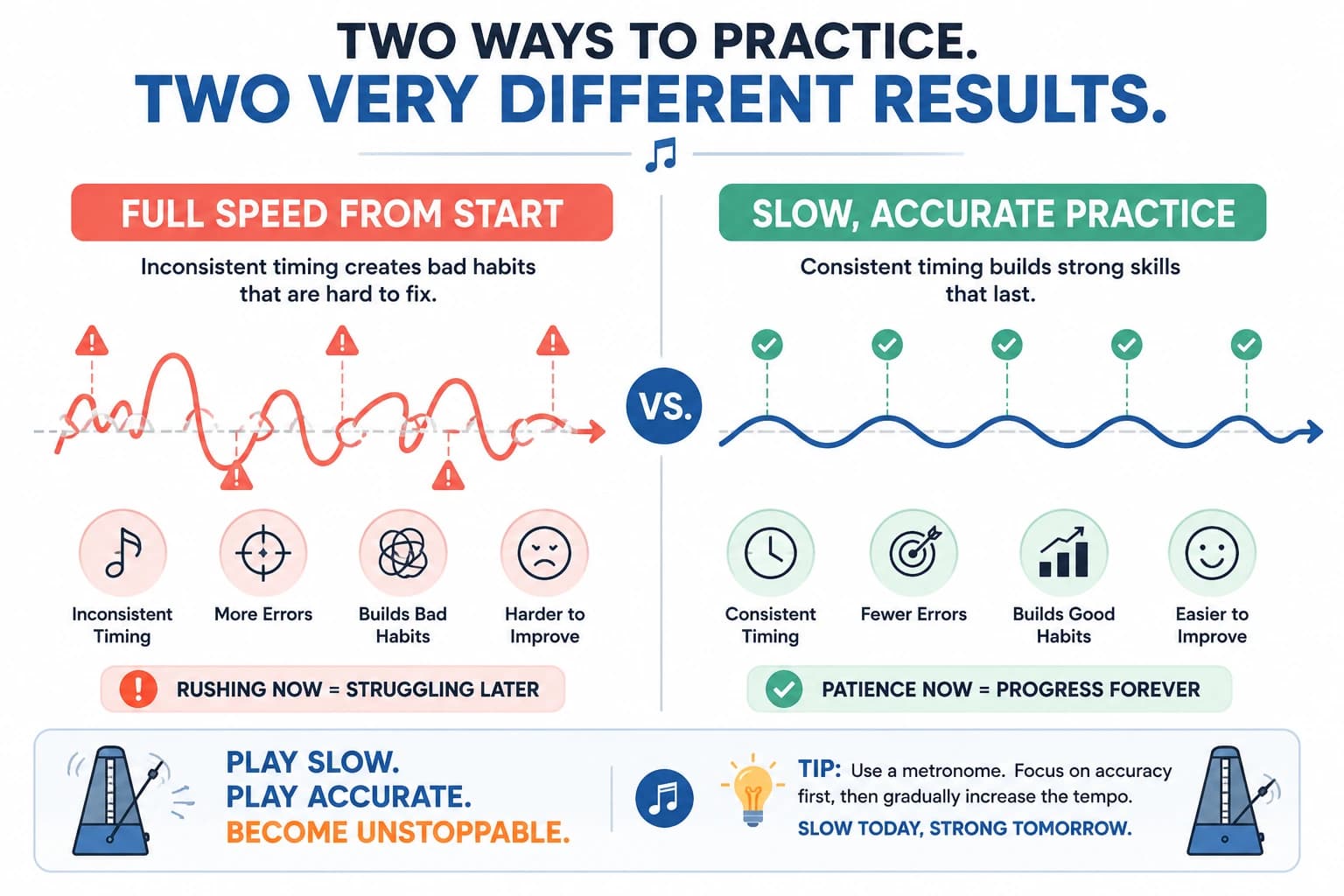
Every musician has felt the temptation to play a new passage at full speed right away. It rarely works, and the reason has less to do with willpower and more to do with how the brain actually learns movement.
Slow, deliberate practice is one of the most consistently effective tools for building real musical skill, not because it feels productive, but because it changes what the brain and body are actually learning. This article explains why slowing down works, what happens physically and mentally when you do it, and how to build a practice routine around it.
Why Slow Practice Works
Slow practice works because it lets you play something correctly before you try to play it quickly, and correct repetition is what the brain actually encodes into skill. Speed without accuracy does not build the pattern you want; it builds and reinforces the pattern you are actually playing, mistakes included.
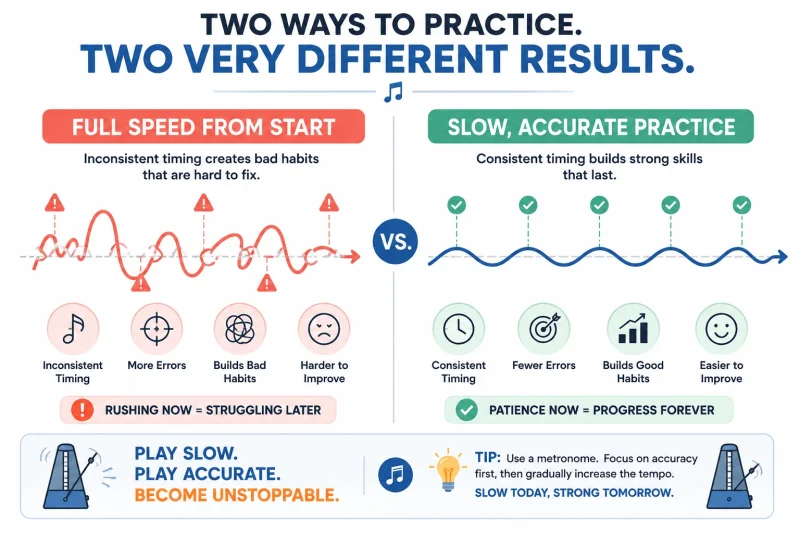
This is the core idea behind deliberate practice, a concept widely used in skill-acquisition research across music, sports, and other precision disciplines. Deliberate practice is not simply repeating something over and over. It is repeating something slowly enough to notice errors, correct them immediately, and reinforce only the version you actually want to keep.
Consider two violinists learning the same fast passage in a concerto. One runs through it at full tempo from the first day, stumbling through the same three notes every time and hoping repetition alone will smooth them out. The other spends the first week at roughly half tempo, isolating exactly where the bow change feels awkward and fixing it before adding speed. By the second week, the second violinist is usually further ahead, not because they practiced longer, but because every repetition they logged was reinforcing the correct version of the passage instead of the same recurring mistake.
A useful way to picture this: every repetition is a vote for what your fingers, breath, or bow arm will do automatically next time. Slow practice makes sure the votes are for the right version.
Quick Answer: Slow practice works because it allows accurate, error-free repetition. The brain reinforces whatever pattern gets repeated most consistently, so practicing slowly ensures you are reinforcing the correct version of a passage instead of its mistakes.
Scientific Benefits
Slowing down a passage produces measurable, well-documented benefits that go beyond simply "getting it right." Three of the most important are timing accuracy, error correction, and confidence under pressure.
Timing Accuracy
At a slower tempo, small timing errors become audible and correctable in real time. A rushed sixteenth-note run at full speed can hide dozens of tiny inconsistencies that a slower tempo exposes immediately, giving you the chance to fix them before they become habits.
Error Correction
Musicians who practice slowly tend to identify the exact beat, finger, or transition where a passage breaks down, rather than vaguely knowing "that part is hard." Isolating the precise point of failure is far more useful than repeating the whole phrase and hoping the problem resolves itself.
Confidence Under Pressure
Motor learning research generally agrees that skills practiced accurately and consistently transfer more reliably under pressure than skills rushed through inconsistently. A passage learned slowly and correctly tends to hold up better in a performance or audition, when nerves make small technical weaknesses far more likely to surface.
Many teachers describe this as the difference between a passage that is "learned" and one that is merely "survived." A drummer who has only ever played a fast fill at full speed will often lose it when nerves speed everything else up around it. If you play drums, practicing with a metronome for drummers makes it much easier to lock in that consistency before adding speed. A drummer who built the same fill slowly, with each stroke deliberate and even, tends to keep the fill intact even when nerves speed everything else up around it.
| Practice Approach | What Gets Reinforced | Typical Result Under Pressure |
|---|---|---|
| Full speed from the start | Whatever pattern happens, including timing slips and tension | Weaknesses tend to resurface, since the pattern was never clean to begin with |
| Slow, accurate repetition first | A correct, consistent motor pattern | The pattern tends to hold up, since it was reinforced correctly before speed was added |
Quick Answer: Slow practice sharpens timing accuracy, makes errors easier to locate and fix, and builds the kind of consistent technical foundation that holds up under performance pressure.
The Neuroscience of Muscle Memory
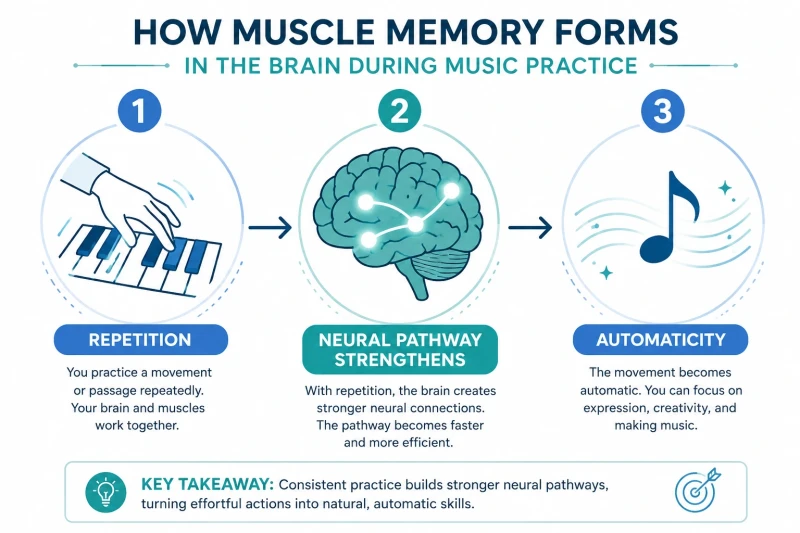
Muscle memory is not stored in the muscles at all; it is a motor pattern encoded in the brain through repetition, which is exactly why the quality of each repetition matters more than the quantity. Every time you play a passage, your nervous system strengthens the specific movement pattern involved, whether or not that pattern is the one you actually want.
How Repetition Builds Motor Patterns
Motor learning research consistently shows that repeated, accurate movement strengthens the neural pathways responsible for that movement, gradually making it feel automatic. This is why a passage practiced correctly at a slow tempo eventually feels effortless: the pattern has been reinforced enough times that it no longer requires conscious attention.
This process is often described as automaticity, the point at which a movement no longer needs step-by-step conscious control. A pianist who has practiced a scale pattern slowly and correctly for weeks eventually stops thinking about individual fingers; the hand simply knows where to go. That automaticity only forms around whatever version of the movement was actually repeated, which is why the accuracy of early repetitions matters so much more than their speed.
Why Speed Without Accuracy Backfires
Practicing a mistake does not skip this process; it accelerates it in the wrong direction. If a passage is rushed and played inconsistently, the nervous system reinforces that inconsistency just as efficiently as it would reinforce a correct pattern. This is a major reason experienced teachers insist on slow, accurate repetition before allowing a student to increase tempo, since a fast but sloppy version becomes surprisingly difficult to unlearn later.
A common misconception is that this "unlearning" simply means practicing the correct version a few more times to override the mistake. In practice, an established motor pattern tends to resurface under pressure, fatigue, or a memory slip, even after the correct version has been practiced for a while. This is why many teachers describe fixing a rushed, sloppy habit as taking noticeably longer than building the same skill correctly from the beginning would have taken.
Quick Answer: Muscle memory is really a motor pattern stored in the nervous system, built through repetition. Because the brain reinforces whatever gets repeated, accurate slow practice builds reliable automaticity, while rushed practice builds an inconsistent habit that is difficult to correct later.
Practice Routine
A slow practice routine works best when it follows a clear, repeatable structure rather than random repetition at an arbitrary speed. Most experienced teachers structure this around three stages: setting the right starting point, proving consistency before moving on, and raising tempo carefully once that consistency exists.
Choosing a Starting BPM
Start well below the passage's target tempo, often 20 to 30 BPM slower than the final speed, using an online metronome tool to keep the pace exact. Guitarists working through fast picking patterns or chord transitions often find a metronome for guitar practice especially useful for locking in accuracy before increasing speed.
For a genuinely difficult passage, some teachers recommend going further still, sometimes to less than half the target tempo, especially for fast technical runs or awkward hand shifts. The specific number matters less than the outcome: you should be able to play the passage several times in a row without a single slip before that tempo is considered "done."
Repetition Before Progression
Play the passage accurately several times in a row before considering any change in tempo. A common benchmark used by teachers is five consecutive clean repetitions at the current tempo before moving on, since a single accurate run can still be partly accidental.
A simple weekly structure many students use looks roughly like this:
| Day | Focus | Typical Tempo |
|---|---|---|
| Day 1–2 | Isolate the hardest 2–4 bars only | 30+ BPM below target |
| Day 3–4 | Full passage, slow and deliberate | 20–30 BPM below target |
| Day 5–6 | Full passage, five clean repetitions required before any increase | Gradual, small increases |
| Day 7 | Review at current tempo, no new increases | Same as end of Day 6 |
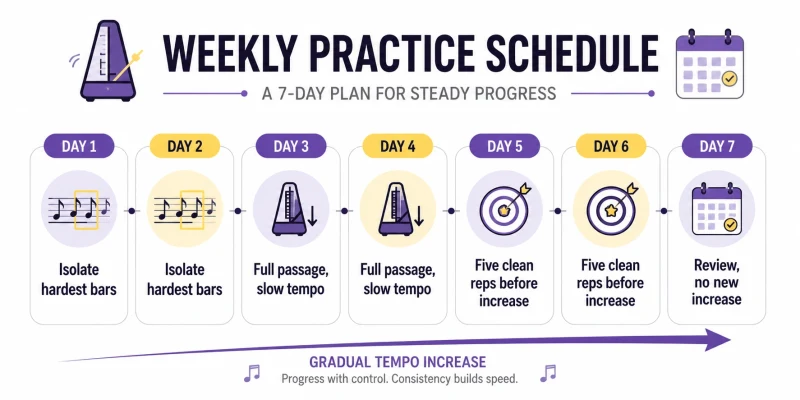
This is a general template rather than a fixed rule; some passages need far longer at a slow tempo, and simpler ones may move through these stages in a single session.
Gradual Tempo Increases
Once a passage feels stable, tempo can be increased in small, deliberate steps rather than jumped to full speed. This article focuses specifically on why slow practice works and how to structure it; the step-by-step method for safely raising tempo over time is covered in a dedicated speed-building guide.
Quick Answer: An effective slow practice routine starts well below target tempo, requires several consecutive accurate repetitions before any tempo change, and increases speed gradually rather than jumping straight to performance tempo.
Common Mistakes
Even musicians who understand the value of slow practice often undermine it through a few recurring habits, usually without realizing they are working against themselves.
Increasing Tempo Too Soon
Moving to a faster tempo after just one or two clean repetitions is one of the most common mistakes, because it does not give the correct pattern enough repetition to become reliable. A single success can be luck as much as skill, and raising the tempo on that single success often means the very next repetition falls apart, which erodes both the pattern and the player's confidence at the same time.
Treating Slow Practice as a Formality
Some musicians run through a passage slowly only once before jumping to full speed, treating the slow repetition as a box to check rather than genuine practice. Slow practice only works if it receives the same focus and attention as full-speed playing, not less. A slow run played on autopilot, with wandering attention, teaches almost nothing, since the brain reinforces whatever actually happens during the repetition, focused or not.
Ignoring Consistency in Favor of Speed
Chasing tempo numbers before a passage is reliably accurate is a common trap, especially under time pressure before a lesson or performance. A passage played correctly at a moderate tempo is more valuable than the same passage played inconsistently at a fast one, and teachers frequently note that students who resist this urge tend to reach their target tempo faster overall, simply because they spend less time unlearning bad repetitions along the way.
Practicing the Whole Piece Instead of the Problem
Running an entire piece slowly from beginning to end feels thorough, but it often wastes time on passages that were never a problem in the first place. Isolating the specific bars that break down and giving them the bulk of the slow repetition tends to produce faster improvement than treating every measure with equal attention.
Quick Answer: The most common slow-practice mistakes share one root cause: moving forward before consistency has actually been established. Raising tempo too early, practicing on autopilot, and spreading attention evenly across an entire piece all undermine the accurate repetition that slow practice is meant to build.
Continue Learning
Continue building your practice and technique skills with these guides:
- How to Practice with a Metronome
- Common Metronome Mistakes
- Best BPM for Beginners
- Subdivision Exercises
Open our free Metronome and start practicing at a slower tempo today.
This article has been researched, written, and reviewed according to our Editorial Policy.
Frequently Asked Questions
Common questions about finding the BPM of a song.