
Delay vs Reverb: Which Effect Should You Use and When?
Confused about delay vs reverb? Learn what each effect actually does, when to use one over the other, and how to combine them for a polished mix.
Quick Answer
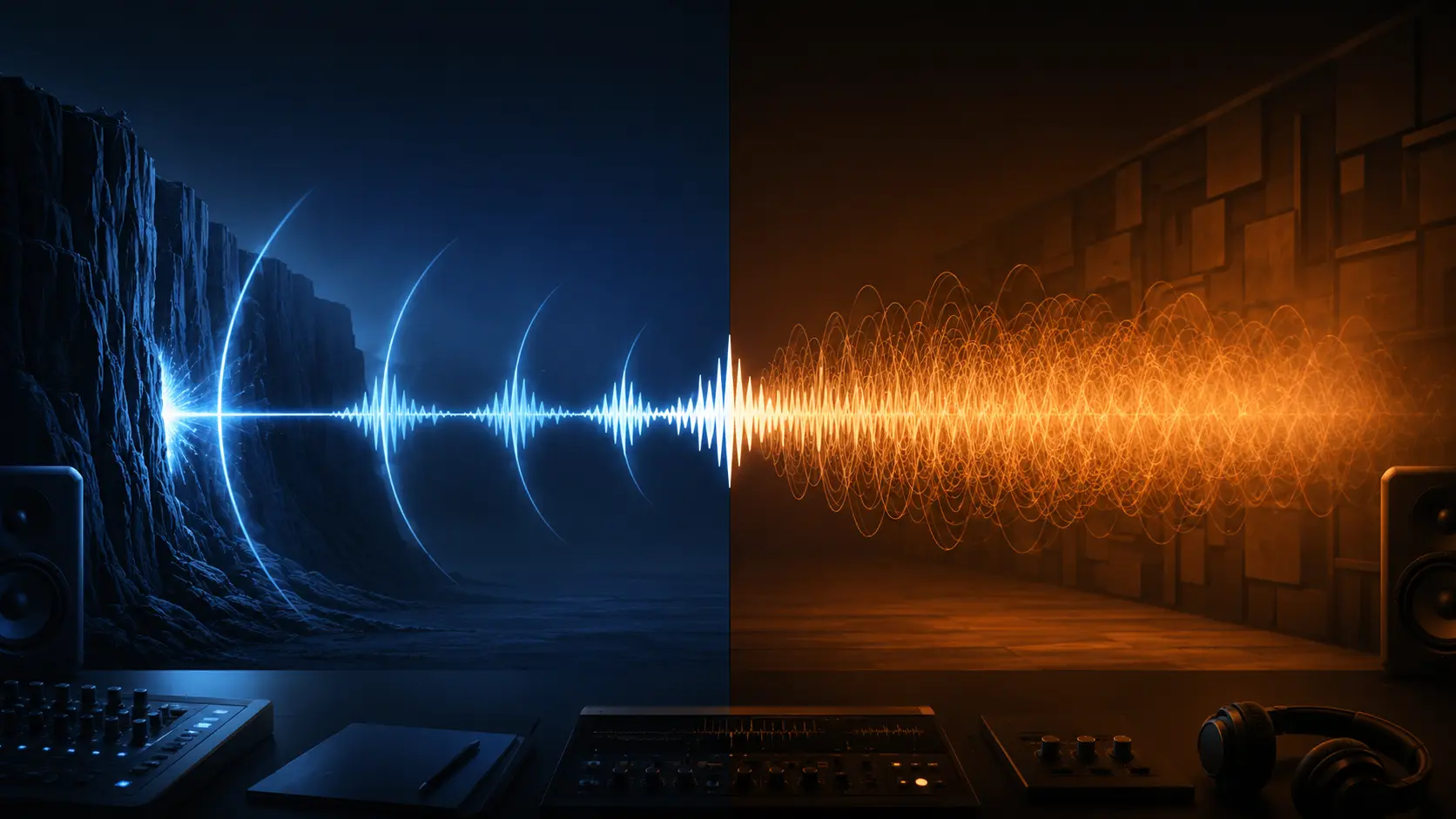
Delay and reverb are both time-based effects that add space to a mix, but they work differently. Delay repeats the original sound as distinct, countable echoes, making it ideal for rhythmic reinforcement, clarity, and width. Reverb simulates the dense reflections of a physical space, creating a continuous decaying tail that adds depth, ambience, and glue. Use delay when you need movement without losing intelligibility, and reverb when you need a sound to feel like it belongs in a room. Using a Delay & Reverb Time Calculator helps match either effect to your song's tempo for a polished result.
Key Takeaways
- Delay produces distinct, evenly spaced repeats that add rhythm and controlled width without muddying the mix.
- Reverb blends thousands of rapid reflections into a smooth tail that simulates physical space and pushes sounds into the background.
- Delay preserves clarity and intelligibility; reverb can blur transients and consonants if overused.
- In professional mixing, delay and reverb are often used together through auxiliary sends, with delay placed before reverb for a cohesive tail.
Delay vs Reverb: Which Effect Should You Use and When?
Every mix eventually reaches the same fork in the road. A vocal feels dry and unfinished. A guitar line sounds flat against the rest of the track. A snare hits but doesn't sit. The instinct is to reach for an effect, but the wrong choice at this stage can make a mix feel cluttered instead of polished.
Delay and reverb are the two effects most likely to get confused with each other, partly because both add a sense of space, and partly because plugin presets often blend them without explaining why. Understanding what each one actually does, and when one clearly beats the other, turns effects processing from guesswork into a deliberate creative decision.
Understanding the Difference Between Delay and Reverb
Delay and reverb both simulate how sound behaves after it leaves its source, but they simulate different physical events.
What does Delay do?
Delay repeats the original sound as distinct, separate echoes. Picture shouting across a canyon: your voice comes back to you as a clear, single repetition, then maybe a second, fainter one. Each repeat is recognizable as the same sound, just delayed in time. In a mix, delay works the same way; it takes the input and plays it back again after a set gap, often with each repeat getting quieter than the last.
What does Reverb do?
Reverb simulates the thousands of tiny sound reflections that happen when sound bounces off walls, ceilings, furniture, and other surfaces in a physical space. Unlike delay's clean, countable echoes, these reflections arrive so quickly and in such density that the ear can't separate them. Instead, they blend into a continuous wash that decays over time. That wash is what tells your brain "this sound happened in a room" rather than "this sound happened in a vacuum."
Delay vs Reverb: A Simple Way to Think About It
The clearest way to separate the two conceptually:
Delay, a sound repeated in distinct copies, evenly spaced, decreasing in volume. Reverb, a sound blurred into a continuous tail that decays smoothly, without distinct repeats.
We tested this side by side on a pop vocal: the same take with a quarter-note delay against a large hall reverb. The delay kept the chorus punchy, and every word stayed intelligible even with the repeats stacking up behind the lead line. The reverb, at a comparable wet level, started burying the consonants within a couple of bars. That comparison is a useful shortcut to remember: delay tends to buy you clarity and rhythm, reverb tends to buy you space and vibe, and it's rare to get both in equal measure from a single effect.
This distinction matters because it changes what each effect is good at. Delay adds rhythm, movement, and a sense of repetition that can reinforce timing. Reverb adds depth, size, and a sense of physical space. A vocal soaked in delay feels rhythmic and layered. The same vocal soaked in reverb feels distant and enveloped. Neither is right nor wrong; they simply solve different problems.
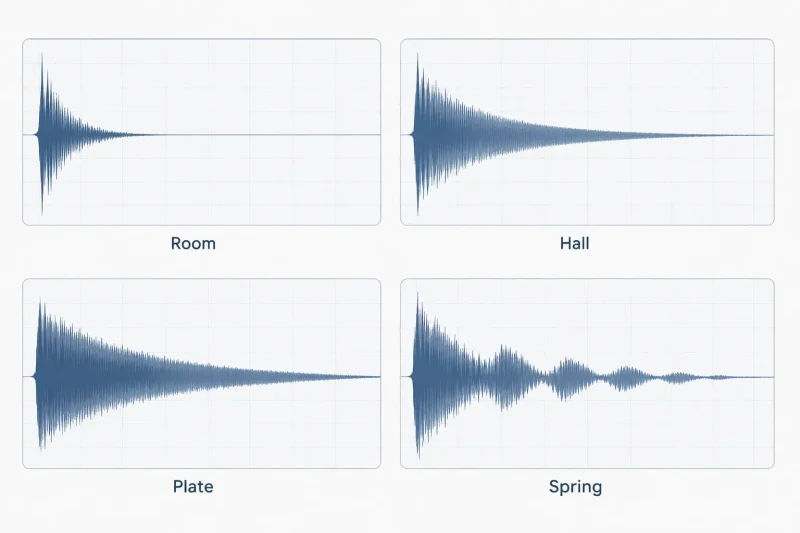
It's also worth understanding that reverb comes in several common flavors, each with a different character:
- Room reverb: short, tight reflections that suggest a small, close space. Useful when you want a sense of space without pulling the sound far into the background.
- Hall reverb: longer, smoother decay that suggests a large venue. Common on strings, choirs, and ballads that need a sense of scale.
- Plate reverb: a dense, smooth, slightly metallic tail originally created by mechanical plate units. A longtime favorite for vocals and snares because it adds richness without sounding like a literal physical room.
- Spring reverb: a bouncier, more textured decay historically built into guitar amplifiers. Associated with surf rock and vintage guitar tones.
Delay has its own well-known variation worth knowing before you go further: slapback delay, a single, fast, low-repeat echo popularized in early rock and rockabilly recordings. It's technically a delay, but because the repeat is so quick and subtle, it can read almost like a tight room rather than an obvious echo effect.
Delay vs Reverb at a Glance
If you're short on time, this quick-reference table sums up the core differences:
| Feature | Delay | Reverb |
|---|---|---|
| Main purpose | Creates repeated, countable echoes | Simulates acoustic space and reflections |
| Sound character | Individual, distinct repeats | Continuous, dense, blended tail |
| Best for | Rhythm, movement, rhythmic emphasis | Depth, ambience, realism, and glue |
| Effect on clarity | Preserves definition and intelligibility | Can blur transients if overused |
| Common use | Guitar solos, lead vocals, synths | Vocals, drums, orchestral recordings |
Keep this table in mind as we explore each effect in more detail below.
When Delay Is the Better Choice
Delay tends to be the right call when you want to add interest or space without making the sound feel farther away. Because each repeat is a distinct copy of the original, delay preserves clarity and definition even while it thickens the sound.
Reach for delay when:
- You want rhythmic reinforcement. A guitar riff or vocal phrase with a delay that lands in time with the song gains a sense of groove and movement. This is why so many iconic guitar lines, from ambient post-rock to reggae-influenced pop, lean on delay rather than reverb. The repeats become part of the rhythm itself. Timing the repeats correctly starts with knowing the track's tempo. If you don't have it yet, our Tap Tempo tool can find the BPM of a song in just a few taps.
- You need space without losing intelligibility. Reverb tails can blur consonants and make lyrics harder to follow, especially in dense mixes. A short, well-placed delay can widen a vocal or lead instrument while keeping every word clear, because the repeats are discrete rather than smeared together.
- You want to create width and depth in a controlled way. Panning delay repeats slightly left and right, or using a stereo delay with offset timing between channels, can make a mono source feel wider and more three-dimensional without dumping level into a large reverb tail.
- You're working with fast or percussive material. Drums, plucked guitar, and staccato vocal phrasing tend to hold up better under delay than reverb, because reverb's smearing effect can muddy sharp transients. A tight, low-feedback delay adds interest while letting the attack of each note stay defined.
A habit worth adopting from our own sessions: when a part feels like it's missing something but still needs to stay forward and intelligible, try delaying before reaching for reverb. It's the effect that adds interest without automatically pushing a sound into the background.
When Reverb Creates a Better Mix
Reverb is the better tool whenever the goal is a sense of physical space, depth, or blend — the feeling that instruments exist together in the same environment rather than sitting on top of a flat, dry mix.
Reach for reverb when:
- You want a sound to feel like it belongs in the mix. Dry, unprocessed elements, especially recorded in a treated home studio, can sound disconnected from everything around them. A touch of room or plate reverb glues a part into the mix by giving it the same sense of space as everything else.
- You need to push something into the background. Reverb naturally reads as distance. A backing vocal, a pad, or a secondary instrument that needs to sit behind the lead can be pushed back convincingly with a longer reverb tail, without needing to touch the fader.
- You're finishing a ballad or emotional passage. Long, lush reverb tails on strings, pianos, and vocals create the swelling, cinematic quality associated with emotional or climactic sections. This is a case where the smeared, continuous decay of reverb is exactly what the moment calls for.
- You're simulating a real performance space. Live recordings, choirs, orchestral scoring, and anything meant to feel like it happened in one room benefit from reverb's ability to recreate that acoustic environment convincingly.
One distinction that separates a considered reverb choice from a default one is pre-delay, the short gap between the dry sound and the first reflection you hear. A practical rule of thumb we return to often: set pre-delay around 30-40 milliseconds on vocals. That gap is enough to let the dry transient and the consonant cut through clearly before the reverb bloom arrives, so the vocal stays intelligible even with a generous, lush tail sitting underneath it. Shorter pre-delay tends to blur the attack; longer pre-delay can start to sound like a separate, disconnected echo.
Reverb size and decay time should also usually match the emotional and rhythmic pace of the song. A fast, energetic track can feel sluggish if the reverb tail is too long, because the residual sound bleeds into the next beat. A slow ballad can feel thin if the reverb decays too quickly. Matching reverb length and pre-delay to tempo, rather than guessing by ear, is exactly what our Delay & Reverb Time Calculator is built for: enter your BPM, and it will calculate precise delay times and reverb settings for you instantly.
Common Myth: More Reverb = A Bigger, More Professional Mix
Reality: Excessive reverb often produces the opposite result. When you drown an instrument in a long decay tail, you push it further back in the mix, blur its transients, and reduce its impact. A controlled, intentional amount of reverb, just enough to create a believable space, actually sounds larger because the important details, like vocal consonants and snare attacks, remain audible and punchy.
If you can immediately hear the reverb as an obvious "effect," it's often a sign that you've used too much. Professional engineers frequently start with very small amounts and increase the level only until the mix starts to feel natural, and usually stop right there.
Using Delay and Reverb Together
In most professional mixes, delay and reverb aren't competitors; they're used together, each handling a different part of the job. Delay adds rhythmic interest and controlled width. Reverb adds glue and depth. Combined thoughtfully, they create a sense of space that neither effect could produce alone. Both effects work best once your project's tempo is locked in. If you're still deciding, our guide on how to choose the right BPM before recording can help you settle on a number before you start dialing in effects.
Before getting into signal order, it's worth addressing how these effects are typically routed in a modern session. Rather than inserting delay and reverb directly onto the track itself, most working engineers place them on auxiliary return tracks and reach the effect through a send, not an insert. This is parallel processing: the dry signal keeps its full clarity and impact, while a controlled amount of the wet delay or reverb blends in alongside it on a separate channel. It gives you independent level control over the wet signal, the ability to automate it separately, and the option to apply different EQ or compression to the effect return without touching the dry source. Inserting reverb or delay directly onto a track still works for quick creative decisions, but for anything going into a final mix, sends and returns give you far more control.
With that routing in mind, the order in which the signal passes through the two effects still matters. A common and effective chain is:
Dry source → Delay send → Reverb on the delay return
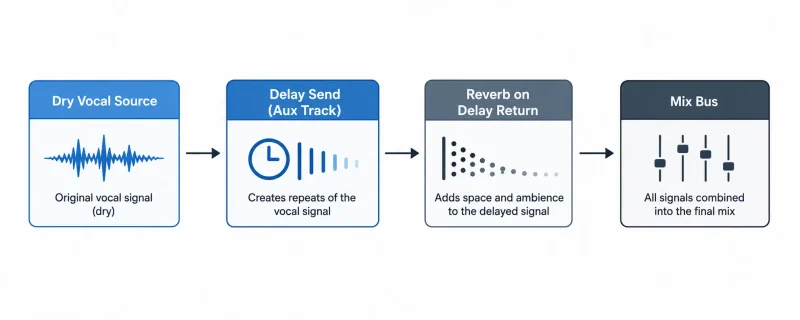
Placing delay before reverb in the signal path means the discrete echoes themselves get treated with reverb, giving the repeats a sense of decaying naturally into the space rather than sounding like separate, dry copies. This is the order most engineers default to for vocals and lead instruments, because it creates a smooth, cohesive tail rather than two competing effects.
Reversing the order — dry source → Reverb send → Delay on the reverb return — produces a different result. Here, the reverb is applied first, and the delay repeats the already-reverberant signal. This tends to sound more chaotic and textured, since each repeat carries its own reverb tail. It's used less often on vocals, but it can work well for experimental or atmospheric production where a denser, less predictable texture is the goal.
A practical way to combine both without cluttering the mix:
- Use a short, low-feedback delay send to add movement and width, keeping the return level low enough that it supports rather than distracts.
- Use a separate, subtler reverb send to glue the part into the mix, keeping the decay time short enough that it doesn't wash out the delay repeats.
- Keep both on their own auxiliary tracks so their levels, EQ, and automation can be adjusted independently from the dry signal; this keeps you in control instead of committing to a fixed blend.
The mistake many home studio producers make is applying delay and reverb at full, default plugin settings, often as inserts, without adjusting either. The result is a mix where every element fights for the same sonic space. The fix isn't avoiding one effect; it's routing both through sends with restraint and intention.
Choosing Effects for Different Instruments
Different instruments and voices respond differently to delay and reverb, largely because of their frequency content and role in the mix.
Lead vocals usually benefit from a light combination: a short slapback or rhythmic delay for interest, paired with a plate or room reverb for cohesion, and a pre-delay in that 30-40ms range to protect the consonants. Too much of either can bury the lyric, so restraint matters more here than almost anywhere else in the mix.
Backing vocals can generally handle more reverb than the lead vocal, since their job is often to sit behind and around the lead rather than compete with it. A longer reverb tail helps separate backing vocals from the lead without needing extra EQ carving.
Electric guitar is one of the most delay-friendly instruments in modern production. Rhythmic, tempo-synced delay repeats are a defining part of many guitar tones, particularly in ambient, post-rock, and pop-rock styles. Reverb is still useful here, especially room or spring reverb for a more amp-in-a-room feel, but delay tends to do more of the creative heavy lifting. For a closer look at dialing in those repeats, see our guide on how to set delay time for electric guitar.
Acoustic guitar typically leans more toward reverb than delay, since the goal is often a natural, room-recorded feel rather than an obviously processed, rhythmic one. A short room reverb usually does more for an acoustic part than a delay would.
Snare drum is a classic reverb candidate, and plate reverb on snare is one of the most recognizable sounds in modern and vintage production alike. Delay is used more sparingly on drums, usually for creative effects rather than as a default treatment.
Podcast and spoken-word audio is the clearest case for restraint. Listeners expect clarity above all else, so both delay and reverb are typically avoided or used in extremely small amounts, just enough to avoid a completely dead, lifeless room sound, without introducing anything that could be mistaken for an audio problem.
Live Sound
Live sound engineers face a fundamentally different environment from studio producers. Concert venues, churches, and clubs already contain natural reflections from walls, ceilings, and audiences. Adding substantial artificial reverb on top of that existing ambience often reduces clarity rather than enhancing it; vocals become distant, and transients lose their punch.
This is why many front-of-house engineers prefer delay for lead vocals and instruments in a live setting. Delay adds rhythmic emphasis and controlled width without compounding the room's natural decay. It keeps the performance present and intelligible, even in reverberant spaces.
Rather than applying studio presets to a live console, experienced engineers listen to the room first and adapt their effects to the venue's acoustics. A dry, outdoor stage may benefit from subtle reverb, while a highly reflective theater often calls for delay only, with reverb used sparingly, if at all.
Mistakes Beginners Make When Combining Effects
Even with a solid understanding of what delay and reverb do individually, it's easy to misuse them in a full mix. A few mistakes come up consistently in the sessions we review.
Using Reverb to Fix a Dry-Sounding Recording Instead of Fixing the Recording Itself
Reverb can mask problems temporarily, but it can't repair a poorly tracked performance. If a vocal or instrument sounds thin, boxy, or lifeless, check your mic placement, preamp gain, and room treatment before reaching for a plugin to cover it up. Effects should enhance a good recording, not rescue a bad one.
Setting Delay Feedback Too High
High feedback means each repeat is only slightly quieter than the last, creating a long trail of echoes that can quickly clutter a dense mix. Most musical delay applications benefit from feedback set low enough that repeats fade out naturally within three to four cycles, just enough to add movement without overwhelming the performance.
Applying Reverb and Delay at the Same Intensity to Every Track
A mix where every element receives an identical, heavy dose of both effects loses all sense of depth. Nothing reads as closer or farther away than anything else. Varying the amount of each effect across different parts, and routing them through sends rather than inserts, is what actually creates a convincing, three-dimensional soundstage.
Ignoring the Tempo of the Song
Both effects behave very differently depending on the song's speed. A reverb tail or delay pattern that isn't related to the track's BPM can clash rhythmically, landing in the gaps between beats in a way that feels sloppy rather than intentional. Tempo-synced settings, where delay times and reverb pre-delay line up with the song's tempo, are what give professional mixes their sense of rhythmic cohesion. If you're not sure where to start, our guide on how to find the BPM of any song walks through several quick, reliable methods.
Choosing One Effect Out of Habit Rather Than Purpose
Reverb is often the default reach because it's forgiving and easy to dial in, but that doesn't make it the right choice for every part. Before adding either effect, ask what the part actually needs: rhythmic interest, width, distance, or glue. That answer points directly to delay, reverb, or a specific combination of both.
Continue Learning
Now that you understand the difference between delay and reverb, these resources will help you dial in precise timing and explore related production techniques.
- Delay & Reverb Time Calculator
- How to Set Delay Time for Electric Guitar Without Guesswork
- Understanding Note Values: Why Quarter, Eighth, and Triplet Delays Sound Different
- Speaker Delay Explained: Live Sound & PA System Guide
Stop Guessing and Start Mixing
Stop guessing at milliseconds. Once you know whether delay, reverb, or both are right for the part in front of you, plug your song's BPM into our Delay & Reverb Time Calculator, grab the exact tempo-synced value, and get back to making the track sound great instead of doing arithmetic.
This article has been researched, written, and reviewed according to our Editorial Policy.
Frequently Asked Questions
Common questions about finding the BPM of a song.