
Understanding Note Values: Why Quarter, Eighth, and Triplet Delays Sound Different
Learn how quarter, eighth, dotted, and triplet note values shape rhythm in music production and why audio plugins use them for precise timing.
Quick Answer
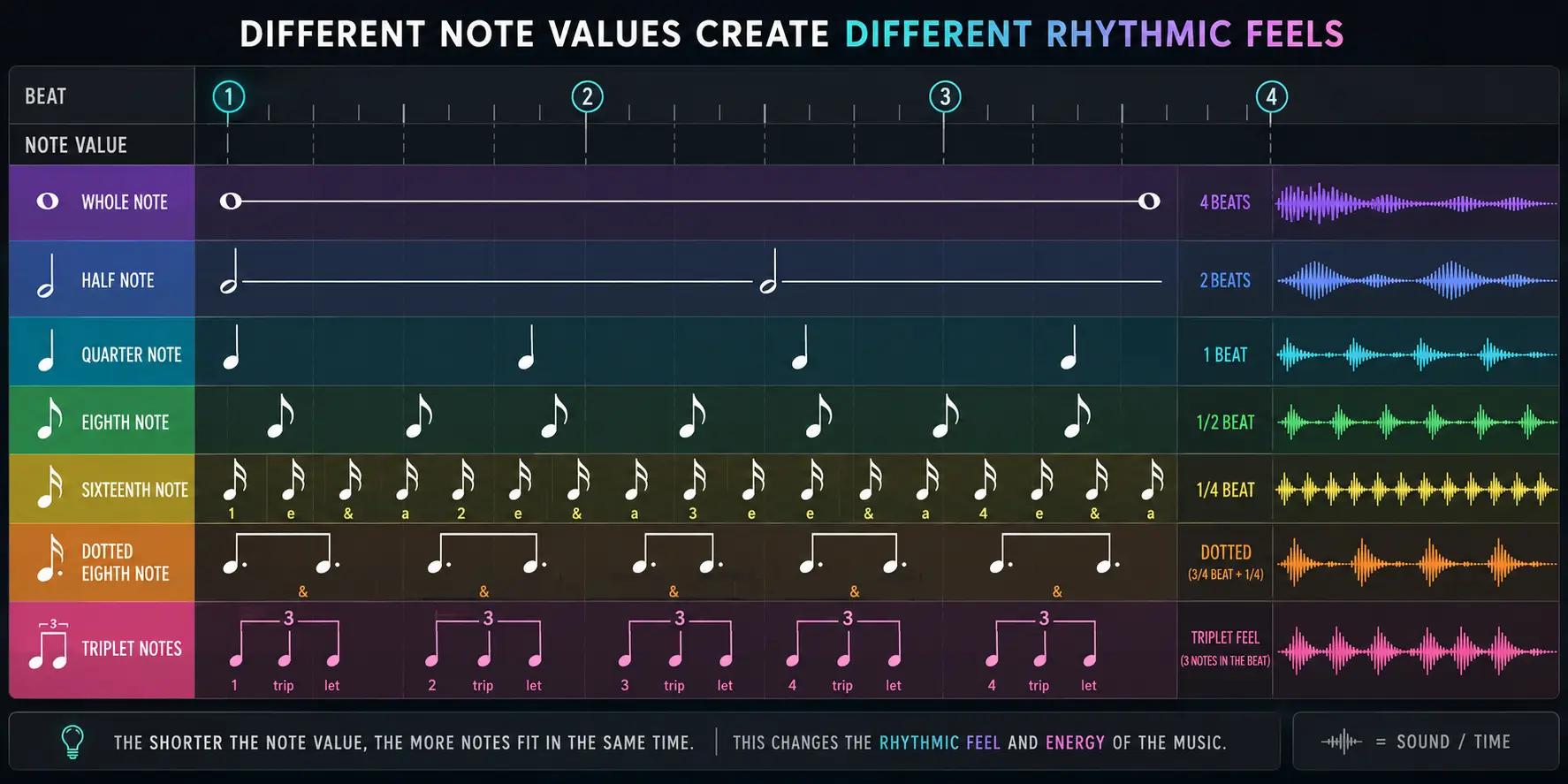
Note values are the rhythmic units that determine how long a sound lasts in relation to a song's beat. Quarter notes, eighth notes, dotted notes, and triplets each create a different feel without changing the tempo, which is why they appear everywhere from DAW sequencing to delay and reverb plugins. Understanding these values gives you a musical shortcut for choosing the right rhythmic subdivision instead of guessing timing values manually. Once you know which note value fits your song, converting it into precise milliseconds is straightforward with a BPM to Milliseconds Calculator.
Key Takeaways
- Note values describe how long a sound lasts in relation to the beat, not in seconds or milliseconds.
- Quarter notes establish the main pulse, while eighth and sixteenth notes add movement and energy.
- Dotted notes and triplets change the feel of a rhythm without changing the song's tempo.
- Most modern DAW plugins use note-value sync so effects stay locked to the project's tempo automatically.
Understanding Note Values: Why Quarter, Eighth, and Triplet Delays Sound Different
When producers talk about rhythm, they rarely think in terms of seconds or numerical timing values. Instead, they work with musical note values, the rhythmic building blocks that determine how a melody moves, how a groove feels, and how time-based effects interact with a song.
If you've ever opened a delay plugin and seen options like 1/4, 1/8, or 1/8D, you've already encountered these note values. Knowing what they mean makes it much easier to choose a rhythm that complements the music instead of relying on trial and error.
This guide explains how the most common note values work, why each subdivision creates a different musical feel, and where you'll encounter them in modern music production. Rather than focusing on mathematical conversions, we'll explore the musical thinking behind these rhythmic divisions so you can make more confident creative decisions.
What Are Musical Note Values?
Every piece of music is built on a pulse, often called the beat. Musical note values describe how long a sound lasts in relation to that beat, giving musicians and producers a consistent way to organize rhythm regardless of tempo or genre.
Instead of measuring duration in seconds or milliseconds, music divides time into recognizable units such as whole notes, half notes, quarter notes, and eighth notes. These values create a common rhythmic language that works equally well for writing melodies, programming drums, editing MIDI, or synchronizing audio effects.
Because these relationships stay the same at any tempo, producers can focus on the musical feel they want to create rather than constantly recalculating timing. A quarter note always represents the same rhythmic position within a beat, even though its actual duration changes as the song becomes faster or slower.
Understanding Beat Subdivisions
Once you understand what note values are, the next step is learning how they divide the beat. This idea, known as beat subdivision, explains why two performances at the same tempo can produce completely different rhythmic feels.
Imagine tapping your foot to a steady beat. If you clap only when your foot hits the ground, you're following the main pulse. Now clap halfway between every tap. Suddenly, the rhythm feels more active, even though the tempo hasn't changed. Add even more claps between each beat, and the music becomes tighter and more energetic without making the song any faster.
This is exactly what beat subdivisions do. They change how the beat is divided, not the speed of the song itself.
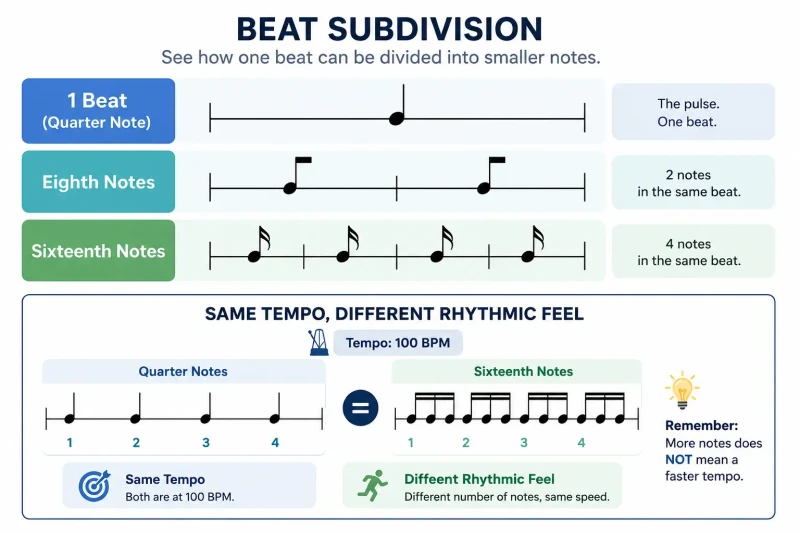
Imagine tapping your foot to a steady beat. If you clap only when your foot hits the ground, you're following the main pulse. Now clap halfway between every tap. Suddenly, the rhythm feels more active, even though the tempo hasn't changed. Add even more claps between each beat, and the music becomes tighter and more energetic without making the song any faster.
This is exactly what beat subdivisions do. They change how the beat is divided, not the speed of the song itself.
Common Beat Subdivisions
The most frequently used note values build on one another by dividing the beat into smaller rhythmic units.
| Note Value | Rhythmic Feel | Common Use |
|---|---|---|
| Whole Note | Long and sustained | Pads, ambient textures, slow melodies |
| Half Note | Open and spacious | Ballads, orchestral arrangements |
| Quarter Note | Strong and steady | Main pulse, rhythmic foundation |
| Eighth Note | More movement | Guitar picking, hi-hats, delay repeats |
| Sixteenth Note | Fast and detailed | Drum programming, electronic grooves |
Rather than thinking of these note values as theory, think of them as creative tools. Each subdivision changes the listener's perception of movement and momentum, helping shape the overall character of a performance or production.
Why Smaller Subdivisions Feel Faster
One common misconception is that switching from quarter notes to eighth notes makes a song faster. It doesn't.
The tempo stays exactly the same. What changes is the number of rhythmic events happening within each beat.
For example, a drum pattern built around quarter notes leaves plenty of space between hits, creating a relaxed and stable groove. Replace those same hits with eighth or sixteenth notes, and the rhythm immediately feels busier because more notes are being played within the same amount of musical time.
This principle appears throughout music production. Drum patterns, bass lines, keyboard parts, arpeggiators, and synchronized effects all rely on subdivisions to create different rhythmic textures without changing the project's tempo.
Understanding beat subdivisions gives you a better sense of how rhythm is constructed. In the next section, we'll look at how quarter notes, eighth notes, and sixteenth notes each create their own musical character and when producers typically choose one over another.
Quarter Notes vs Eighth Notes vs Sixteenth Notes
Although these note values are closely related, each one creates a very different listening experience. Choosing the right subdivision isn't about following a rule; it's about supporting the groove, energy, and movement of the music.
Quarter Notes: The Foundation of the Groove
Quarter notes establish the main pulse of a song. They feel balanced, predictable, and easy to follow, which is why they're often used to reinforce the rhythm rather than add complexity.
In many genres, the kick drum, snare, or a repeating keyboard pattern relies on quarter-note movement to keep listeners connected to the beat. Because there's plenty of space between each note, the rhythm feels stable and controlled.
If you're looking for a clean, natural pulse, quarter notes usually provide the strongest foundation.
Eighth Notes: Adding Motion Without Increasing Tempo
Eighth notes divide every beat into two equal parts. The song isn't any faster, but the additional rhythmic events create the impression of more movement.
This subdivision appears everywhere in modern music. Guitar strumming patterns, hi-hats, bass lines, synth sequences, and countless melodic phrases use eighth notes to make a track feel more active while keeping the groove easy to follow.
Because of that balance between clarity and motion, eighth notes are one of the most versatile rhythmic choices in music production.
Sixteenth Notes: Creating Energy and Detail
Sixteenth notes divide each beat even further, producing a tighter and more energetic rhythm. Instead of creating space, they fill it with smaller, faster movements that add excitement and momentum.
They're commonly heard in electronic dance music, hip-hop hi-hat patterns, funk guitar rhythms, and intricate percussion programming. Used carefully, sixteenth notes can make a section feel lively and driving. Used excessively, they can also make an arrangement feel crowded.
For that reason, producers often introduce sixteenth-note patterns selectively, using them to increase intensity during choruses, drops, or other high-energy moments.
Choosing the Right Note Value
There isn't a universally "correct" subdivision. The best choice depends on what you want listeners to feel.
A slower, emotional arrangement may benefit from the openness of quarter notes, while a dance track often gains momentum from eighth-note rhythms. Sixteenth notes, on the other hand, are typically chosen when a production needs extra drive, detail, or rhythmic excitement.
The important thing to remember is that changing the subdivision changes the character of the rhythm, not the song's tempo. That's why producers experiment with different note values even when the BPM stays exactly the same.
How Dotted Notes and Triplets Change the Feel
Once you're comfortable with basic note values, you'll start noticing two rhythmic variations that appear frequently in modern music production: dotted notes and triplets. Both change the feel of a rhythm without changing the song's tempo, making them powerful creative tools for shaping movement and groove.
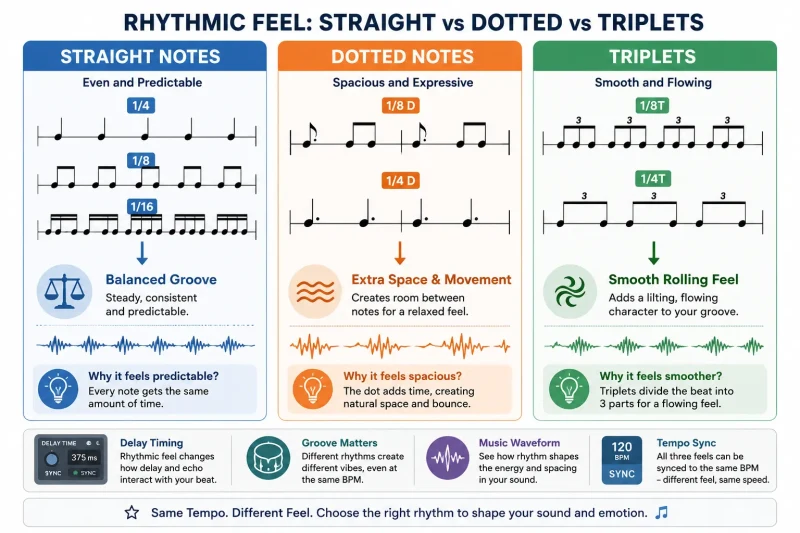
Once you're comfortable with basic note values, you'll start noticing two rhythmic variations that appear frequently in modern music production: dotted notes and triplets. Both change the feel of a rhythm without changing the song's tempo, making them powerful creative tools for shaping movement and groove.
Dotted Notes Create More Space
A dotted note lasts 50% longer than its standard note value. Instead of repeating at perfectly even intervals, the rhythm stretches slightly, creating a sense of anticipation before the next repeat arrives.
This subtle change is enough to make a familiar rhythm feel more spacious and dynamic. That's one reason dotted note values are widely used in modern pop, rock, worship music, and atmospheric productions; they add movement without making the arrangement sound crowded.
A dotted eighth note is one of the best-known examples. It produces a rhythmic bounce that feels different from a standard eighth-note pattern, often weaving naturally around the main beat instead of landing directly on it.
Triplets Divide the Beat Differently
Triplets follow a completely different concept.
Instead of dividing a beat into two or four equal parts, triplets divide it into three evenly spaced notes. This creates a smoother, rolling rhythm that immediately stands out from straight subdivisions.
Because the spacing is different, triplets introduce a flowing, almost swinging quality that listeners naturally perceive as more relaxed or expressive. They're common in blues, jazz, gospel, R&B, and many modern electronic productions where producers want the rhythm to feel less mechanical.
Even a simple melody can sound completely different when played with triplet timing instead of straight eighth notes.
Choosing Between Straight, Dotted, and Triplet Rhythms
Each subdivision creates its own musical character.
Straight note values deliver a balanced, predictable groove. Dotted notes introduce extra space and forward movement. Triplets produce a smoother, rolling rhythmic feel.
None of these options is inherently better than any other. The right choice depends on the emotion, groove, and musical style you're trying to create. Many producers experiment with different subdivisions before settling on the one that best supports the song.
How Audio Plugins Use Note Values
If you've used a modern digital audio workstation, you've probably noticed that many time-based plugins offer rhythmic note values instead of asking you to enter a timing value manually.
Delay plugins are the most obvious example. Rather than selecting an exact number, you can simply choose a quarter note, eighth note, dotted eighth, or triplet from a menu. The plugin then keeps its repeats synchronized with your project's tempo, even if the BPM changes later.
This approach is also common in modulation effects, rhythmic gates, tremolos, sequencers, and arpeggiators. By working with musical subdivisions instead of fixed timing values, these tools stay locked to the song's rhythm and maintain a consistent groove throughout the project.
That's why understanding note values is so valuable. Instead of guessing which setting might sound right, you can choose a rhythmic subdivision that matches the musical feel you're aiming for. Once you've decided on the appropriate note value, converting it into an exact timing value for your project becomes the final step, a task that's much easier with the right conversion tool.
When to Convert Note Values into Milliseconds
Choosing the right note value is only the first step. At some point, you'll need an exact timing value that your software or hardware can use. That's where converting note values into milliseconds becomes useful.
Many modern plugins handle this conversion automatically when tempo sync is enabled. You simply select a quarter note, dotted eighth, or triplet, and the plugin calculates the correct timing based on your project's BPM.
However, not every device or plugin works this way. Some effects require you to enter a timing value manually, while others allow you to disable tempo synchronization entirely. In these situations, knowing the musical subdivision isn't enough; you also need its equivalent timing value.
When Manual Conversion Becomes Useful
You'll most often need note values converted into milliseconds when working with:
- Hardware effects that require manual timing input.
- Plugins operate in milliseconds instead of note-value sync mode.
- Older studio equipment without automatic tempo synchronization.
- Projects where you're matching timing across multiple devices.
Rather than estimating or experimenting until something sounds right, converting the chosen note value note value into an exact timing value helps everything stay rhythmically consistent.
Start with the Song's Tempo
Before any conversion can happen, you need to know the BPM of your project. Every note value changes its actual duration depending on the song's tempo. A quarter note in a slow ballad lasts much longer than a quarter note in a fast dance track, even though both represent the same rhythmic position.
If you're unsure of your project's tempo, it's worth confirming it before moving on to timing conversions.
Let the Calculator Handle the Math
Once you've decided which rhythmic subdivision best suits your music and you know the song's BPM, there's no reason to calculate the timing manually.
Our BPM to Milliseconds Calculator instantly converts quarter notes, eighth notes, dotted notes, triplets, and other common subdivisions into precise millisecond values based on your project's tempo. That allows you to focus on creative decisions while ensuring your timing remains accurate across your entire production.
Continue Learning
Now that you understand how note values shape rhythm across music production, these guides will help you explore the musical timing and BPM concepts behind every groove.
- What Are Milliseconds in Music?
- How DJs Calculate the Perfect BPM Before Mixing Songs
- How to Find the BPM of Any Song: 7 Proven Methods
- How to Practice with a Metronome
Note values are the backbone of every rhythm you hear in music, from the slowest ambient pad to the fastest drum-and-bass break. When you understand how quarter notes, eighth notes, dotted notes, and triplets each change the feel of a groove, you gain a reliable framework for making creative decisions in any DAW.
That understanding also makes timing conversions far less intimidating. Instead of treating milliseconds as an abstract concept, you can see them as the practical translation of a musical choice you've already made.
Final Thoughts
Understanding note values isn't about memorising music theory; it's about making better creative decisions. Once you recognise how quarter notes, eighth notes, dotted notes, and triplets shape the feel of a rhythm, choosing the right subdivision becomes much more natural. Instead of guessing which setting might sound best, you can deliberately select the rhythmic pattern that supports your arrangement, whether you're programming drums, writing melodies, or working with time-based effects.
The most important principle is simple: the same tempo can feel completely different depending on the subdivision you choose. A quarter-note delay feels spacious and grounded. An eighth-note delay adds momentum. A triplet delay introduces a rolling, swinging character. None of these options is inherently right or wrong, but each one serves a different creative purpose.
Over time, recognising these distinctions becomes second nature. You'll start hearing subdivisions in the music you love, and you'll know exactly which note value to reach for when shaping your own productions.
Convert Note Values into Precise Millisecond Timings
After choosing the rhythmic subdivision that fits your track, use our BPM to Milliseconds Calculator to instantly convert it into accurate millisecond values based on your project's BPM. It's a quick and reliable way to keep your effects, hardware, and production workflow perfectly synchronized.
This article has been researched, written, and reviewed according to our Editorial Policy.
Frequently Asked Questions
Common questions about finding the BPM of a song.