
Speaker Delay Explained: Live Sound & PA System Guide
Learn how speaker delay helps live sound engineers align PA systems, delay towers, and fill speakers for clear, consistent venue coverage.
Quick Answer
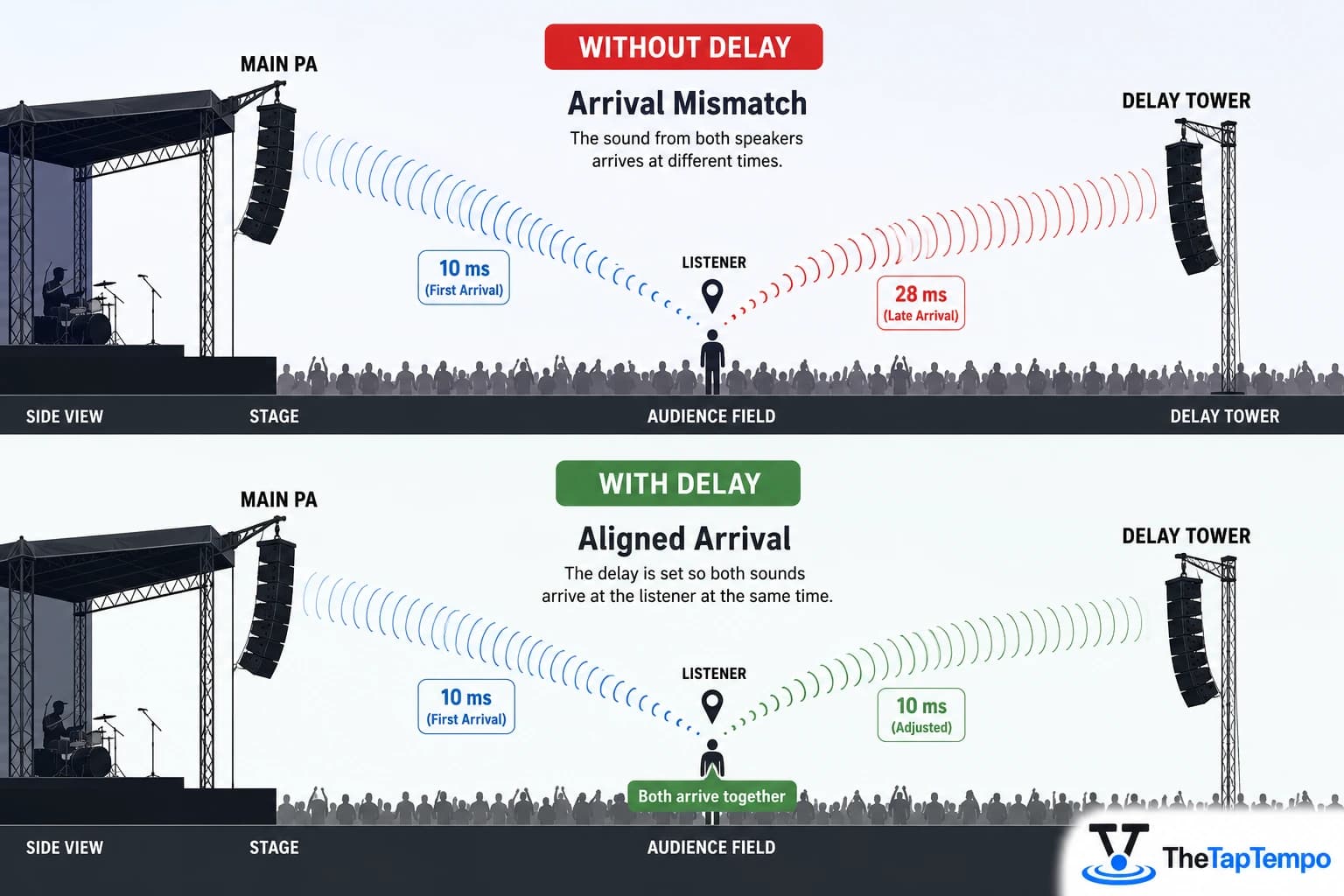
Speaker delay is a timing adjustment, measured in milliseconds, applied to PA speakers so that when a main system and a secondary system (like a delay tower or fill speaker) cover the same listening area from different distances, their sound arrives together instead of at separate times. Without it, listeners in the overlap zone hear an echo, smearing, or a hollow tone, with it, the whole venue sounds like one coherent system instead of several competing ones.
Anyone who has stood far from the stage at a large concert, church service, or outdoor event has likely noticed the sound doesn't feel quite the same as it does up front. It can feel blurred, hollow, or inconsistent compared to nearby listeners, usually because of how multiple speaker systems combine when their arrivals reach that area at different times. Speaker delay is the timing adjustment live sound engineers use to correct this and keep coverage consistent across a venue.
This guide explains what speaker delay is, why large venues depend on it, and how engineers apply it across concerts, churches, theatres, arenas, and outdoor events.
What Is Speaker Delay in Live Sound?
Speaker delay in live sound is a timing adjustment used to synchronize physically separated PA speakers. It compensates for the difference in distance sound travels from each speaker system to a given listening area. Without this adjustment, listeners near a secondary speaker system hear two distinct arrivals of the same signal instead of one unified sound.
Sound travels at a predictable speed, roughly 343 meters per second at 20°C, though this shifts slightly with temperature and humidity. Because of this, listeners at different distances from a speaker hear it at slightly different times.
When two speaker systems cover the same listening area from different distances, one is delayed relative to the other so both arrivals reach that area together. Which system is delayed depends on the chosen timing reference and the room's geometry, not simply on which speaker is physically closer.
This is the meaning of speaker delay used throughout this article: timing compensation between physically separated loudspeaker systems in professional sound reinforcement. It is not a creative audio effect.
In music production, a delay effect repeats a signal to create audible echoes or ambience. Speaker delay in live sound does the opposite. It's tuned so the audience doesn't perceive separate arrivals at all, only one coherent sound.
Quick Answer: Speaker delay is a timing adjustment, measured in milliseconds, applied so two or more PA speaker systems coordinate their arrival at a specific target listening area, rather than every speaker in the venue arriving everywhere at exactly the same instant.
Why Large Venues Use Speaker Delay Systems
A single PA system, however powerful, struggles to maintain even coverage once the audience extends across enough distance and depth. As listeners move farther away, level and clarity fall off, and speech intelligibility suffers well before the system runs out of output.
Raising the main system's volume doesn't fix this. It just makes an already inconsistent sound louder, because the problem is arrival time, not level.
Adding a second speaker system closer to a distant seating area solves the level and clarity problem, but only if its timing is handled correctly. If two systems covering the same listeners play at the same instant despite being different distances away, the audience in the overlap area hears one system slightly ahead of the other. This registers as an echo, a smeared transient, or an odd tonal coloration.
Correctly timing the systems removes that mismatch and lets them function as one coherent source. This is why delay towers, front fills, and distributed systems are common across concert production, church audio, theatre sound, and outdoor events.
Main PA, Delay Speakers, and Delay Towers
The main PA is the primary loudspeaker system covering most of the audience from the stage or a central flying position. Delay speakers and delay towers are secondary systems placed farther into the venue to extend coverage where the main PA alone can't maintain adequate level or clarity.
In most PA designs, the main system serves as the timing reference other zones are aligned against. In some configurations, a different reference point is chosen instead, based on system design or the specific coverage priorities for that show.
A delay tower is a loudspeaker positioned partway down a long audience field, often on a raised structure so it can cover the crowd around it without being blocked by people standing nearby. Towers are typically placed where the main PA has already lost enough level or clarity to underserve the audience beyond it.
A tower usually sits closer to its own listeners than the main PA does, so it's delayed to match. The exact relationship should be confirmed for the venue rather than assumed, since placement and coverage geometry vary from show to show.
Distributed speaker systems extend this same principle to more complex venues. Several smaller speakers are spread through balconies, side sections, or difficult architectural areas instead of one or two large towers. Each zone is aimed and timed for its own target listening area and referenced back to the system serving as the timing anchor for the room.
Delay systems earn their place when part of the audience sits far enough from the main coverage that level, clarity, or intelligibility measurably drops. Adding one without a genuine coverage gap creates more inconsistency than it resolves, since an untimed or poorly aimed secondary system adds unwanted overlap rather than fixing anything. Coverage need should always come before the decision to add a delay system.
How Engineers Time-Align PA Speaker Systems
Time alignment means matching arrival times between speaker systems at a chosen listening position, not just matching their level. Engineers determine how much later or earlier a secondary system's sound reaches that position compared to the reference system, then apply delay so both arrivals coordinate for the intended coverage area.
This concept relates to the broader relationship between distance and delay time used in acoustic timing. Readers who want to see that relationship directly can use the Delay & Reverb Time Calculator, though real-world PA alignment also depends on measurement, listening, and venue-specific factors a simple calculator can't fully capture.
Engineers follow a consistent conceptual sequence when aligning a distributed PA system:
- Plan speaker placement and aiming. Decide where each system needs to physically sit and which direction it needs to cover before any timing work begins.
- Establish coverage and levels. Confirm each zone produces appropriate level and evenness across its intended audience area.
- Identify arrival-time differences. Determine how the timing of each secondary system compares to the reference system at a shared listening position.
- Apply appropriate delay. Adjust the system's timing so its arrival coordinates with the reference at that position.
- Check overlap and phase interaction. Confirm overlap areas don't produce audible cancellation, coloration, or inconsistency.
- Verify through measurement and listening. Confirm the result with measurement tools and by listening at multiple representative positions, since a single measurement point rarely represents the entire venue.
Alignment should be verified after deployment, because no single timing setting produces identical results at every seat. Temperature and humidity affect how sound travels, and a filled audience changes the room's acoustic behavior compared to an empty one, since bodies absorb and reflect sound differently than bare seats or the floor.
These factors don't change the delay value programmed into the system, but they affect what a measurement shows and how well the coverage actually sounds in practice. This is why engineers recheck alignment once the room is populated or conditions change.
How to Calculate Speaker Delay From Distance
The relationship between distance and delay time follows a simple formula. It's useful for understanding the concept, even though it isn't a substitute for measurement.
Delay (ms) = Distance Difference ÷ 343 × 1000
This uses approximately 343 meters per second as the speed of sound at 20°C. The distance difference is the gap between the acoustic paths of the two systems to the target listening position, not just their distance from the stage.
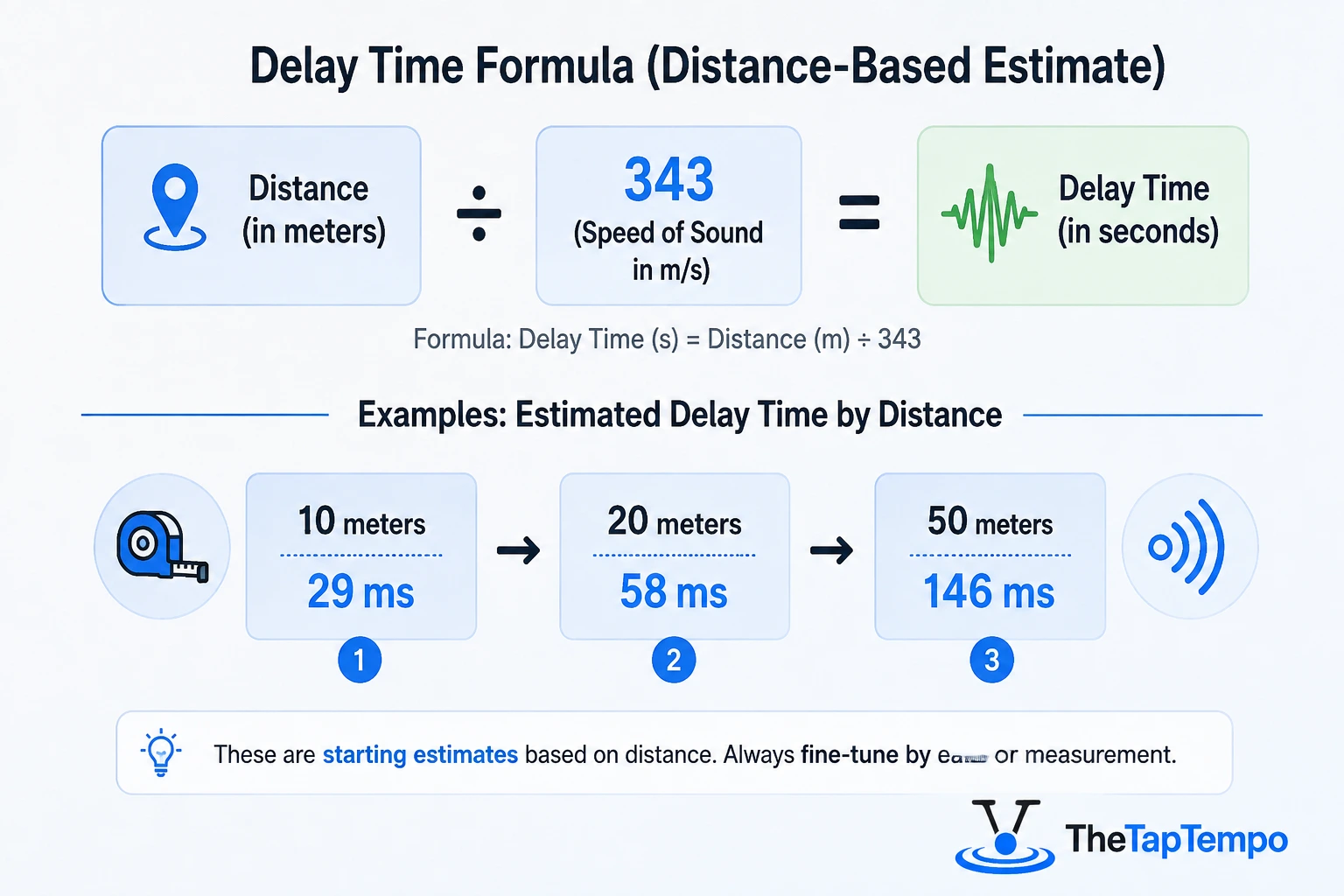
| Distance Difference | Approx. Delay |
|---|---|
| 10 m | 29 ms |
| 20 m | 58 ms |
| 50 m | 146 ms |
For example, if a delay tower's acoustic path to the target listening position is approximately 20 meters shorter than the main PA's path to that same position, the basic distance calculation corresponds to about 58 ms of acoustic travel-time difference.
This is a simplified, distance-based estimate. It gives a useful starting reference, but it doesn't account for air temperature and humidity on the day of the show, the exact acoustic path sound takes through the room, processing latency in the sound system itself, or the precise listening position chosen as the reference.
Real PA alignment is based on measured acoustic arrival times, not distance alone. Engineers use this kind of calculation as a starting point, then confirm and refine the actual delay setting using measurement tools and critical listening at the target coverage area.
Front Fills, Rear Fills, and Audience Coverage
Front fills and rear fills are smaller supplementary speakers that cover audience areas the main PA doesn't reach evenly. Front fills typically address seats close to the stage. Rear fills and under-balcony speakers typically address areas farther back or obstructed by architecture.
Main arrays are usually positioned to cover the bulk of a room evenly, which often leaves the seats closest to the stage outside their optimal coverage pattern. Front-fill speakers, commonly mounted along the stage lip, are aimed at these nearby seats to restore even coverage.
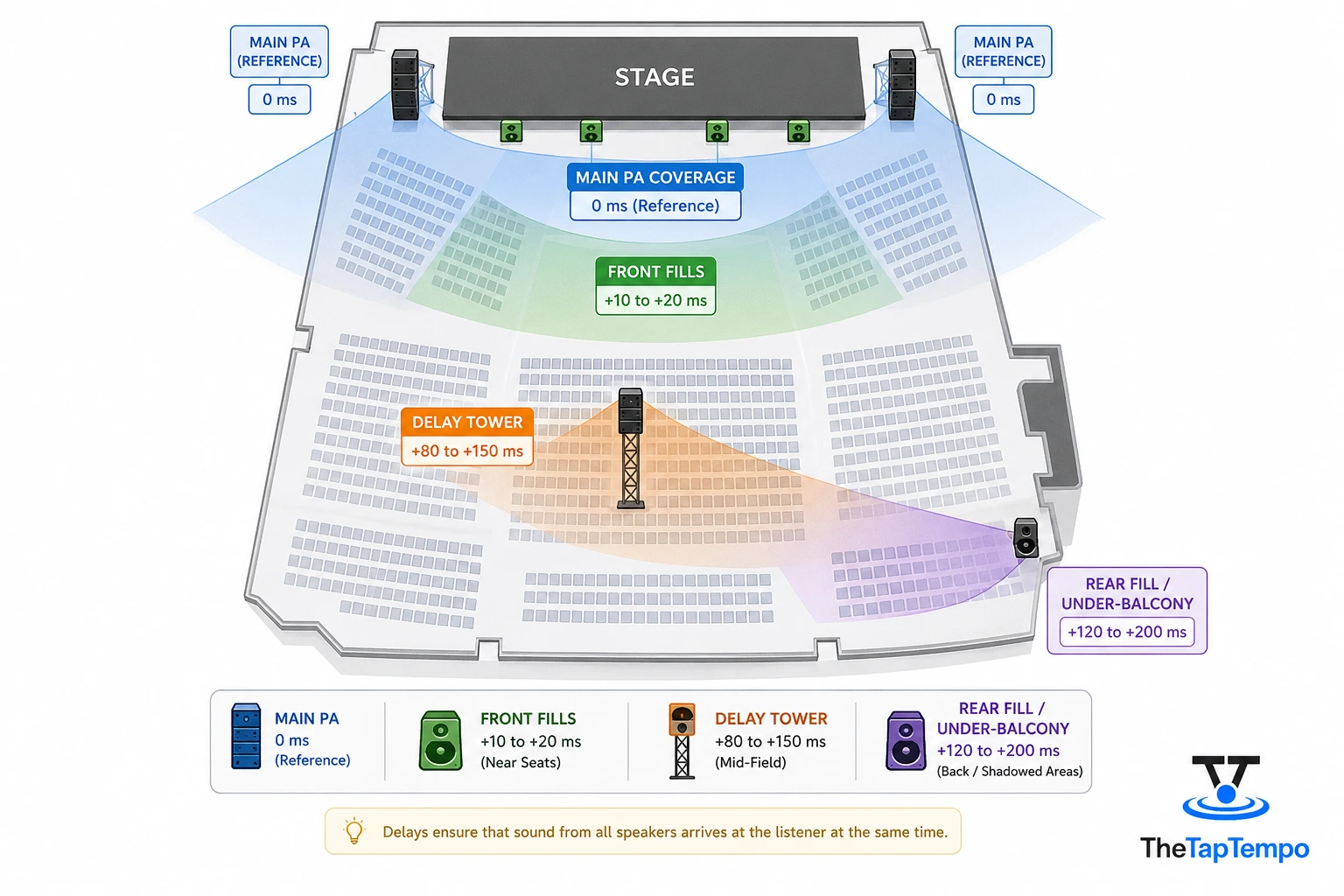
Front fills are aligned to the chosen reference position. If their acoustic arrival is earlier than the reference system at that position, delay is added to bring the arrivals into alignment. A front fill positioned very close to the main system's own reference point may need little adjustment, while one positioned much closer to its listeners typically needs more.
Front-fill level shouldn't be used as a substitute for correct timing. Raising the level of a misaligned fill makes the mismatch more noticeable, not less.
Rear-fill and under-balcony speakers address a related but distinct problem: seating in acoustic shadow, where the main PA's direct sound is blocked or significantly reduced by architecture. Restoring intelligibility to these seats follows the same alignment principle. The fill is timed against the reference system so the audience perceives one coherent source rather than two competing ones.
This distributed-coverage approach appears across many venue types. Churches often use front fills for the first several rows and under-balcony speakers for enclosed seating. Theatres rely on distributed fills to handle balconies and side sections shaped by the building's architecture. Arenas and long halls depend on a combination of delay towers and fills to reach audience areas far from the stage, and outdoor events apply the same principles across an open field with no architecture to help.
What Happens When Speaker Delay Is Wrong?
When speaker delay is set incorrectly, listeners in the overlap area between two systems hear artifacts instead of one clean sound. This ranges from subtle smearing to a noticeably hollow or blurred tone.
These artifacts occur because two versions of the same signal arrive at slightly different times. The ear interprets that mismatch as distortion of the source rather than reinforcement of it.
At the milder end, transient sounds such as speech consonants or the attack of a drum lose definition as two close-but-not-identical arrivals blur together. As the timing error grows, this can develop into a clearly audible echo or double sound, particularly on percussive material or spoken word.
Comb filtering can also occur when two arrivals overlap. Whether it becomes audible depends on the timing difference, the frequencies involved, the relative level of each signal, and the polarity or phase relationship between them. When these factors combine unfavorably, certain frequencies reinforce while others cancel, producing a thin, hollow, or phasey character that shifts as a listener moves through the space. Comb filtering is a common contributor to reduced speech intelligibility, since it tends to affect the frequency ranges that carry vocal clarity.
These problems aren't uniform across the room. Listeners standing in an overlap zone hear the worst of it, while listeners closer to only one system notice little difference.
This unevenness is itself a signal of a timing problem rather than a coverage problem. A true coverage gap sounds simply quiet or thin. A timing error sounds actively strange or phasey even at adequate volume, and it becomes more obvious, not less, as level increases.
Real-World Live Sound Alignment Examples
Concert Arena
In a large arena, the main PA often covers the front and middle sections of the floor clearly. Level and clarity can fall off by the time sound reaches the rear of the general admission floor or the upper sections.
A common arrangement pairs the main PA with one or more delay towers farther back, timed relative to the main system based on their placement. Done well, this produces consistent level and vocal intelligibility from front to back.
Done poorly, rear listeners hear an audible echo or smeared vocals where the tower and the main PA arrive far enough apart to register as separate events.
Church Auditorium
Many churches have wide seating sections, side wings, or under-balcony areas the main PA doesn't cover evenly, in a context where speech clarity matters as much as music.
A typical arrangement pairs the main system with front fills for the first several rows and distributed or under-balcony speakers for enclosed seating, each timed relative to the reference system based on its placement. Handled well, speech stays clear and music feels balanced throughout the room.
Handled poorly, listeners in the overlap areas may describe the sound as hollow or oddly detached from the platform.
Outdoor Festival or Event
Outdoor audience fields regularly extend beyond the distance a single PA system can cover with consistent level and clarity, since there's no architecture to help contain or reinforce the sound.
The standard solution is a main system supported by one or more delay towers spaced through the field, each timed to its reference and covering its own zone. This extends intelligible coverage much deeper into the crowd than the main system could manage alone.
Poorly timed transitions between zones produce audible repeats or a noticeable seam where one tower's coverage meets another's.
Theatre or Large Hall
Theatres and large halls introduce architectural challenges beyond simple front-to-back distance, including balconies, deep under-balcony seating, and varied seating depth across sections.
These venues typically combine the main system with front, rear, balcony, or other distributed fills, each aligned to its intended listening area. Handled well, the result is consistent speech clarity whether a listener sits in the orchestra section or the balcony.
Handled poorly, dialogue sounds blurred, or the sound seems to obviously originate from a nearby speaker rather than the stage.
Optional Small-Venue Example
Not every room needs a delay system. In a small club, lecture hall, or intimate venue where the main PA already covers every seat with even level and clarity, adding a second delayed system typically introduces more overlap and phase interaction than benefit.
In these cases, the better decision is to leave the system as a single, well-placed main PA rather than add complexity the room doesn't need.
Best Practices for Clear, Consistent PA Coverage
Consistent PA coverage starts with planning, not with adding more speakers. Introduce a delay system only once a genuine gap in level, clarity, or intelligibility has been identified. Place and aim each system correctly first. Even accurate timing can't compensate for a speaker aimed at the wrong seats.
Establish a clear timing reference for the room and align each zone to that reference for its intended coverage area. Set levels only after basic timing has been addressed, since setting volume before alignment tends to mask timing problems rather than reveal them.
Check overlap and phase interaction wherever two zones meet, since these transition areas are where alignment errors are most audible. Verify the result at multiple representative listening positions rather than relying on one spot near the mix position.
Listen for smearing, tonal changes, or reduced intelligibility as warning signs of a timing issue. Recheck alignment after moving speakers or changing DSP settings and signal routing, since these changes can shift relationships that were previously correct. Volume is never a substitute for correct timing. It makes an existing mismatch easier to hear, not solves it.
Getting speaker delay right is what allows a large venue to sound like one coherent system instead of several competing ones. Coordinating arrival times, rather than relying on volume alone, is what extends clear, intelligible coverage across concerts, churches, theatres, arenas, halls, and outdoor events.
To see how physical distance relates to acoustic timing, use the Delay & Reverb Time Calculator alongside the alignment principles covered in this guide. It's a helpful reference for understanding distance-to-timing relationships, not a substitute for professional PA prediction, measurement, or tuning software.
Continue Learning
The articles below cover other applications of delay. They are separate from live-sound speaker alignment and do not replace this guide's focus on PA-system timing.
- Delay vs Reverb – creative effects and ambience.
- Stereo Delay Explained – stereo and ping-pong delay behavior.
- How to Set Delay Time for Electric Guitar – guitar delay and pedal settings.
- Latency vs Musical Timing – system latency and creative timing.
This article has been researched, written, and reviewed according to our Editorial Policy.
Frequently Asked Questions
Common questions about finding the BPM of a song.