
How to Increase Speed Without Losing Accuracy
Stuck at a tempo plateau? Learn the structured method to build playing speed with a metronome safely, maintain accuracy, and break through limits.

Quick Answer: Speed is built through structured repetition, not by forcing faster tempo. Confirm a clean working tempo, raise it in small 2–5 BPM increments, test with 3–5 clean repetitions before locking it in, and log your progress. Plateaus are normal — when a tempo increase fails, drop back, reinforce, and retest rather than pushing harder.
You can play the passage cleanly at a slower tempo. Push it up a few clicks on the metronome, and it falls apart: fingers rush, notes blur together, or you simply can't keep up. This is one of the most common frustrations in instrumental practice, and it isn't a sign that you're doing something wrong. It's a sign that speed needs to be built with the same structure as any other skill.
This guide covers the part most practice advice skips: what to do once "just increase the tempo gradually" stops working. You'll find a repeatable method for testing speed safely, a way to recognize and break through plateaus, and a recovery process for the tempo jumps that don't go as planned.
Why Speed Should Be Built Gradually
Speed is not a separate skill from accuracy. It's what accuracy looks like once a movement has been practiced enough times that your body can execute it without conscious effort, and that transition takes structured repetition, not just faster attempts.
How the Body Learns Speed
When you first learn a passage, you're relying on conscious attention to get each note right. With enough clean, consistent repetition, that same passage becomes automatic, meaning your body can execute it correctly without you actively thinking through every movement. This shift toward automaticity is well documented in motor learning research, and it explains why speed genuinely cannot be rushed past a certain point: the nervous system needs repetition at a manageable tempo before it can reliably reproduce that movement faster.
Trying to skip this stage by jumping straight to a faster tempo doesn't save time. It usually produces a version of the passage built on tension and guesswork rather than genuine motor learning, which tends to break down under pressure exactly when you need it most.
Why Rushing Tempo Backfires
Pushing the tempo up before a passage is genuinely automatic usually shows up as one of two problems: increased physical tension as your body compensates for movements it hasn't fully learned, or inconsistency, where you can play it correctly once but not reliably. Neither of these resolves by simply practicing more at the same rushed pace. Both tend to get worse.
The basic principle of increasing tempo in small, gradual steps is already covered in our guide on how to practice with a metronome, so we won't re-explain it here. What this article focuses on is what to do once gradual increases stop being enough on their own, which is where most players actually get stuck. This applies equally whether you're a guitarist working through a solo or a drummer building up a fill.
Quick Answer: Speed is the byproduct of enough clean repetition at a manageable tempo, not a separate skill you can force. Pushing tempo before a passage is automatic tends to build tension and inconsistency instead of real progress.
Step-by-Step Speed Method
A structured speed method replaces vague "practice faster" advice with a repeatable process: establish a clean baseline, test upward in small increments, confirm the result with multiple repetitions, and log what happened before deciding your next move. All four steps use nothing more than a metronome and a consistent way to track what you play.
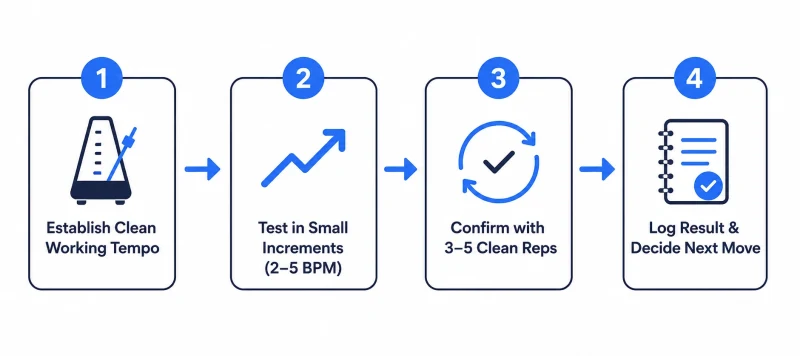
Establish Your Clean Working Tempo
Before increasing anything, find the tempo at which you can play the passage correctly, with even timing and no tension, at least three times in a row. This is your working tempo, and it's the foundation the rest of the method builds on. If you're not certain what that tempo is, start slower than feels necessary. Confirming a genuinely clean baseline matters more than starting fast.
Test in Small Increments
Once your working tempo is confirmed, raise the metronome by a small amount, typically around 2 to 5 BPM, a range commonly recommended by experienced instructors for testing whether a passage can handle more speed without falling apart. Play the passage once at the new tempo. This single attempt isn't a pass or fail test on its own; it's information about whether the new tempo is worth testing further.
Confirm With Multiple Clean Repetitions
A single clean attempt at a new tempo doesn't mean you've actually built that speed. It means you got lucky once. Play the passage three to five times at the new tempo, and only treat it as a genuine step forward if most or all of those repetitions come out clean, evenly timed, and free of noticeable tension.
This distinction between a single successful attempt and a repeatable performance is one of the most overlooked parts of speed training. Players who skip this step often feel like their speed is inconsistent from one practice session to the next, when the real issue is that the previous "success" was never actually repeatable to begin with.
Quick Answer: One clean attempt at a new tempo is information, not confirmation. Only treat a tempo as genuinely built once you can reproduce it cleanly across three to five repetitions in a row.
Log the Result and Decide Your Next Move
If the repetitions come out clean, that tempo becomes your new working tempo, and you can test the next increment. If they don't, drop back to your last confirmed clean tempo and spend another session solidifying it before testing upward again. Either outcome is useful information, not a failure.
Keeping a simple written log of your working tempo over time turns this from a vague feeling of progress into something measurable, which the Measuring Progress section below covers in more detail.
A Worked Example
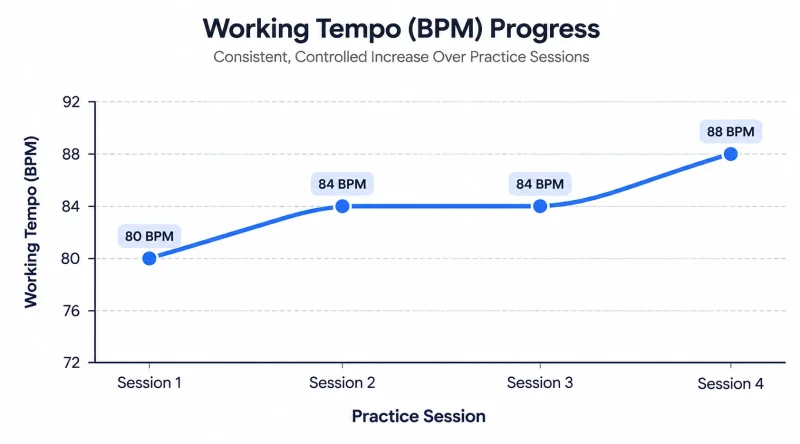
Here's how the four steps look in practice. Say a guitarist confirms a clean working tempo of 80 BPM on a difficult passage, meaning three consecutive repetitions with even timing and no tension. They raise the tempo to 84 BPM and play it once. It sounds promising, so they run four more repetitions at 84 BPM: three come out clean, but two show slight rushing in the same measure.
Because most, but not all, of the repetitions were clean, they treat 84 BPM as confirmed and move to 88 BPM. This time, only two of five repetitions are clean, with noticeable tension appearing in the same spot each time. Rather than continuing to attack 88 BPM, they drop back to 84 BPM, spend the rest of the session reinforcing it, and log both results. The following session, 88 BPM succeeds on the first real attempt, because the movement had time to consolidate at 84 BPM first.
This is what the method is designed to produce: not a single fast attempt, but a tempo you can trust.
Quick Answer: A structured speed method means confirming a clean baseline, testing small increments, requiring multiple clean repetitions rather than one, and logging the result so you know whether to advance or reinforce.
Avoiding Plateaus
A speed plateau, where progress seems to stall at the same tempo across multiple sessions, is a normal and expected part of building speed rather than a sign that something has gone wrong. Understanding why plateaus happen makes them far less discouraging and easier to work through.
Why Plateaus Are a Normal Part of Progress
Skill development rarely improves in a straight line. It's common for practice to plateau for a period before a noticeable jump in ability appears, a pattern widely observed in motor learning research across many physical skills, not just music. A plateau often means your body is still consolidating the movement at the current tempo, even if that consolidation isn't visible session to session.
Treating a plateau as a signal to push harder usually backfires. It tends to reinforce the tension and inconsistency described earlier rather than resolve them.
Recovering After a Failed Tempo Increase
When a tempo increase doesn't hold, the most effective response is to drop back to your last confirmed clean tempo rather than repeatedly attacking the tempo that just failed. Spend the next several repetitions reinforcing that lower, reliable tempo with genuinely clean playing. This isn't losing progress. It's protecting the progress you've already made from being overwritten by tense, inconsistent repetition at a tempo you weren't ready for.
Once that working tempo feels solid again, usually within the same session or the next one, you can retest the increment that previously failed. Many players find it succeeds on the second attempt simply because the underlying movement had more time to consolidate.
Quick Answer: After a failed tempo increase, drop back to your last confirmed clean tempo and reinforce it rather than repeatedly forcing the tempo that failed. Retesting after a session or two often succeeds where forcing it did not.
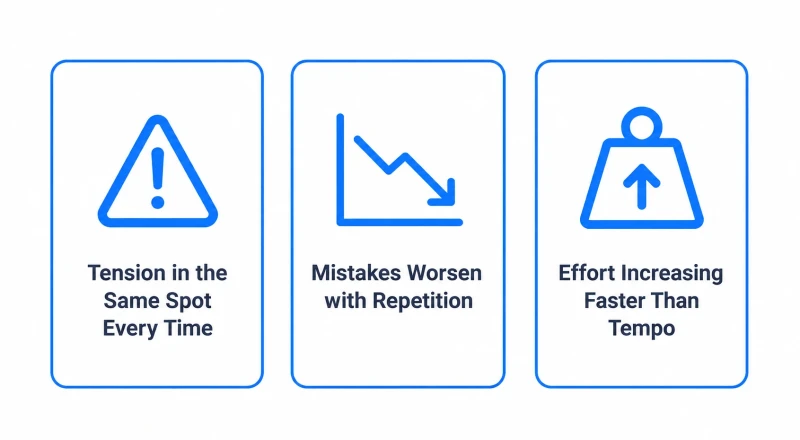
Warning Signs You're Increasing Tempo Too Fast
A few patterns tend to show up before a tempo increase fully fails, and catching them early saves a session of frustration. Tension that appears in the same spot every repetition, rather than random slips in different places, usually means the movement itself hasn't been learned at that speed yet. Mistakes that get worse the more times you repeat the passage, instead of improving with repetition, are another sign you've moved up too soon.
A third sign is more subtle: the passage feels physically effortful in a way it didn't at your previous working tempo, even when the notes come out correct. Effort that increases faster than tempo does is usually an early warning that the current speed isn't sustainable yet, even if it technically works for now.
Using Practice Variability to Break Through
When a plateau persists across several sessions, introducing variability into your practice, such as practicing the passage at a slightly slower tempo than your working tempo, or in short isolated sections, can help. This approach relates to a broader principle in motor learning: practice that varies slightly from session to session often transfers better to real performance than repeating the exact same conditions over and over.
Practically, this might mean spending part of a session at a deliberately relaxed tempo focused purely on physical ease, then returning to your working tempo with that relaxation carried forward.
Quick Answer: Plateaus are a normal part of skill development, not a warning sign. After a failed tempo increase, return to your last clean tempo, reinforce it, and retest later rather than repeatedly forcing the tempo that failed.
Measuring Progress
Real progress in speed training is measured by what you can repeat reliably, not by the fastest single attempt you've ever managed. Building a simple, consistent way to track this turns practice into a process you can actually evaluate instead of a vague sense of whether things feel better or worse.
What Counts as a Clean Repetition
A repetition counts as clean when the notes land with even timing, the intended dynamics and articulation are intact, and there's no audible tension or rushing. It does not need to be perfect in every musical sense, but it should sound like a controlled, intentional performance rather than something that barely survived. Defining this clearly before you start testing tempo increases removes a lot of the guesswork around whether you're actually ready to move up.
Building a Tempo Progression Log
A short log of your working tempo over time makes plateaus and genuine progress much easier to distinguish from each other. It doesn't need to be complicated. A simple table works well:
| Session Date | Working Tempo | Tested Tempo | Result |
|---|---|---|---|
| Session 1 | 80 BPM | 84 BPM | 4/5 clean, confirmed |
| Session 2 | 84 BPM | 88 BPM | 2/5 clean, not confirmed |
| Session 3 | 84 BPM | 88 BPM | 5/5 clean, confirmed |
| Session 4 | 88 BPM | 92 BPM | 3/5 clean, confirmed |
Notice that Session 2's failed attempt at 88 BPM wasn't wasted time. It set up the confirmed success in Session 3, once the working tempo had another session to consolidate.
Reviewing this log every week or two, rather than session by session, usually gives a clearer picture of real progress than judging any single day. A single session can look like a plateau on its own while still being part of a steady upward trend across several weeks, and a written log is what makes that trend visible instead of guessed at.
Repeatable Performance vs. One Lucky Take
It's tempting to measure progress by the fastest tempo you've ever hit, even once. This tends to be misleading, because a single fast, tense attempt often can't be reproduced on demand and doesn't reflect what you can actually rely on in a performance or recording. Repeatable performance, meaning a tempo you can hit cleanly on most attempts rather than occasionally, is a far more honest measure of real progress, even though it usually looks like a smaller, slower-moving number than your best single attempt.
Quick Answer: Track your working tempo over time rather than your single best attempt. A tempo you can play cleanly most of the time is a more accurate measure of progress than a fast performance you can't reliably repeat.
Continue Learning
Continue building your speed and practice skills with these guides:
- Why Slow Practice Works
- How to Practice with a Metronome
- Common Metronome Mistakes
- Understanding Note Values: Why Quarter, Eighth, and Triplet Delays Sound Different
Ready to put this into practice? Open the Metronome tool and run today's speed routine: confirm your working tempo, test one small increment, and log the result before deciding whether to push further.
This article has been researched, written, and reviewed according to our Editorial Policy.
Frequently Asked Questions
Common questions about finding the BPM of a song.