
Why the Same Tempo Marking Can Sound Different in Different Performances
Why do two orchestras playing the same Allegro sound different? Explore how conductors, acoustics, instruments, and phrasing shape tempo interpretation.
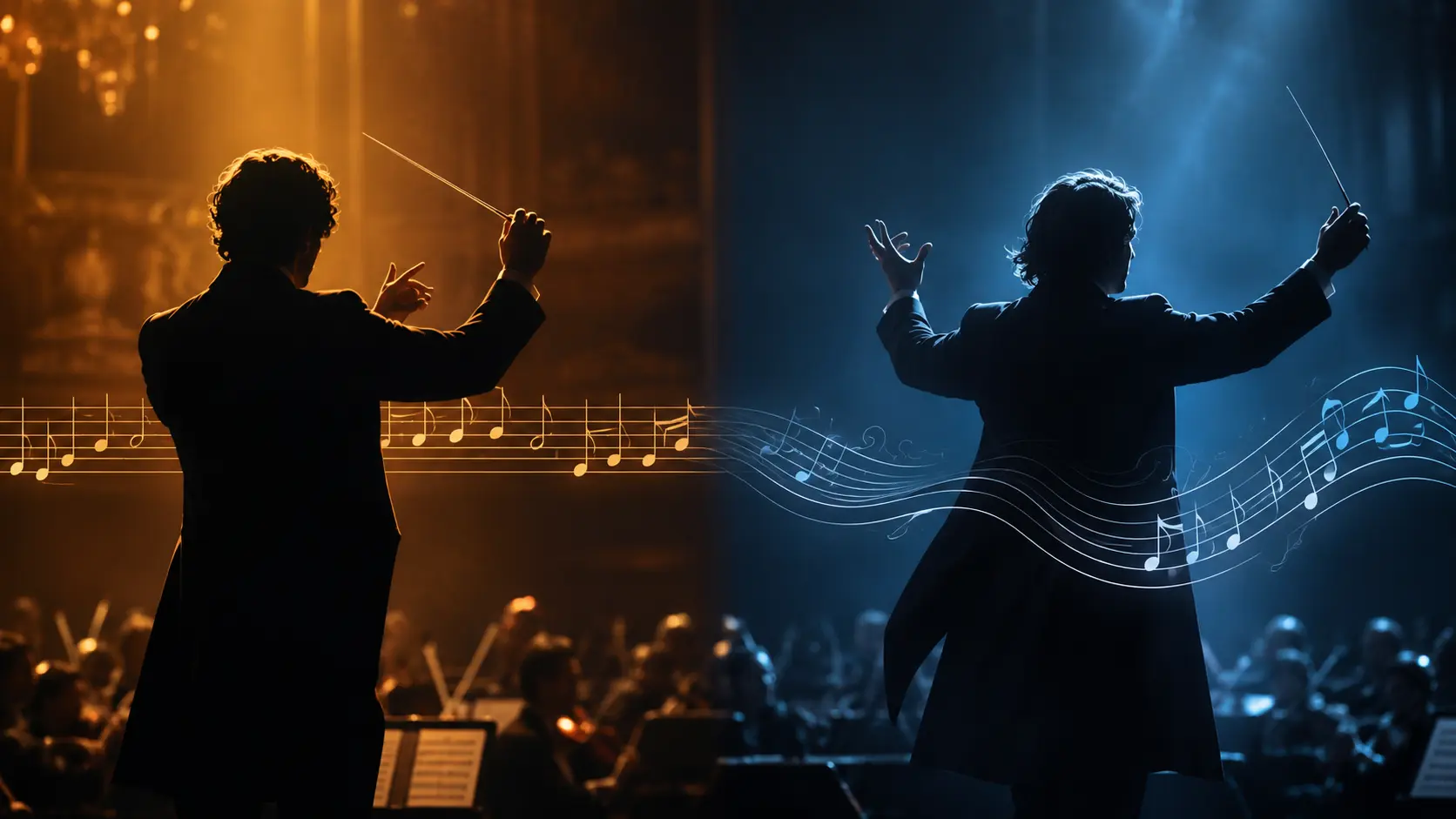
Put on two different recordings of the same symphony, both marked Allegro in the score, and you may notice they don't sound like they're moving at the same speed at all. Neither performance is wrong. Neither conductor misread the music.
As we explored in our guide to why composers use tempo markings instead of BPM numbers, a tempo marking was never meant to lock a piece to a single, unbending speed. This article goes a step further and looks at what actually happens in a real performance: the specific, practical forces that cause two skilled, faithful interpretations of the same marking to sound genuinely different from one another.
Are Tempo Markings Exact Instructions?
No, and understanding why is the foundation for everything else in this article.
What a Tempo Marking Actually Guarantees
A tempo marking guarantees character and a general sense of pace. It does not guarantee an identical, reproducible speed every time the piece is performed.
Think of a tempo marking less like a fixed setting and more like a set of banks on a river. The water can move faster in one stretch and slower in another, speed up around a bend, and settle in a wide pool, but it never leaves the banks the composer built. Two rivers following the same banks can still carry water at noticeably different speeds.

Why Two Faithful Performances Can Still Differ
This is exactly what happens between two orchestras performing the same Allegro. Both are working inside the boundary the marking establishes.
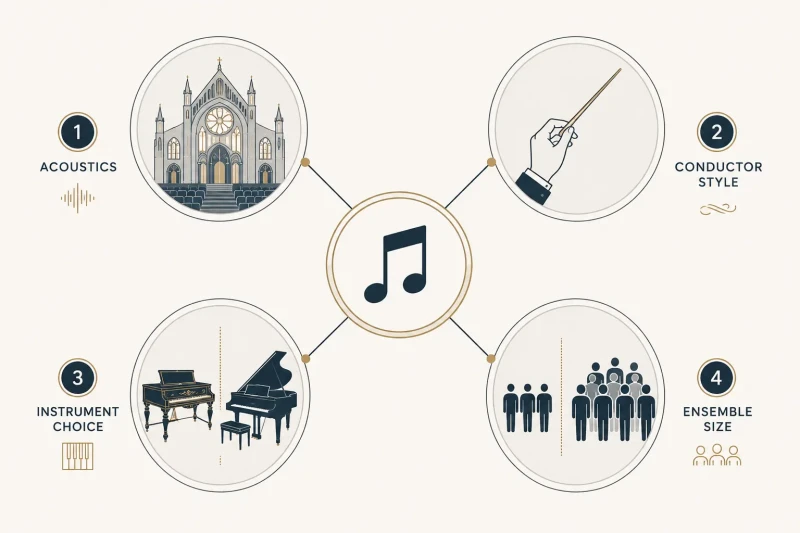
Neither has drifted outside the composer's intent. What differs is everything that happens inside that boundary: who is conducting, what room the orchestra is playing in, what instruments they're using, and how the musicians choose to shape each phrase. Those factors are the real subject of this article.
How Conductors Shape Tempo During a Performance
A conductor's job has never been to simply keep time. It's to decide how the tempo marking should live and breathe across an entire performance.
Toscanini's Strict Fidelity vs. Furtwängler's Elastic Tempo
Two of the twentieth century's most influential conductors, Arturo Toscanini and Wilhelm Furtwängler, approached this job in almost opposite ways. Toscanini was known for insisting on textual fidelity and a tightly controlled tempo, treating precision and discipline as the highest priorities in serving the composer's score.
Furtwängler took a more flexible approach, often described as an "elastic" sense of tempo, where the pulse could stretch and contract within a movement to serve the emotional arc of the music. Listeners familiar with both conductors' recordings of the same Beethoven symphony can often identify who is on the podium within moments, not because one of them is wrong, but because their entire philosophy of tempo differs.
Why Tchaikovsky's Own Marking Doesn't Match Tradition
Sometimes performance tradition drifts even further from the marking than a conductor's personal style would suggest. The finale of Tchaikovsky's Fourth Symphony is marked Allegro con fuoco, not Presto, yet generations of conductors, particularly in the Russian tradition, have taken it at a startlingly fast pace that pushes well beyond what the marking alone implies.
This tradition became so entrenched that a famously fast account by conductor Yevgeny Mravinsky is still discussed by musicians today. It shows how a performance practice can develop a life of its own, sitting alongside the marking rather than strictly inside it, and how conductors after a landmark recording often feel pulled to follow suit.
The Conductor's Job: Serving the Score, Not Replacing It
None of this means a conductor is free to ignore the marking entirely. A tempo choice still has to serve the character the composer indicated, even while expressing something personal within it.
The best conductors treat the marking as the destination and their own judgment as the route they take to get there.
Why Acoustics, Instruments, and Ensemble Size Matter
Not every difference between performances comes from a conductor's personal philosophy. Some of it comes from physical realities that have nothing to do with taste.
How a Reverberant Hall Changes a Feasible Tempo
A large, reverberant concert hall or cathedral holds onto sound for longer than a dry, acoustically controlled space. Play a fast passage too quickly in a space like that, and the notes blur into each other before the room has finished ringing with the last one.
Conductors and performers routinely adjust their sense of tempo to the room they're playing in, taking a slightly broader pace in a resonant space to preserve clarity, and allowing more precision at faster speeds in a drier hall. The tempo marking hasn't changed. The room has simply changed what's musically possible.
How Period Instruments Encourage Different Tempo Choices
Instrument choice shapes tempo just as strongly. A fortepiano, the lighter-action ancestor of the modern piano common in Mozart and early Beethoven's lifetime, produces a sound that decays much faster than a modern concert grand.
Because the sound fades quickly, performers on a fortepiano often lean toward a livelier tempo to keep the musical line from feeling like it has gaps in it, where a modern piano's longer sustain can comfortably support a broader pace in the same passage. Gut strings and period bows create a similar effect for string players, favoring a lighter, more transparent articulation that naturally suits a different tempo feel than modern steel strings and a modern bow. This is part of why the historically informed performance movement, which uses period instruments and historical techniques, has generally trended toward brisker tempos than the mid-twentieth-century recordings most listeners grew up with.
How Ensemble Size Affects What Tempo Is Achievable
A larger ensemble takes longer for a sound to travel from one side of the stage to the other and for every player to lock together rhythmically. Coordinating fifty musicians at a very fast tempo is a fundamentally different physical challenge than coordinating a string quartet at the same speed.
This is one reason a large symphony orchestra and a small chamber ensemble may settle on noticeably different tempos for pieces that carry the exact same marking. A string quartet has four players to keep aligned and can often sustain a faster, tighter tempo than an eighty-piece orchestra attempting the same passage, simply because there are fewer places for the ensemble to drift apart.
This isn't a limitation to apologize for. It's one more real, physical reason two faithful performances of the same marking can move at genuinely different speeds.
The Role of Musical Expression and Rubato
Even without a different conductor, hall, or instrument, a single performer can still shape tempo in ways that make each performance unique.
What Rubato Actually Means
Rubato is the practice of gently pulling tempo forward or holding it back within a phrase, borrowing a fraction of a second here and giving it back a moment later. It's an expressive tool, not a departure from the marking, and every well-trained musician learns to use it in service of the music rather than against it.
How Phrasing Decisions Create Audible Tempo Differences
A performer deciding how to shape a single phrase, where to breathe, which note to lean into, how long to let a final chord ring, is making dozens of small tempo decisions that never appear anywhere in the score. Two performers playing from the exact same edition of a piece, with the exact same marking, will make different choices at nearly every one of these moments.
None of these choices individually breaks the tempo marking. Together, across an entire piece, they add up to two performances that feel genuinely distinct.
Why the Same Performer Never Repeats a Phrase Identically
Even a single musician playing the same piece on two different nights will shape a phrase slightly differently each time. Fatigue, the mood of the room, how a colleague phrased the previous passage, or simply how the instrument feels that evening can all nudge a rubato decision by a fraction of a second.
This is part of why no recording, however carefully studied, should be treated as the single correct version of a piece. It's one performer's honest interpretation on one particular night, made within the same boundary every performer works inside.
Finding the Balance Between Accuracy and Interpretation
Interpretation has limits. A performance can lean too far in either direction, and both extremes create real problems.
Professional Insight
Experienced musicians often check their own interpretation by asking whether a listener unfamiliar with the piece could still recognize its character. If a performance strips out every ounce of judgment, it can feel mechanical and lifeless. If it drifts so far from the marking that the character disappears entirely, it stops representing the piece the composer actually wrote.
Where Interpretation Crosses Into Distortion
A performance that ignores the tempo marking's character altogether, playing an Adagio at a brisk, businesslike pace or an Allegro so cautiously that its energy disappears, has stopped interpreting the marking and started replacing it. This is different from the natural variation discussed throughout this article, because it abandons the composer's intent rather than honoring it through a different lens.
How Skilled Performers Self-Check Their Interpretation
Skilled musicians treat the tempo marking as a check on their own instincts, returning to it throughout rehearsal to confirm their interpretation still serves the character the composer asked for. Interpretation, at its best, is a conversation with the score rather than a departure from it.
| Approach | What It Prioritizes | Risk If Taken Too Far |
|---|---|---|
| Strict tempo adherence | Precision, ensemble unity, structural clarity | Can feel rigid or mechanical |
| Flexible, personal interpretation | Expression, phrasing, emotional shape | Can drift away from the composer's intent |
| Balanced interpretation | Honoring the marking while allowing judgment | Requires ongoing self-checking, not a fixed formula |
When Tempo References Become Helpful
Understanding why performances vary doesn't remove the need for a starting reference point, especially when you're preparing your own interpretation rather than simply listening to someone else's.
Compare common tempo markings and their commonly accepted tempo ranges with our Tempo Markings Tool before deciding how to interpret a piece. Use that range as your foundation, then apply the same judgment discussed throughout this article: your hall, your instrument, your ensemble, and your own musical instincts.
Once you've settled on a working tempo, a metronome helps you practice that interpretation consistently rather than letting it drift unintentionally between rehearsals. And if you're studying a specific recording to understand how another performer approached the same marking, Tap Tempo lets you tap along and get an approximate reading instead of guessing by ear.
If you're translating a marking into a numeric practice reference for the first time, a BPM calculator can help you understand approximate values once you've already done the interpretive thinking this article describes.
Continue Learning
- How Accurate Is Tap Tempo
- Common Metronome Mistakes That Slow Down Your Progress
- How to Choose the Right BPM Before You Start Recording a Song
- What Are Milliseconds in Music
- Measure Numbers in Music
Tempo markings provide direction, not strict limits. Use our Tempo Markings Tool to explore common tempo references while remembering that musical interpretation always plays an important role.
This article has been researched, written, and reviewed according to our Editorial Policy.
Frequently Asked Questions
Common questions about finding the BPM of a song.