Why Composers Use Tempo Markings Instead of BPM Numbers
Why do composers write "Allegro" instead of a BPM number? Discover how tempo markings preserve musical expression, interpretation, and artistic intent.
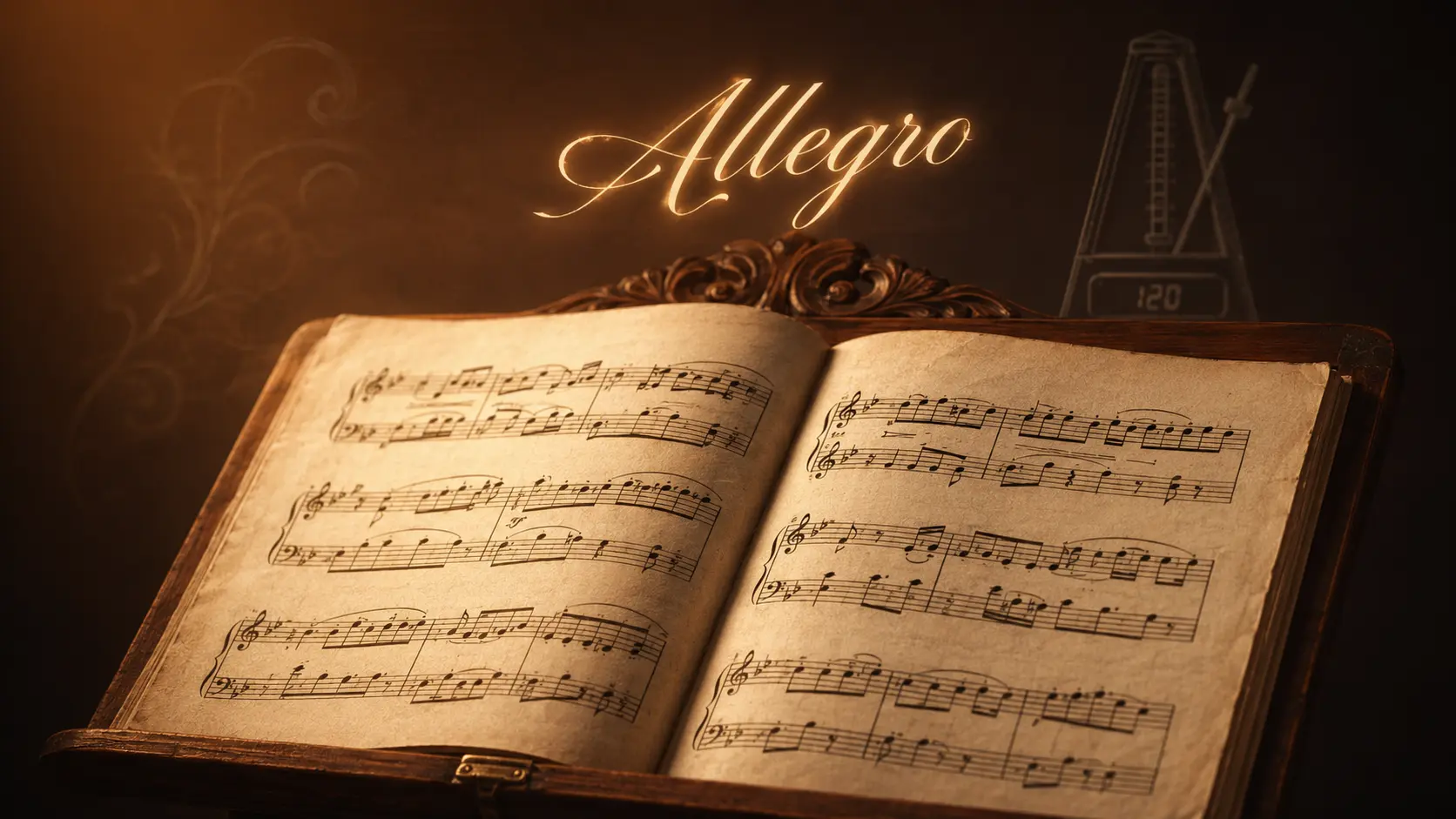
Open almost any piece of classical sheet music, and you'll find a word sitting above the first measure, not a number. Allegro. Andante. Largo. A composer who wanted precision could have simply written "120 BPM" and left no room for doubt. Instead, generations of composers chose language over mathematics, and that choice tells us something important about what tempo actually means in music.
Understanding why this tradition has survived for centuries changes how you read a score, how you interpret a piece, and how you think about tempo altogether.
Tempo Is More Than Just a Number
A metronome marking tells you how fast to play. A tempo marking tells you how the music should feel while you play it.
Why a BPM Number Can't Capture Musical Character
That distinction matters more than it first appears. If Beethoven had written only "♩ = 126" above the first movement of his Fifth Symphony, performers would know the speed, but nothing about the character behind it. By writing "Allegro con brio" instead, he communicated urgency, energy, and a kind of forward-leaning intensity that a number alone can never carry.
This is the core reason tempo markings exist. They were never designed purely as a measurement of speed. They were designed as a performance instruction, a small piece of emotional direction embedded directly into the score.
A conductor or performer reading "Andante cantabile" understands not just a moderate walking pace, but an invitation to shape the phrase like a singing voice. Strip away the word and replace it with a number, and that instruction disappears.
Same BPM, Different Feel: Chopin vs. Baroque Dance
Consider how differently a pianist might approach two pieces marked at a similar tempo. A Chopin nocturne marked Andante and a Baroque gigue marked Allegro at a comparable BPM would still be played with completely different touch, phrasing, and rubato, because the words tell the performer far more about intention than the numbers do.
Tempo, in this sense, is inseparable from character. A number can describe motion. Only language can describe meaning.
Why Italian Words Became the Language of Musical Tempo
Tempo markings weren't always part of Western notation. Before the 17th century, composers relied on fixed rhythmic conventions and note values to imply how fast a piece should move, rather than writing explicit instructions above the staff. As music grew more expressive and performance contexts became more varied, composers needed a more direct way to communicate intent to performers who might never meet them in person.
How Italian Tempo Markings Originated in the 17th Century
Italy was the natural source of this new vocabulary. During the 17th and 18th centuries, Italian composers dominated European musical life, and opera in particular pushed the development of expressive, character-driven performance instructions.
Terms like allegro, adagio, and largo became standardized through this period. Because Italian musicians and Italian opera carried so much influence across the continent, the terminology spread with them, and even composers working in Germany, France, and England adopted Italian markings as the accepted international convention.
Why Non-Italian Composers Kept Using Italian Tempo Markings
That convention has proven remarkably durable. Composers who wrote in German, French, or English frequently continued using Italian tempo words long after their own national musical traditions had matured, simply because the terminology had become a shared performance language understood by musicians everywhere.
Bach's own instrumental music shows this clearly, and it also shows how much room these markings left for interpretation. The first movement of his Brandenburg Concerto No. 3 carries no tempo marking at all in Bach's original score. Performers and editors have had to choose between Allegro and Allegro moderato ever since, based on style rather than a number Bach ever wrote down.
How the Meaning of Allegro and Other Tempo Words Has Changed
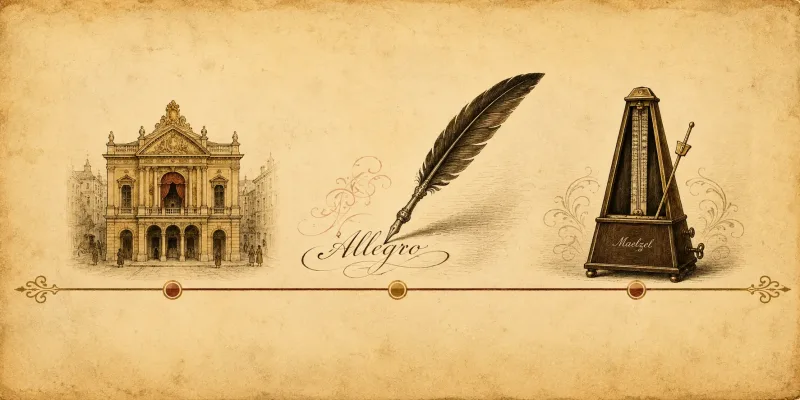
Some tempo words also carry meanings that have shifted over the centuries. Allegro originally connoted joy or liveliness as much as speed, and terms like allegretto have not always meant precisely what they mean in a modern score.
Music theory education commonly frames this as one of the more counterintuitive parts of learning notation: a word can stay on the page for three hundred years while its meaning quietly drifts underneath it. This is part of why tempo markings resist being reduced to fixed numbers. They are historical, cultural, and expressive artifacts as much as technical instructions, and a performer who understands their history reads them very differently than someone who treats them as a lookup table.
How Tempo Markings Leave Room for Musical Expression
A number is fixed. A word invites judgment.
This is precisely why composers have continued choosing tempo markings over strict BPM values, even in an era when metronomes make exact tempo trivially easy to specify. A marking like Andante gives a performer a general character and a workable range, but it deliberately leaves room for the performer's own musical judgment to shape the final result.
This flexibility is not a flaw in the system. It's the entire point.
How a Student and a Professional Read the Same Marking Differently
A student encountering Andante for the first time often plays it as a single, unwavering speed, because a fixed tempo feels safer and easier to count. That reading isn't wrong, but it's incomplete.
A professional approaching the same Andante treats the marking as a starting character rather than a finish line. They'll ease into a phrase, hold back slightly before a cadence, or lean into a melodic peak, all while staying recognizably within the tempo the composer asked for. The difference isn't accuracy. It's how much interpretive judgment each performer brings to the same word on the page.
How Tempo Markings Allow Rubato and Personal Phrasing
A concert pianist performing a Chopin nocturne marked Andante will almost never play every measure at a single, unwavering tempo. Rubato pulls certain phrases slightly forward and lets others breathe, all while remaining faithful to the overall Andante character the composer intended.
If Chopin had insisted on a rigid BPM value with no flexibility, this kind of expressive phrasing would directly contradict the notation. Because he wrote a tempo marking instead, expressive tempo fluctuation becomes part of a correct interpretation rather than a departure from it.
How Conductors Interpret the Same Tempo Marking Differently
The same principle applies at the ensemble level. A conductor shaping a movement marked Allegro moderato is making dozens of interpretive decisions about pacing, weight, and forward motion, all within the boundaries that word establishes.
Two respected conductors can take the same Allegro moderato movement and produce two legitimately different, equally valid performances, because the marking was never meant to eliminate interpretation. It was meant to guide it.
Why Tempo Markings Often Include Mood Words Like Agitato
This is also why tempo markings frequently appear alongside mood or character words rather than standing alone. A marking such as Allegro agitato tells a performer both how fast to move and what emotional quality that speed should carry.
A number can never do both jobs at once.
Can Two Performances Use Different Tempos?
Yes, and this is one of the clearest ways to see why composers avoided locking tempo to a single number.
Why Different Recordings of the Same Piece Use Different Tempos
Listen to five different recordings of the same Mozart piano concerto movement marked Allegro, and you will hear five genuinely different tempos, sometimes varying by a significant margin. All five can be musically correct.
None of them violates the score, because Allegro was never intended as a single, immovable value. It defines a character and a general range of speed, and skilled performers exercise judgment within that range based on the instrument, the acoustic space, the era of performance practice being followed, and their own musical instincts.
Why Beethoven's Own Metronome Markings Are Still Debated
This has been true even among composers who tried to pin tempo down more precisely. When Beethoven began publishing metronome markings for his symphonies in the early 19th century, following the invention of Johann Maelzel's metronome, many performers and scholars still found his numeric markings unusually fast, and conductors have debated and adjusted them for two centuries since.
Beethoven's own tempo markings became a case study in exactly the tension this article is describing: even a composer who embraced numeric precision still needed to communicate character through words, and performers continued exercising judgment regardless of the number attached.
Professional Insight
When a conductor inherits Beethoven's own metronome numbers, many treat that figure as a ceiling to work toward across rehearsals rather than a fixed target to hit from the first read-through. The number sets an outer boundary. The tempo marking still decides how the music gets there.
Why Brahms and Wagner Disagreed About Tempo Rigidity
Other major composers pushed back against numeric rigidity entirely. Johannes Brahms was openly critical of treating metronome markings as unbending law, and Richard Wagner complained throughout his career that conductors were misjudging the tempos his scores called for, despite having written explicit tempo indications.
If composers themselves disagreed about what a "correct" tempo should sound like, it becomes clear why a flexible marking, rather than a fixed number, remained the more useful tool for communicating intent across different performers, instruments, and generations.
How to Read a Tempo Marking as a Range, Not a Fixed Speed
For performers, this means a tempo marking should be read as an instruction with a boundary, not a demand for one exact speed. A pianist preparing a piece marked Andante moderato is not looking for the single correct BPM.
They are learning the character the composer wanted, then finding a tempo within that character that serves the phrasing, the instrument, and the performance context.
When BPM Numbers Become More Useful Than Tempo Words
None of this means BPM numbers are unimportant. It means they serve a different purpose than tempo markings do.
A tempo marking communicates character and intention. A BPM number communicates a specific, reproducible speed. Both have their place, and knowing when to reach for each one is part of becoming a more capable musician.
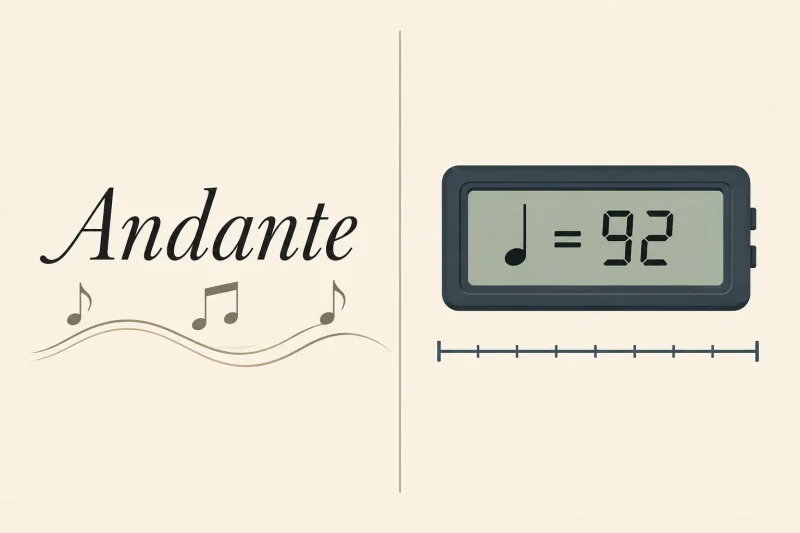
| Tempo Marking (e.g. Andante) | BPM Number (e.g. ♩ = 92) | |
|---|---|---|
| Communicates | Character, mood, and general pace | An exact, reproducible speed |
| Leaves room for | Rubato, phrasing, interpretive judgment | Little to no variation |
| Best used for | Reading a composer's intent from a score | Practicing, counting, and reproducing a specific speed |
| Historical role | The original method of indicating tempo | A later addition, popularized after the metronome |
Why Beginners Need a BPM Reference Point for a Tempo Marking
If you're a student sitting down to practice a piece marked Allegro for the first time, the word alone won't tell you exactly where to set a metronome. You need an approximate numeric reference to get started, even though the final tempo you settle on will ultimately depend on your own interpretation.
This is exactly where BPM values become genuinely useful again: not as a replacement for the composer's intention, but as a practical starting point for turning that intention into a specific practice tempo.
How to Convert a Tempo Marking Into a Practice BPM
This is also where a tool becomes more valuable than memorization. Rather than guessing at what Andante or Allegro typically means in practice, you can look up the commonly accepted tempo ranges for any tempo marking and use them as your reference point.
Explore common tempo markings and their approximate tempo ranges with our Tempo Markings Tool, then use that number as your starting tempo, adjusting from there based on the character the marking is asking for.
Once you have a working tempo in mind, a metronome becomes the practical companion for turning that number into consistent, reliable practice.
And if you're working from a recording or trying to reverse-engineer the tempo of an existing performance rather than a printed score, a BPM calculator can help you translate what you're hearing into an approximate numeric value you can compare against the marking in the score.
How Tempo Markings and BPM Numbers Work Together
The relationship between the two systems is simple once you see it clearly. The tempo marking tells you what the composer wanted the music to feel like. The BPM number tells you how to translate that feeling into something you can count, practice, and reproduce with your instrument.
Continue Learning
- How to Practice with a Metronome
- How DJs Calculate BPM Before Mixing Songs
- Understanding Note Values
- How to Find the BPM of Any Song
- How to Set Delay Time for Electric Guitar
Understanding the purpose of tempo markings is the first step. When you need to see their commonly accepted tempo ranges and practical reference values, use our Tempo Markings Tool.
This article has been researched, written, and reviewed according to our Editorial Policy.
Frequently Asked Questions
Common questions about finding the BPM of a song.