
How Musical Phrases Are Built from Bars and Measures
Learn how musical phrases are built from bars and measures. Understand phrase structure, length variations, cadences, and how to spot phrases in sheet music.
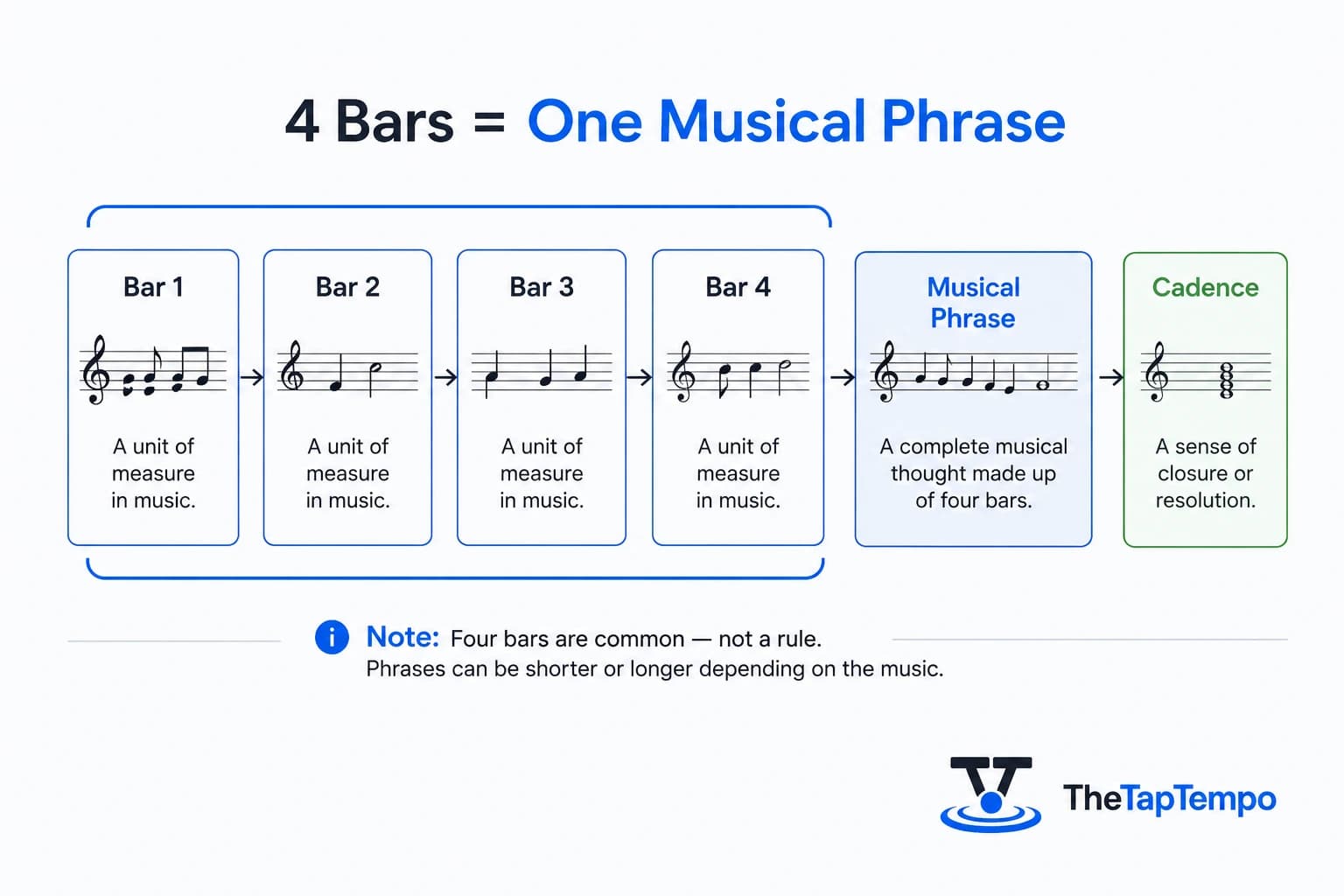
A bar holds the beats, but a phrase holds the meaning. A musical phrase is a group of one or more bars that expresses one complete musical idea, the equivalent of a sentence in language, and it ends at a point of resolution called a cadence. Understanding how phrases form from individual bars and measures changes how you read music, how you compose, and how you listen.
This guide breaks down how bars connect into phrases, why phrase length varies so much between pieces, and how cadences signal that a phrase has reached its ending point.
What Is a Musical Phrase?
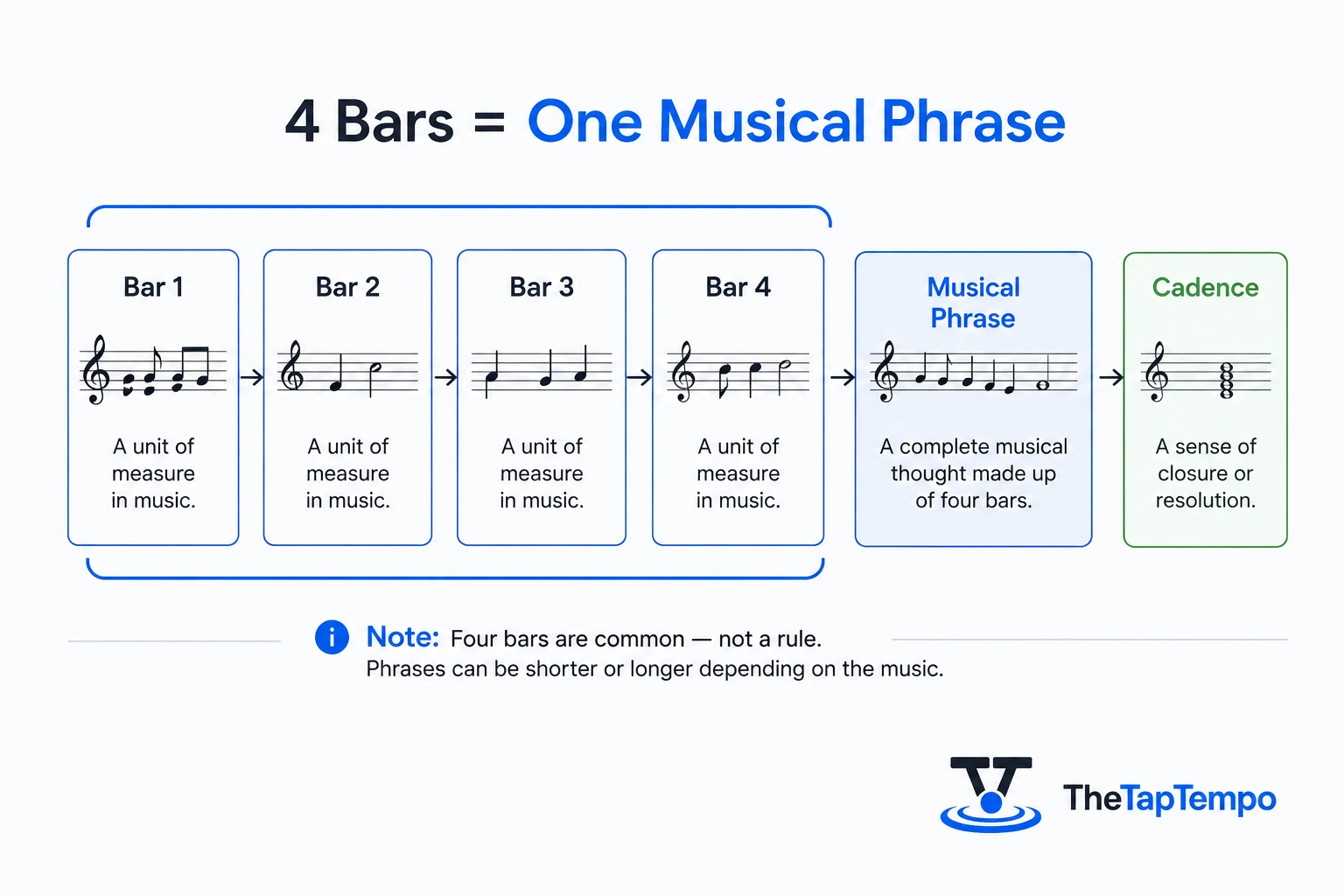
A musical phrase is a relatively complete musical thought that moves toward a point of arrival, often a cadence. It's the musical equivalent of a sentence: shorter fragments can exist inside it, but the phrase itself feels finished, even if the larger piece continues afterward.
Music theorists describe this in slightly different ways depending on their tradition, but the core idea stays consistent: a phrase is the smallest unit of music that carries a more or less complete musical thought, ending at a point of full or partial rest called a cadence. Some define it more broadly as any group of measures with some degree of structural completeness, but both agree on the essential point: a phrase is defined by its sense of arrival, not by a fixed number of bars.
Phrase vs. Bar and Measure
A musical phrase may span one or more bars, while a bar is simply a metric container for beats, marked off by bar lines. The bar is the building block; the phrase is the idea built from it. Two pieces can share the same time signature and tempo yet organize their bars into completely different phrase lengths.
Phrase vs. Motif
A motif is the smallest recognizable musical idea, often just one or two measures long, such as a short rhythmic or melodic fragment that a composer repeats and develops. A phrase is usually built from one or more motifs, but a motif on its own is too brief to feel like a complete musical thought.
Phrase vs. Phrasing
Musical phrasing is different again. Phrasing refers to how a performer shapes a phrase in real time, through dynamics, articulation, and subtle timing choices. This article is about phrase structure, the underlying architecture of the music itself, not performance technique.
How Bars Connect to Create Musical Ideas
A single bar rarely says much on its own. Musical meaning tends to emerge once several bars work together, building a line that has direction, tension, and eventually some kind of resolution.
Composers create that forward motion in a few consistent ways. Repetition is one of the most common: a short melodic or rhythmic figure appears, then reappears with only small changes, giving the ear something familiar to hold onto across multiple bars.
Variation works alongside repetition, taking that same figure and altering its pitch, rhythm, or contour just enough to keep the idea moving instead of feeling static.
Melodic direction matters too. A phrase often rises toward a high point before settling back down, or pushes away from a stable note before returning to it, creating a simple arc the ear can follow across the bars.
Underneath that melody, harmonic movement plays an equally important role. A chord progression that moves away from the tonic and eventually back toward it gives the listener a sense of departure and return that reinforces the phrase's shape.
None of this happens within a single measure. It's the combination of measures working together, each one building on the last, that turns a string of notes into something a listener recognizes as one musical idea. To grasp this relationship, you first have to look at what happens inside a single bar, which is covered in more depth in Why Music Is Divided Into Bars.
How Composers Build a Musical Phrase
Composers rarely start with a finished phrase. They start with something much smaller and build outward from there.
The typical starting point is a motif, a compact musical idea, usually one to two measures long, distinctive enough to be recognized when it returns. From that motif, a composer often develops a slightly longer basic idea, then repeats or answers it with a second idea that continues the thought.
This combination, an opening idea followed by repetition or continuation, typically fills the first half of a phrase.
The second half usually intensifies the musical activity. This might mean shortening the rhythmic values, increasing harmonic movement, or fragmenting the original motif into smaller pieces that push the music toward its cadence.
This build-up of tension right before resolution is a defining feature of how a phrase reaches its ending point.
Bach's Minuet in G Major, a simple keyboard piece often used to teach phrase construction, shows this pattern clearly. Its opening phrase grows from a short two-bar melodic idea, repeated and extended into a complete four-bar unit that settles at a clear cadence before the next phrase begins. Whether you're analyzing a piece like this or writing an original melody, the underlying pattern tends to hold: a small idea appears, develops, and is pushed toward closure.
Why Phrase Length Varies Between Pieces
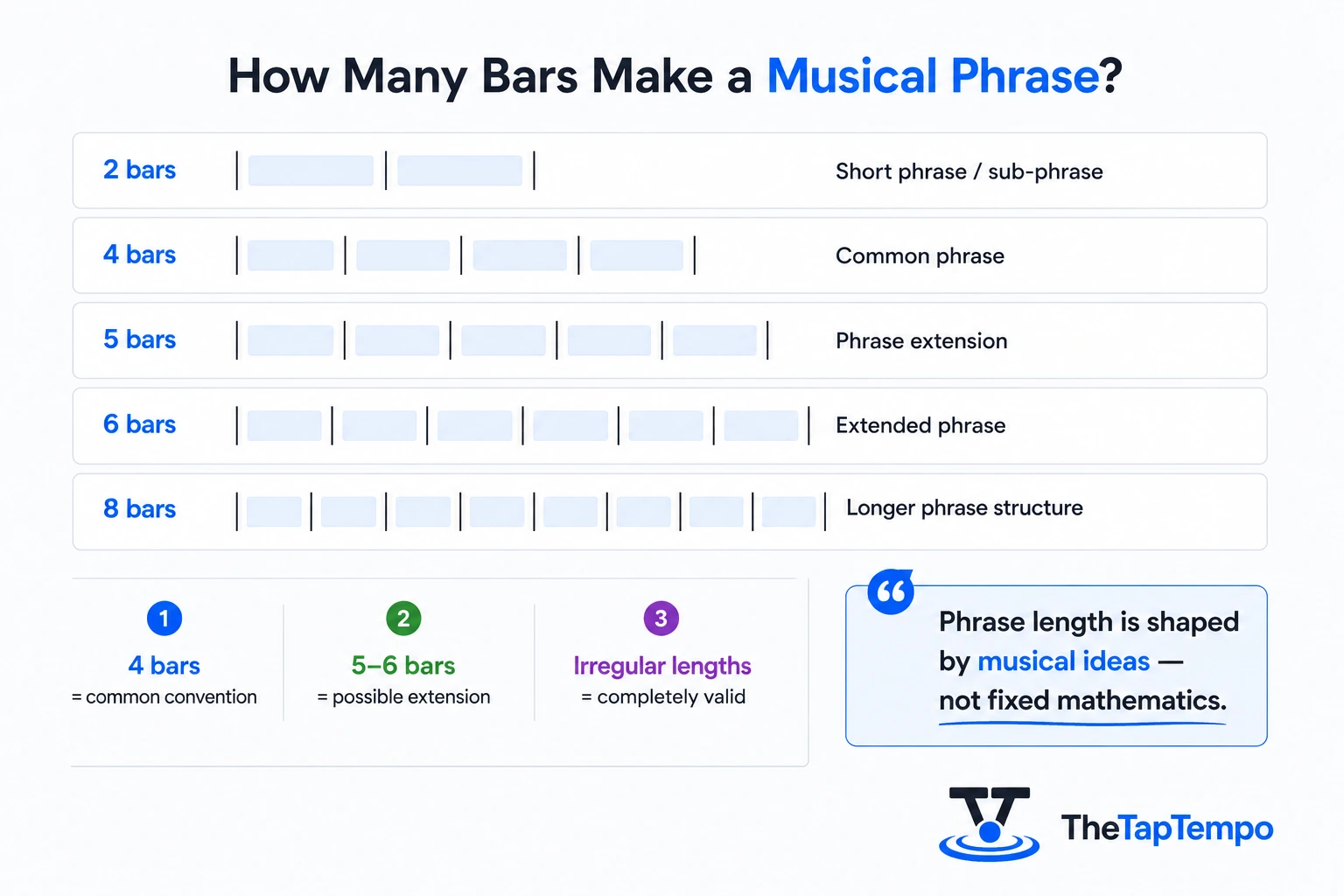
A four-bar phrase is common in Western tonal music, but it is a convention, not a rule. Plenty of well-known music uses phrases of two, three, five, six, eight, or even irregular lengths, and understanding why requires looking past the idea that phrase length is fixed math.
Common Phrase Lengths
Two-bar phrases can appear as short sub-phrases within longer ideas, while four- and eight-bar structures are especially common in many Western tonal and popular-music contexts. Four-bar phrases are the most familiar length in Classical-era music, folk melodies, and much of popular songwriting, largely because pairing two-bar groups into a four-bar unit creates a natural sense of balance that listeners have come to expect.
The well-known folk melody “Twinkle, Twinkle, Little Star” is a textbook example: its opening line forms a four-bar phrase that pauses on an unresolved harmony, answered by a second four-bar phrase that closes the idea firmly, together forming an eight-bar unit. “Greensleeves” builds on the same principle at a larger scale, stringing together four-bar phrases into a longer, flowing melodic form rather than repeating one short idea over and over.
Irregular Phrase Lengths and Phrase Extension
Once you start listening for it, irregular phrase length shows up throughout the repertoire. A phrase might extend to five or six bars because the composer adds extra measures before finally reaching the cadence, a technique known as phrase extension. Some well-known popular melodies work this way; analysts have pointed to songs such as The Beatles' “Eleanor Rigby” and Elton John's “Goodbye Yellow Brick Road” as examples that use five-bar phrase units rather than the more expected four, often to fit a lyric line naturally.
In the opposite direction, phrase contraction happens when two phrases overlap so that the ending of one phrase doubles as the beginning of the next, a device called elision. Elision appears in Mozart's Symphony No. 40, where the ending of one phrase overlaps with the beginning of the next, effectively “stealing” a measure. Both techniques let composers avoid the predictability of rigid four-bar blocks while still creating music that feels structurally sound.
The reason four-bar phrasing feels so natural has more to do with listener expectation than any strict musical law. This duple grouping (2 + 2 = 4) feels natural in Western tonal music, and listeners have come to expect cadence or closure after four measures. But this is a convention shaped by centuries of musical practice, not a universal law, and composers break it whenever the musical idea demands it.
The Role of Cadences in Ending a Phrase
Regardless of whether a phrase is four bars, five bars, or irregular, it needs a clear ending point. That point is called a cadence, the musical event that signals a phrase has arrived somewhere, whether that's a full stop or a pause before the next idea continues. Cadence in music functions the way punctuation functions in a sentence: it tells the listener whether the thought is finished or whether more is coming.
Cadences generally fall into two broad categories. Conclusive cadences resolve strongly, giving a clear sense that the phrase has ended. Inconclusive cadences resolve more weakly, leaving the music sounding open and pointing forward to what comes next. This distinction often separates a “question” phrase from an “answer” phrase, a relationship explored further below.
Types of Cadences
A few cadence types appear often enough in phrase endings to be worth knowing by name. An authentic cadence moves from the dominant chord back to the tonic and is the strongest, most conclusive way to end a phrase. A half cadence stops on the dominant chord instead of resolving to the tonic, leaving the phrase sounding unfinished, which makes it common at the end of a first, question-like phrase.
A plagal cadence moves from the subdominant to the tonic, familiar from the “Amen” sung at the end of many hymns. A deceptive cadence sets up the expectation of resolving to the tonic but shifts to a different chord instead, creating a moment of surprise.
| Cadence Type | Chord Movement | Example (Key of C) | Sound |
|---|---|---|---|
| Authentic | V → I | G → C | Finished/Strong |
| Half | Ends on V | G (stops) | Suspended/Question |
| Plagal | IV → I | F → C | Amen/Church-like |
| Deceptive | V → vi | G → Am | Surprise/Twist |
Not every chord change marks a phrase boundary. Harmony shifts constantly within a phrase without signaling its end. What defines a true cadence, and therefore a genuine phrase boundary, is the specific combination of harmonic motion, melodic resolution, and rhythmic pacing arriving together at a point of relative rest.
How to Recognize Musical Phrases in Sheet Music
Spotting phrase boundaries gets easier once you know what clues to look for, and none of them require advanced theory to notice.
Cadences are the clearest signal. Watch for a moment where the harmony settles, especially where it resolves to the tonic or pauses on the dominant, since this is where most phrases naturally end.
Melodic repetition offers another clue: when a melody suddenly returns to a figure heard earlier, that return often marks the start of a new phrase rather than a continuation of the previous one.
Longer note values and rests are also reliable markers. A held note or brief silence frequently appears right at a phrase's end, functioning almost like a breath, which is exactly what it represents in vocal and wind music where performers need a moment to inhale before the next phrase.
In notated music, phrase marks, curved lines drawn over a group of notes, sometimes indicate this directly, showing the performer where one idea ends and the next begins.
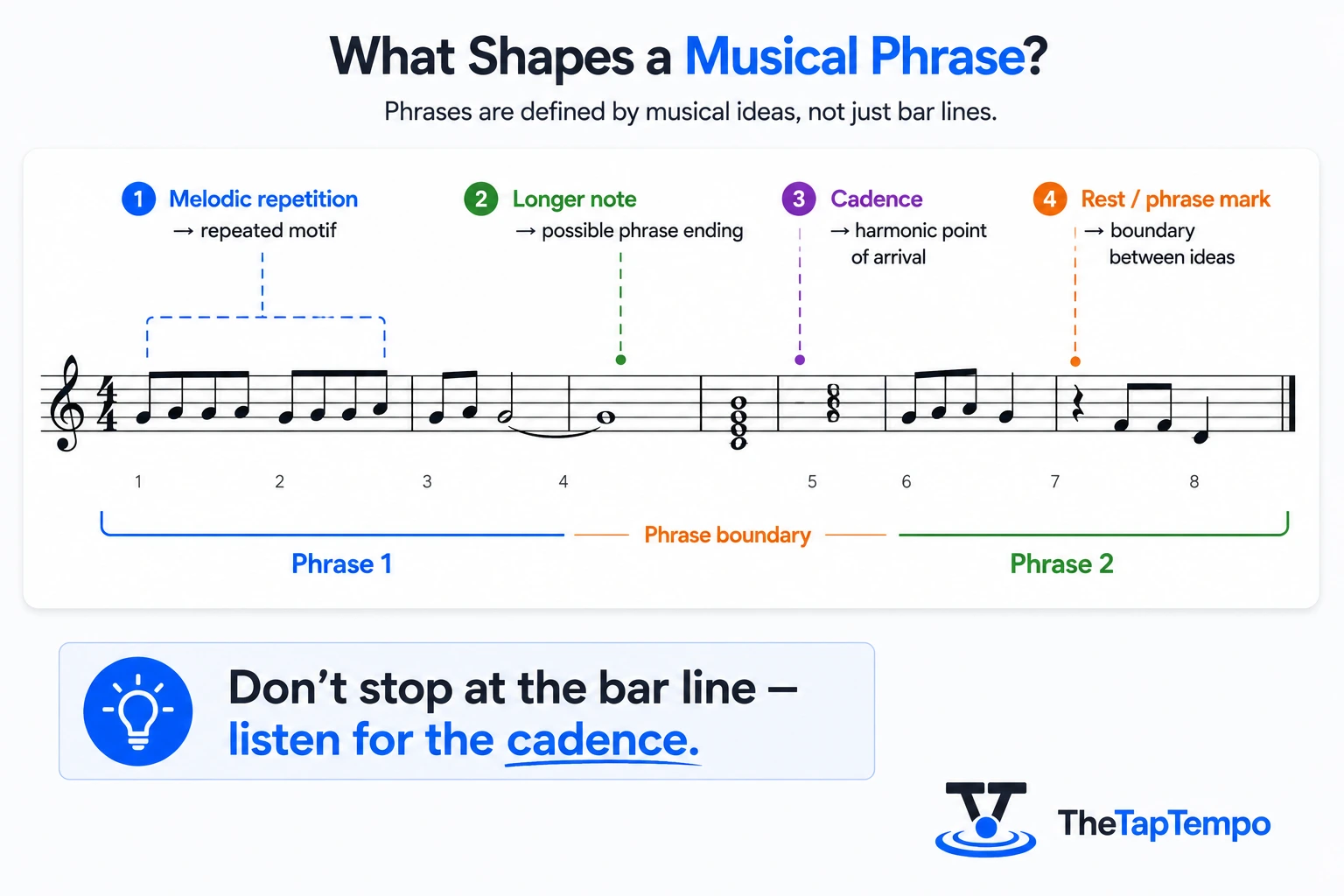
Harmonic movement matters here too. Tracking where the chords are heading, toward the tonic for a strong ending or toward the dominant for a suspended one, will usually tell you more about phrase structure than the bar lines alone. That last point is worth emphasizing: bar lines organize beats, but they don't automatically mark where a phrase ends. Learning to listen past the bar lines, toward the cadence and melodic shape underneath them, is what separates true phrase recognition from simply counting measures.
How Phrases Combine Into Larger Musical Structures
Once you can identify individual phrases, the next step is understanding how they connect to form larger musical units.
Antecedent and Consequent Phrases, and the Period
A period forms when two phrases work together in a question-and-answer relationship. The first phrase, called the antecedent phrase, typically ends with a weaker, inconclusive cadence such as a half cadence, leaving the music sounding unresolved. The second phrase, the consequent phrase, usually opens with the same or a closely related melodic idea, then pushes forward to a stronger, conclusive cadence such as an authentic cadence.
Mozart's “Andante” from Piano Concerto No. 21 is frequently used to demonstrate this pairing, with its opening melody built from an antecedent phrase that pauses on a half cadence, answered by a consequent phrase of matching length that closes firmly on an authentic cadence. Together, the two phrases form a balanced period that many listeners recognize instinctively, even without knowing the formal terms for it.
Musical Sentences and Phrase Groups
A musical sentence works a little differently. Rather than pairing two similar phrases, a sentence presents a basic idea, repeats it once, and then moves into a continuation section that speeds up the harmonic rhythm, fragments the original motif, and drives toward a single cadence at the end. Where a period feels like two balanced halves answering each other, a musical sentence feels more like one continuous idea gradually accelerating toward its conclusion.
Occasionally, composers write phrase groups: three or more phrases that follow one another without forming a clean antecedent-consequent pairing. These structures still rely on the same building blocks, motifs developing into phrases and phrases reaching cadences, but they combine more freely than a strict period or sentence.
Musical phrases don't exist in isolation. They're the connective tissue between the smallest musical ideas and the larger sections that make up a complete piece, whether that's a Classical-era minuet or a modern pop chorus.
Continue Learning
Phrase construction builds directly on how bars themselves are organized. If you haven't already, Why Music Is Divided Into Bars is a useful starting point for understanding the foundation this article builds on. From there, Understanding Strong and Weak Beats explains the internal rhythmic organization that shapes how motifs and phrases feel as they unfold across each bar.
To navigate longer works precisely, Measure Numbers in Music explains how measures are numbered for rehearsal, analysis, and reference across a score.
Recognizing how musical phrases form from bars and measures changes the way you read and listen to music, turning strings of notes into ideas with real shape and direction. When you're ready to analyze the beats within a measure, try the Beats Per Bar Calculator to see how beats are organized before studying how those measures combine into musical phrases.
This article has been researched, written, and reviewed according to our Editorial Policy.
Frequently Asked Questions
Common questions about finding the BPM of a song.