
Measure Numbers in Music: Why Bars Matter During Rehearsals
Learn what measure numbers in music are, why conductors call out bar numbers, and how orchestras, bands, and choirs use them to navigate scores fast.
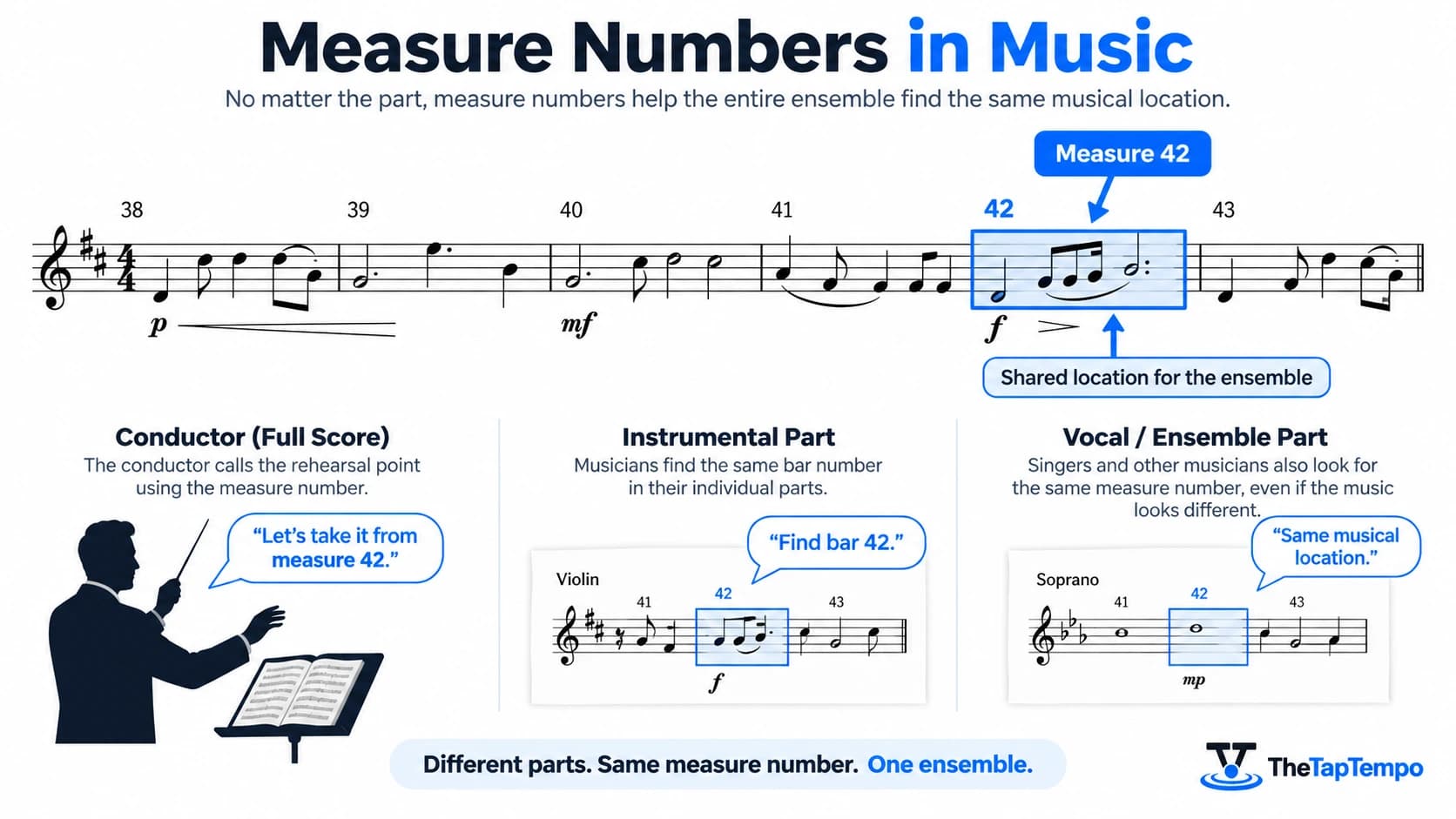
A conductor raises a hand and says, “Let's take it from measure 42.” Within seconds, musicians holding different parts and pages are looking at the same spot in the music. The number often gives the ensemble a shared location, without anyone needing to describe a note, a lyric, or a page.
That small moment depends on a system most musicians learn early and think about rarely: measure numbers in music. They turn a stack of individual parts into a document that a room full of people can navigate together during a rehearsal.
This article looks at why that system exists, how conductors and performers rely on it, and how it differs from the related but distinct idea of rehearsal marks.
How Measure Numbers Help Musicians Stay Together
Measure numbers exist so that musicians in an ensemble can find the same location in the music without describing notes, lyrics, or page numbers aloud. A number printed above a bar provides a stable reference within that score, whether you're reading a full score, an instrumental part, or a vocal line.
That consistency depends on the numbering matching across every version of the music in the room. A conductor's full score and a player's individual part are laid out differently: different page breaks, different line spacing, sometimes different transpositions.
If measure 42 in the score lines up with measure 42 in the part, the instruction “from 42” still points to the same place for everyone. Orchestral preparation guidance treats this alignment as a basic requirement of usable performance materials, since a score and its parts are meant to communicate the same information to every musician reading them.
This matters more in ensemble settings than in solo practice. A pianist working alone can simply say, “that part where the melody comes back.” An ensemble usually can't rely on that kind of description, since dozens of musicians are reading different instruments, different clefs, and sometimes different keys. A shared numbering system removes the need to translate an instruction across all of that.
In rehearsal, this shows up constantly. A conductor stops mid-phrase, calls out a bar number, and the room resets around a shared point of reference. A reliable numbering system is part of what allows a rehearsal to move forward smoothly, rather than losing time to confusion about where to start again.
Why Conductors Refer to Bars Instead of Lyrics or Notes
Conductors often use bar numbers because they are less ambiguous than descriptions that may repeat. A word like “forte” or a lyric like “the light” might appear more than once in a piece, so referring to them alone can leave room for a musician to land on the wrong occurrence.
Consider a choir rehearsal. If a director says, “Let's go back to where it says 'in the morning,’” and that phrase appears in two verses, part of the choir may turn to the wrong place.
If the director instead says, “Sopranos, begin at measure 27, right after the piano introduction,” the instruction points to one specific measure, regardless of which verse a singer might have been thinking of.
This doesn't mean conductors avoid describing the music. Many instructions still combine a bar number with a lyric, an entrance, a rehearsal mark, or a general description, “two bars before the crescendo, at measure 42,” for example. Conductors frequently pair a bar number with a tempo instruction as well, telling the ensemble not just where to start, but at what speed, a combination covered in more detail in our guide to tempo markings.
Bar Numbers vs Rehearsal Marks: What's the Difference?
Bar numbers and rehearsal marks both help musicians navigate a score, but they serve different purposes.
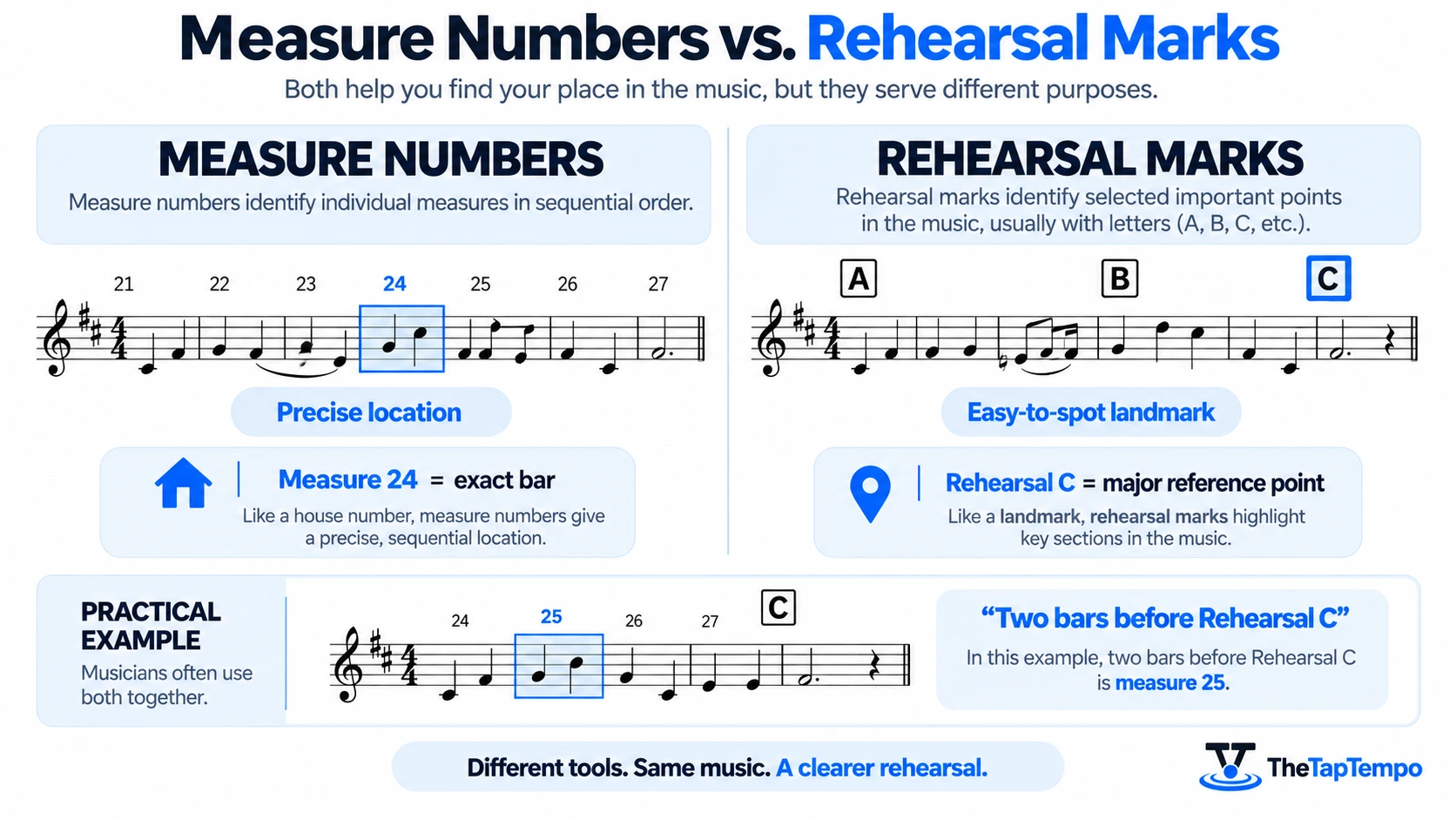
A bar number identifies a specific, individual measure as part of a sequential numbering system, even though not every number in that sequence is necessarily printed. A rehearsal mark, often a letter, a number, or another visible label, highlights a selected point that stands out at a glance, usually at an important structural, musical, or rehearsal moment such as a new section, a tempo change, or a significant entrance.
Measure numbers work like addresses in a numbered street: the sequence provides precise locations, even when only some numbers are printed on the page. Rehearsal marks work more like a neighborhood landmark, easier to spot from a distance, but only marking a handful of locations, not every one.
In practice, the two systems are often used together. A conductor might say, “Two bars before rehearsal C,” combining an easy-to-spot landmark with a precise offset. This pairing is common in orchestral preparation, since the landmark helps a musician find the general area quickly, and the number pinpoints the exact bar once they're there.
For a performer, the practical takeaway is simple: rehearsal marks are useful for finding the right general area, and measure numbers are useful for confirming the intended bar within that score or edition. Reading both together tends to make score navigation more reliable than relying on just one.
How Large Ensembles Navigate Long Scores Efficiently
Large ensembles rely on measure-number placement and multi-measure rest labeling to help musicians track their place through long stretches of music, especially during passages where they aren't playing.
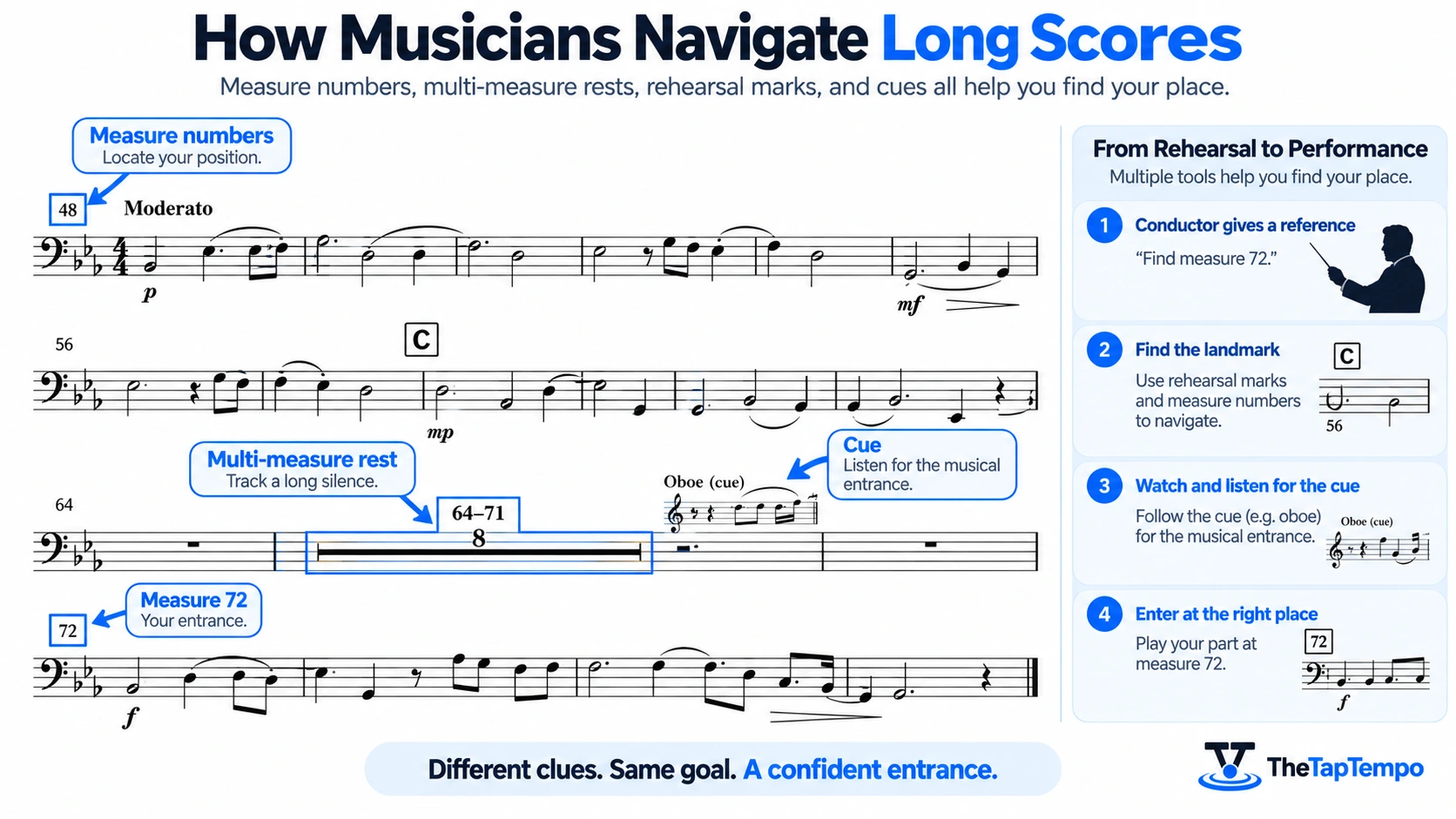
One common convention in professional orchestral preparation is to print measure numbers at the beginning of each system, although some scores omit the number from the first system of a movement or use another layout. This keeps the page less cluttered while still giving a performer a reference point at regular intervals across the piece. Placement can still vary by publisher, engraver, or notation software, so it's worth treating this as a widely used practice rather than a fixed rule every score follows identically.
Long rests present a particular navigation challenge. A player may have many measures of silence before an important entrance. Rather than requiring the performer to count silently through every bar, some scores show a measure-number range beside a multi-measure rest. The range identifies the span of silence and helps the performer locate the upcoming entrance. Exact formatting of these ranges can differ from one score or notation program to another.
Professional parts may also include cues, small excerpts of another instrument's or voice's material printed during a long rest, so a resting player can listen for a specific musical event rather than relying on counting alone. Whether a given part includes cues depends on the edition and the preparation standards used for that score. Where cues are present, the rest range, the cue, and the nearest measure number or rehearsal mark together give a musician several ways to confirm they're entering at the right spot.
Choir rehearsals add another layer, since singers are often reading a vocal line together with a piano reduction rather than a full orchestral texture. Here, measure numbers can help a director address one voice part at a time. In one rehearsal, a director might say, “Sopranos from measure 27, altos join at measure 31,” so each section knows exactly where to enter.
Concert bands use a similar approach to isolate individual sections. A conductor might say, “Woodwinds from measure 16,” or “Brass and percussion from measure 40.” In both cases, the measure number identifies the location, while the section name identifies who should play. Every musician in the band can check the same bar in their own part, whether or not they're the ones playing at that point. These are illustrative examples; the exact wording and workflow a conductor uses will vary between ensembles.
Common Beginner Mistakes When Following Measure Numbers
Assuming the number describes the music
A measure number identifies location; it does not explain the rhythmic content of the measure. Treat finding the bar and interpreting what is inside it as two separate tasks.
Confusing rehearsal marks with measure numbers
A student told to “go to letter C” may search for a number instead, or vice versa. Since both systems can appear close together on the page, check which one an instruction refers to before searching.
Assuming every measure must display a printed number
Many scores only print numbers at the beginning of selected systems, so a missing number above a given bar is expected, not an error. If you can't find a number where you expect one, look back to the most recent printed number and count forward.
Misreading pickup-measure numbering
A pickup, or anacrusis, is an incomplete opening measure that comes before the first full bar of a piece. Measure numbering commonly begins with the first complete measure. However, editions and notation systems may handle pickup numbering differently, so follow the numbers shown in your own score or part, and confirm with the conductor if a number seems off by one.
Assuming numbering always continues across movements
Some scores restart measure numbering at the beginning of each new movement, while others number straight through the entire work without resetting. Neither approach is universal, so check which system a particular score uses rather than assuming it matches the last piece you played.
Continuing to play from the wrong location when a score and part disagree
If a conductor's called number doesn't match what's printed in your part, stop and verify rather than guess. A short verification process is usually faster than continuing to rehearse from the wrong place:
- Identify the correct movement or section.
- Find the nearest rehearsal mark or other visible landmark.
- Locate the nearest printed measure number.
- Count forward or backward to the requested bar.
- Confirm the surrounding lyric, cue, entrance, or musical event.
- Check that the part and conductor's score use the same edition or numbering convention.
Piano students run into a smaller-scale version of the same situation. A teacher might say, “Let's look again at measure 9, where the melody returns,” and the student uses the printed number to return to that exact spot rather than searching by ear or by general area of the page. Edition mismatches are less common in piano study, since there's usually one player and one part, but confirming the number against the surrounding music is still a useful habit, especially if a student is working from a different edition than the teacher.
Understanding Musical Organization Beyond Beat Counting
Measure numbers help musicians find a location in the music, not what happens inside it. Readers who want to look more closely at how a measure's beats are organized can use our Beats Per Bar Calculator.
Continue Learning
- Why Music Is Divided Into Bars
- How Musical Phrases Are Built from Bars
- Strong and Weak Beats in Music
- Understanding Tempo Markings in Performance
Bars don't just organize music; they help musicians communicate accurately during rehearsals. Use our Beats Per Bar Calculator to better understand how each measure is structured before reading more complex scores.
This article has been researched, written, and reviewed according to our Editorial Policy.
Frequently Asked Questions
Common questions about finding the BPM of a song.