
Why Music Is Divided Into Bars Instead of Continuous Rhythm
Learn why music is divided into bars and measures, how bar lines evolved, and why they remain essential for rhythm, notation, and performance.
Quick Answer
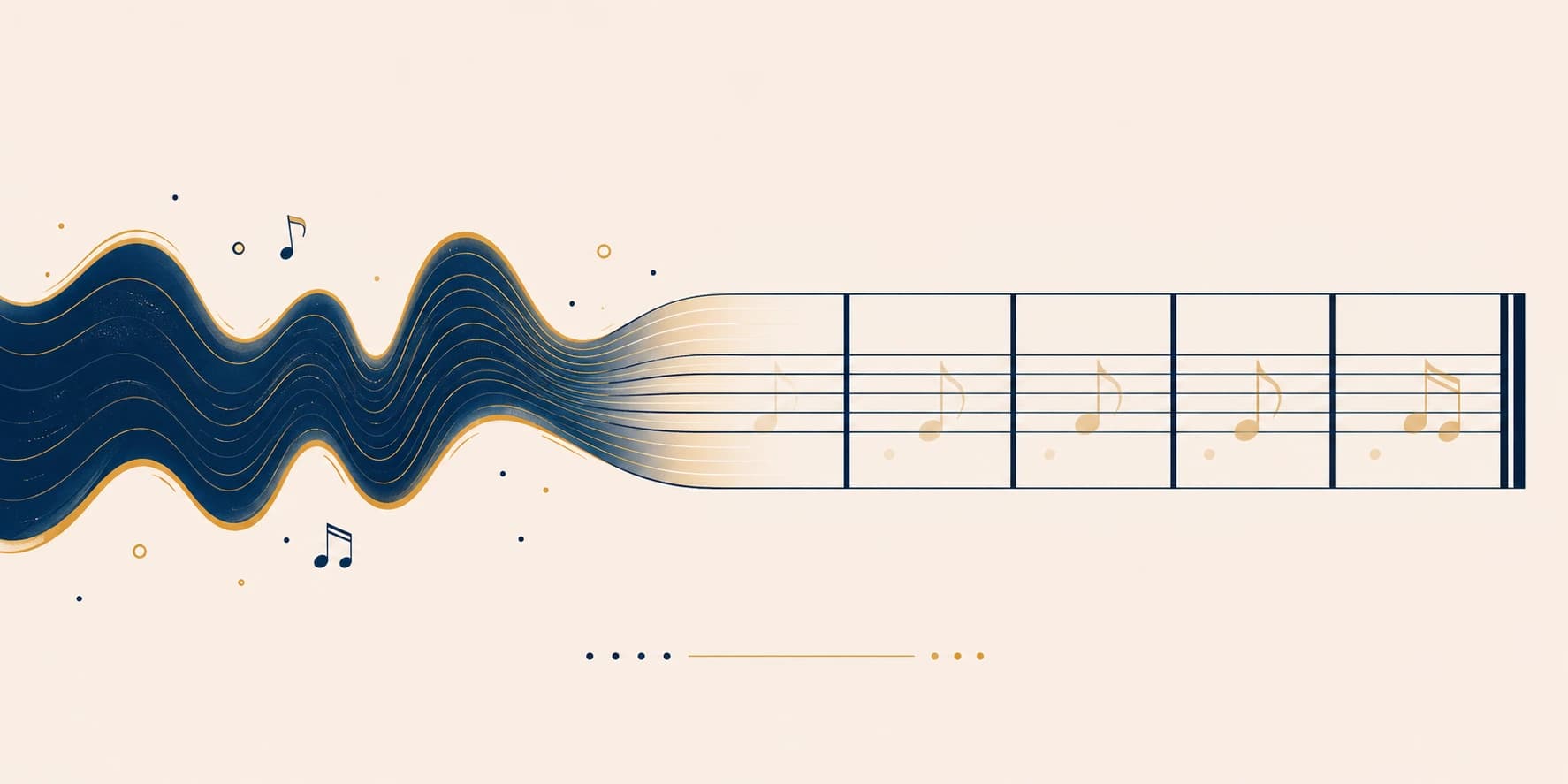
Music is divided into bars and measures because organizing continuous rhythm into equal, repeatable units makes it possible for multiple musicians to read, rehearse, and perform together reliably. Before bar lines existed, rhythm relied on memorized tradition and note shapes, which worked for solo singers but broke down when composers wrote independent parts for ensembles. Bar lines standardized during the Baroque period solved this by giving every performer a shared visual reference for staying aligned.
Key Takeaways
- Bars break continuous rhythm into small, equal, repeatable units that musicians can process quickly.
- Bar lines evolved from inconsistent Renaissance markings to a standardized system tied to time signatures in the Baroque era.
- Ensembles depend on bars to stay synchronized, communicate during rehearsals, and align independent parts on the page.
- The same bar-based logic appears in songwriting, studio session charts, and modern music production software.
Open almost any piece of sheet music, and one thing stands out before you even read a single note. Vertical lines run down through the staff, slicing the music into small, even segments. Those segments are bars, also called measures.
They're so common today that it's easy to forget they weren't always there. For most of music's early history, rhythm existed without them. So why did bars become standard, and why does nearly every piece of written music still depend on them?
The answer has less to do with counting and more to do with communication. Bars exist because music is rarely created or performed by one person working alone. Rhythm that isn't organized visually is very hard to share.
This article looks at where that organization came from, what problem it actually solves, and why it still matters every time musicians read, rehearse, or perform together.
Music Before Standard Bar Lines
Rhythm Without a Fixed Grid
In medieval and early Renaissance notation, rhythm worked differently than it does today. Composers used a system known as mensural notation, where the length of a note was shown through its shape and its relationship to nearby notes, rather than through a fixed grid of equal beats. There was no vertical line telling a singer exactly where one rhythmic unit ended and the next began.
For solo or unison singing, this system worked fine. Performers already knew the material, often through years of oral tradition, and the notation served mainly as a memory aid rather than a precise instruction manual.
The Limits of an Oral System
The limitations became obvious as music grew more complex. Once composers began writing independent parts for multiple singers or instruments performing at the same time, the absence of a shared visual reference point created real problems. Two voices could drift out of alignment with no built-in way to check or correct it, because nothing on the page marked where they were supposed to line up.
How Standardization Took Hold
Bar lines began to appear during the late Renaissance, though they were used inconsistently and often marked larger musical sections rather than equal rhythmic divisions. It wasn't until the mid-1600s, early in the Baroque period, that bar lines became standardized at consistent lengths and were tied directly to time signatures. Composers such as Bach and Handel used them as a routine part of notation, and from that point forward, regularly spaced bar lines became a fixed feature of written music.
| Before standardized bar lines | After standardized bar lines |
|---|---|
| Rhythm shown through note shape and context | Rhythm shown through equal, repeating units |
| Relied heavily on memorized tradition | Could be read accurately by unfamiliar performers |
| Difficult to align independent parts | Parts could be lined up vertically on the page |
| Hard to describe a specific location in a piece | Any location could be named precisely |

The shift wasn't about making music sound different. It was about making music possible to coordinate on paper, not only by ear.
How Bars Organize Musical Ideas
A bar takes a continuous stream of rhythm and divides it into small, repeatable units. Instead of tracking an unbroken sequence of note values from the first sound to the last, a performer can process rhythm in short, predictable chunks. Once a musician understands what fits inside one bar, that same understanding applies to every other bar in the piece.
Bars and Sight-Reading
This has a direct effect on how musicians actually read music. Sight-reading depends heavily on pattern recognition. A trained musician doesn't read note by note. They read in groups, often a bar or half a bar at a time. Bar lines give the eye a natural stopping and resetting point, which makes it far easier to anticipate what's coming next rather than reacting note by note in real time.
Musicians often use a metronome when practicing bar-based rhythms, helping them develop accurate timing and internalize how beats are grouped within each measure
Bars and Phrase Structure
Bars also help organize larger musical ideas. A melodic phrase often spans a specific number of bars, and composers intentionally use this structure to create balance, repetition, and musical expression. A question-and-answer phrase might occupy four bars followed by another four, creating a symmetry the listener can feel even without consciously counting anything. Without bars marking off these units, a printed score would be far harder to scan for that kind of structure.
Bars as a Compositional Tool
This organizational role extends into composition itself. Many composers think in bars as they write, sketching phrase lengths and structural sections using the bar as their basic unit, similar to how a writer thinks in sentences and paragraphs rather than individual words.
Why Bars Make Ensemble Performance Easier
The clearest practical benefit of bars appears the moment more than one musician has to perform together. A soloist can adjust to their own internal sense of timing without much external reference. An ensemble cannot, because every player needs a shared framework for staying aligned with everyone else.
Common Reference Points
If an ensemble loses synchronization mid-performance, whether from a memory slip, a missed entrance, or simple nerves, bars give everyone a way to re-anchor. A player who briefly loses their place can look at where the group is within the current bar and rejoin at the next one, rather than having no fixed point to return to at all.
Simplifying Rehearsal Communication
Rehearsals depend on quick, precise instructions. A conductor or section leader can say "let's take it from bar forty," and every musician in the room can locate that exact spot within seconds. Without bar numbers, the same instruction would require vague, time-consuming description, something like "the part after the loud section, just before the melody changes instruments."
Aligning Independent Parts
In orchestral or band writing, different instruments often play completely different rhythmic patterns at the same time. A cello line might sustain long notes while a flute line moves quickly through short ones. Bars let both parts sit on separate staves yet remain vertically aligned, so a conductor or player can see at a glance which notes are meant to sound together.
None of this changes how the music actually sounds. A well-performed piece would sound the same whether or not bar lines existed on the page. What changes is how reliably a group of independent musicians can produce that sound together, especially under the pressure of a live performance or a tight rehearsal schedule.

How Conductors, Teachers, and Performers Use Bar Numbers
Once bars became a fixed part of notation, numbering them was a natural next step. That numbering system has become one of the most practical tools in professional and educational music-making.
Conductors and Rehearsal Efficiency
Conductors rely on bar numbers constantly during rehearsal. Full orchestral scores are often printed with a bar number at the start of every line or every few bars, letting a conductor direct musicians to an exact location without describing the music in words. This matters especially in large ensembles, where dozens of musicians need to find the same spot at the same time, often while holding instruments and with no time to search through pages.
Professional Insight: During rehearsals, many conductors call out both a bar number and a rehearsal letter together, especially in longer works. The rehearsal letter gets the section quickly, and the bar number confirms the exact beat within it. It's a small habit, but it saves real rehearsal time when a full ensemble needs to restart in unison.
Teachers and Targeted Practice
Music teachers use the same system for a different purpose. When a student struggles with a passage, a teacher can isolate the exact bar, or a short group of bars, causing the difficulty, rather than asking the student to repeat an entire piece to fix one problem area. This turns practice into a targeted process instead of a repetitive one.
Performers and Memory Anchors
Performers use bar numbers as memory anchors, too. Musicians who perform from memory often build their internal map of a piece around bar groupings, mentally labeling sections by where they fall numerically. If a memory slip happens during performance, an experienced player can often recover by recalling which bar range they were in and reconstructing the music from that point.
Rehearsal Marks as Checkpoints
Rehearsal marks, often letters or numbers placed above specific bars in orchestral and band scores, extend the same idea. They act as larger checkpoints within a piece, usually placed at the start of a new section or a significant change in the music. A conductor can call out a rehearsal mark for major restarts, while still relying on precise bar numbers for anything more specific.
Why Modern Music Still Relies on Bar Structure
It would be reasonable to assume bar lines mainly matter for classical or notated concert music, but the same structural logic appears across nearly every style of written and recorded music today.
Songwriting and Structure
Songwriters still think in bars when building a song's structure, even if they never look at traditional notation. A verse might be described as a certain number of bars long, a chorus another number, and a bridge something different again. This shorthand lets musicians who have never met, working across different instruments and even different recording sessions, communicate structure clearly and quickly.
Studio and Session Work
Session musicians and studio engineers rely on bar-based thinking constantly. Charts used in recording sessions, sometimes called number charts, often organize a song's sections by bar count rather than full notation. This lets a group of musicians sight-reading an arrangement for the first time follow the structure accurately without needing every note written out.
Music Production Software
Music production software has adopted the same underlying concept. Recording and composition programs display bars as a visual timeline, letting a producer or composer see where sections begin and end at a glance. The visual logic mirrors exactly what bar lines have always done on paper: breaking a continuous flow of sound into organized, referenceable segments.
Across all of these contexts, the reason bars persist is the same reason they were introduced centuries ago. Music is rarely created or performed in isolation. Any activity involving multiple people working together benefits from a shared structural reference, and bars remain one of the simplest and most effective tools for creating that reference.
Understanding Musical Structure Before Counting Beats
Once you understand why bars exist, the next natural question is what actually happens inside one. Every bar contains a specific number of beats, and that number is determined by a piece's time signature. This is where the concept of a bar moves from structural theory into practical counting.
Different meters organize beats within a bar in different ways, which affects how a piece feels rhythmically and how a musician counts along while playing or conducting. Tempo markings work alongside time signatures by indicating how fast a piece should be performed, giving musicians additional context beyond the number of beats contained in each bar.
Understanding this next layer is essential for actually performing music accurately, not just recognizing why bars exist in the first place.
Once you're ready to explore how different time signatures organize beats within each measure, our Beats Per Bar Calculator makes it easy to see exactly how many beats belong in a bar for any given meter, and how that structure translates into counting and performance.
Continue Learning
- Why the Same Tempo Marking Can Sound Different in Different Performances
- Delay vs Reverb: Which Effect Should You Use and When?
- Understanding Note Values: Why Quarter, Eighth, and Triplet Delays Sound Different
- How to Choose the Right BPM Before You Start Recording a Song
- Measure Numbers in Music
Bars are the foundation of written musical organization. Once you understand why they exist, use our Beats Per Bar Calculator to explore how different musical meters organize beats within each measure.
This article has been researched, written, and reviewed according to our Editorial Policy.
Frequently Asked Questions
Common questions about finding the BPM of a song.