
Understanding Strong and Weak Beats in Music
Learn why some beats in music feel stronger than others. Explore downbeats, upbeats, and beat hierarchy with real musical examples.
Quick Answer
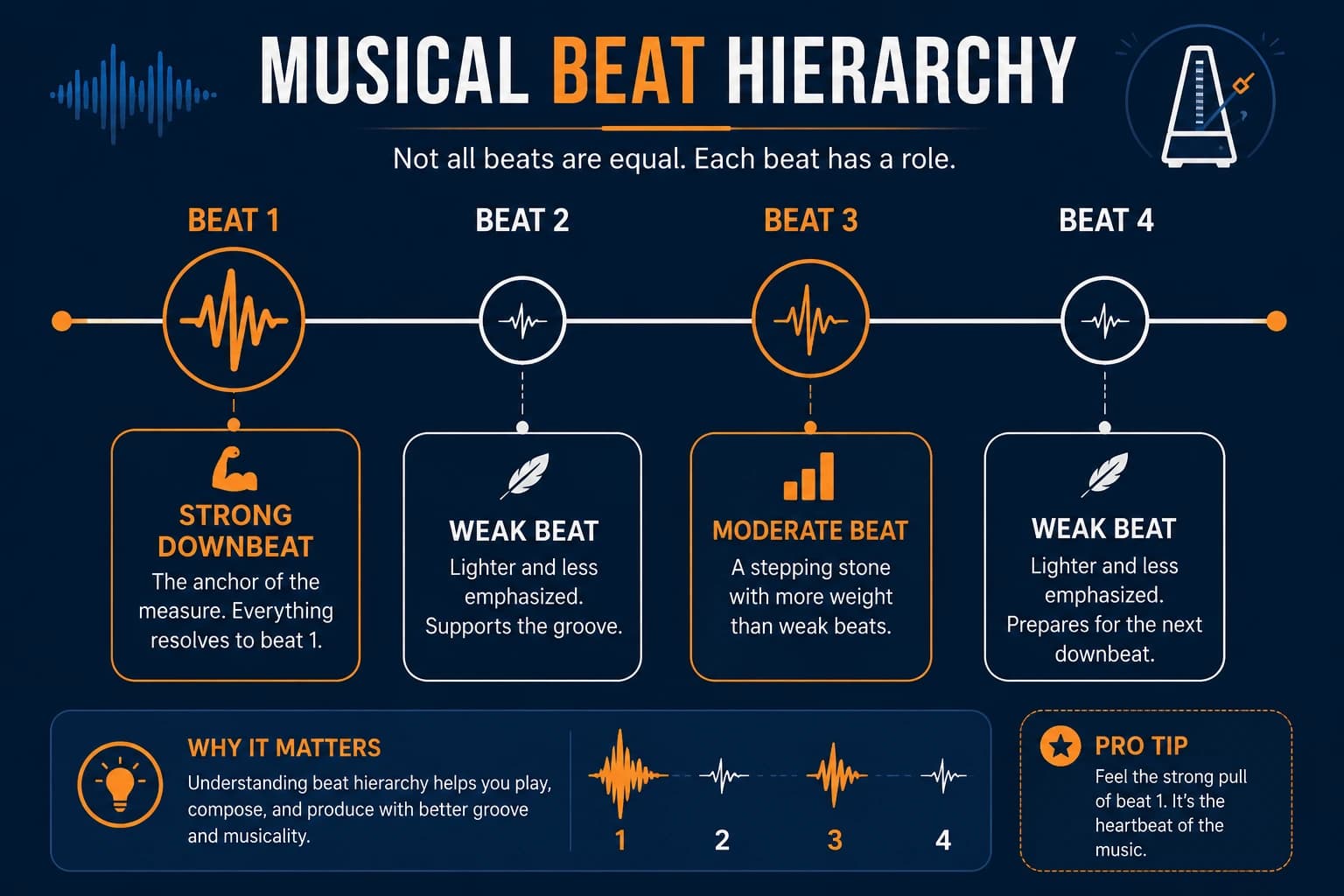
Strong beats feel emphasized because they mark the start of a rhythmic grouping, while weak beats feel like they are leading toward that point. This happens through metrical position, not just volume.
Key Takeaways
- Strong beats mark the beginning of rhythmic groupings; weak beats provide forward motion.
- Beat hierarchy follows predictable patterns: strong-weak-medium-weak in 4/4, strong-weak-weak in 3/4.
- The downbeat is the strongest beat; the upbeat creates anticipation leading into it.
- Composers and performers use beat emphasis deliberately to shape phrasing, tension, and groove.
Close your eyes and tap along to almost any song, and you will notice something strange. Not every tap feels the same. Some beats land with weight, almost demanding attention, while others slip by lightly, barely noticed. This is not an accident of performance. It is one of the most fundamental organizing principles in music: the difference between strong and weak beats.
Every rhythm you have ever felt, from a military march to a slow waltz to a pop chorus, is built on this hidden hierarchy. Musicians rely on it instinctively, conductors shape it with their hands, and listeners respond to it even without knowing why. This article explains where that feeling comes from, how it shapes musical phrasing, and why performers pay such close attention to it.
What Makes One Beat Feel Stronger Than Another?
A beat feels strong when it receives natural emphasis within a repeating rhythmic pattern, usually because it marks the beginning of a new grouping of beats. This emphasis is not always loud. It can come from timing, phrasing, harmonic change, or simply where the beat sits inside the pattern.
The Role of Metrical Accent
According to standard music theory practice, this pattern of emphasis and de-emphasis is called metrical accent, and it exists independently of how forcefully a note is actually played. A note can be metrically strong while being played softly, and a note can be metrically weak while being played loudly. The two ideas are related, but they are not the same thing.
How the Ear Anchors to Beat One
Think about counting "1, 2, 3, 4" while listening to a song. Most listeners naturally feel beat one as the anchor point, the moment where the rhythmic cycle resets. Beats two, three, and four feel like they are moving toward that anchor rather than replacing it. This is not because beat one is played louder in every case. It is because the human ear organizes repeating patterns around a point of reference, and in Western music, that reference point is usually the first beat of the group.
Why Composers Rely on This Perception
Composers and arrangers use this natural perception deliberately. A chord change, a melodic leap, or a bass note often lands on a strong beat because that is where the listener's ear expects something meaningful to happen. Weak beats, by contrast, are often used for connective material such as passing notes, quieter harmonies, or rhythmic anticipation that builds toward the next strong beat.
This relationship between strong and weak beats is sometimes described using the term musical pulse, which refers to the steady, repeating sense of time that underlies a piece of music. Strong and weak beats give that pulse shape. Without this hierarchy, a series of evenly spaced clicks would feel mechanical rather than musical, which is part of why even a simple metronome click can start to feel like it has "groups" once a musician begins playing along to it. If you want to build this instinct directly, you can practice feeling strong and weak beats while keeping a steady pulse using a metronome, letting the even clicks become a backdrop against which your own sense of hierarchy takes shape.
Downbeats, Upbeats, and Natural Beat Hierarchy
The downbeat is the strongest beat in a musical grouping, almost always the first beat, and it functions as the point where a musical phrase or measure feels most resolved. The upbeat, often the beat immediately before the downbeat, functions as a point of anticipation that pulls the listener forward into that resolution.
What Downbeats and Upbeats Actually Do
Together, these two roles create the push and pull that gives rhythm its sense of motion. The downbeat feels like arrival. The upbeat feels like preparation. Neither one works the same way without the other, which is why musicians almost always describe them as a pair rather than as separate, unrelated ideas.
How Conductors Make Hierarchy Visible
Conductors physically demonstrate this hierarchy every time they lead an ensemble. In a standard four-beat conducting pattern, the downward motion on beat one is deliberately more emphatic than the smaller gestures used for beats two, three, and four. Beat four often involves an upward preparatory motion, which is why many musicians associate the upbeat with a feeling of "lifting into" the next downbeat rather than settling into place.
Strong-Weak Patterns Across Different Meters
Not every beat in a bar carries equal weight, and beat hierarchy typically follows a predictable pattern depending on how many beats are grouped together.
| Beat Position | Typical Strength | Common Role |
|---|---|---|
| Beat 1 | Strongest | Downbeat, point of arrival |
| Beat 2 | Weak | Connective motion |
| Beat 3 | Moderately strong | Secondary accent (in groups of 4) |
| Beat 4 | Weak, often anticipatory | Leads back to beat 1 (upbeat) |
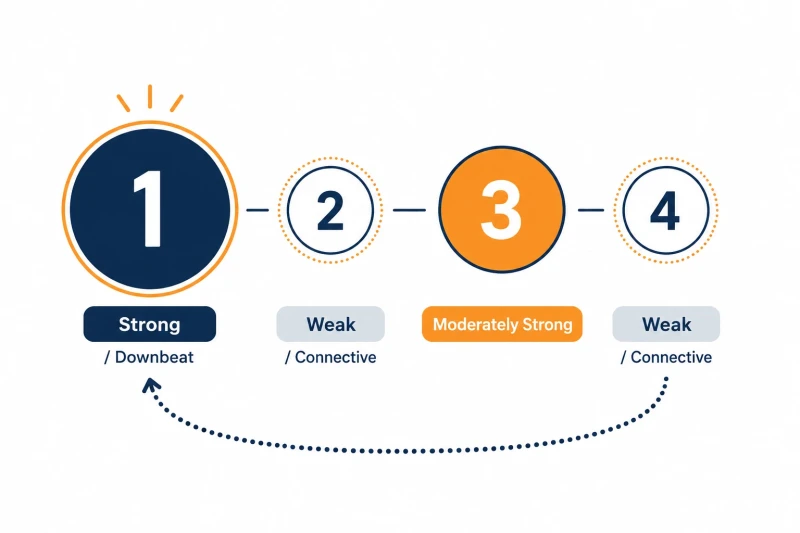
Quick Answer: The downbeat is the strongest beat and usually starts a grouping, while the upbeat leads into it. Beat hierarchy is not random. It follows predictable patterns of strong, weak, and moderately strong positions.
This pattern is why a four-beat grouping is often felt as strong-weak-medium-weak rather than four identical pulses. A three-beat grouping, such as the pattern found in a waltz, follows a different hierarchy: strong-weak-weak, which is part of why waltzes have such a distinctive, circular feeling compared to marches.
Hierarchy Exists Even Without Emphasis
It is worth noting that beat hierarchy exists whether or not a performer deliberately emphasizes it. Even in a passage played at a completely even volume, listeners will still perceive certain beats as structurally stronger, simply because of their position within the repeating pattern. Performers who understand this can choose to reinforce the natural hierarchy or intentionally work against it for expressive effect, a technique explored further in the next section.
How Strong Beats Shape Musical Phrases
Musical phrasing depends heavily on where strong beats fall, because listeners use those beats as reference points to understand where a phrase begins, develops, and resolves. A phrase that consistently arrives on strong beats feels grounded and predictable, while a phrase that deliberately avoids or delays those strong beats can feel suspended, urgent, or unresolved.
Strong Beats as Points of Arrival
Consider a simple example. In a four-beat pattern, a melody that lands its most important note on beat one will feel settled and complete. The same melody, shifted so its important note lands on beat two or beat four instead, will feel like it is reaching for something, even if none of the actual notes have changed. This shifting of melodic weight away from the expected strong beat is one of the most common tools composers use to create tension.
Syncopation and the Weak-Beat Surprise
This is where the concept of syncopation becomes relevant, though this article focuses on beat emphasis rather than rhythmic notation itself. Syncopation happens when a normally weak beat, or a point between beats, receives unexpected emphasis. Genres such as jazz, funk, and reggae rely heavily on this technique, deliberately placing accents on weak beats to create the sense of groove that defines those styles. Without a clear underlying sense of strong and weak beats, syncopation would not work, because there would be no expected pattern to depart from in the first place.
Why Composers Balance Stability and Momentum
A useful way to understand this relationship is through a professional insight many arrangers apply instinctively: strong beats create stability, and weak beats create momentum. A phrase built entirely on strong beats can feel static after a while, which is why skilled composers intentionally route melodic motion through weak beats to keep the music feeling like it is moving somewhere. This is often the invisible difference between a phrase that feels alive and one that feels flat, even when the notes themselves are similar.
Quick Answer: Strong beats give phrases a sense of arrival and stability, while weak beats create forward motion and tension. Composers use this contrast deliberately to shape how a phrase feels, not just how it sounds.
Why Performers and Conductors Pay Attention to Beat Emphasis
Performers and conductors treat beat emphasis as a practical tool rather than an abstract theory concept, because it directly affects how an ensemble stays together and how a performance communicates feeling to an audience.
Beat Emphasis as a Practical Tool
A conductor's physical gestures exist specifically to make beat hierarchy visible, allowing dozens of musicians to align around the same strong and weak beats without needing to count out loud. This is one of the clearest real-world applications of beat hierarchy, since an entire orchestra can stay synchronized purely through shared awareness of where the strong beat falls.
How Conducting Patterns Reveal the Hierarchy
In an orchestral setting, the conducting pattern itself is built around this hierarchy. A four-beat pattern typically moves down for beat one, across to the left for beat two, across to the right for beat three, and up for beat four, with the downward gesture on beat one being the clearest and most decisive motion in the entire pattern. This is not stylistic flair. It is a functional signal that tells every performer exactly where the strongest point of the bar occurs.
Choir Directors and Solo Performers
Choir directors rely on the same principle, often exaggerating the preparatory upbeat gesture so singers can breathe and enter together precisely on the downbeat. Solo performers, including pianists and guitarists, use beat hierarchy internally even without a conductor, mentally reinforcing where the strong beats fall so that their tempo remains steady and their phrasing feels intentional rather than accidental.
Marches, Waltzes, and Backbeats in Practice
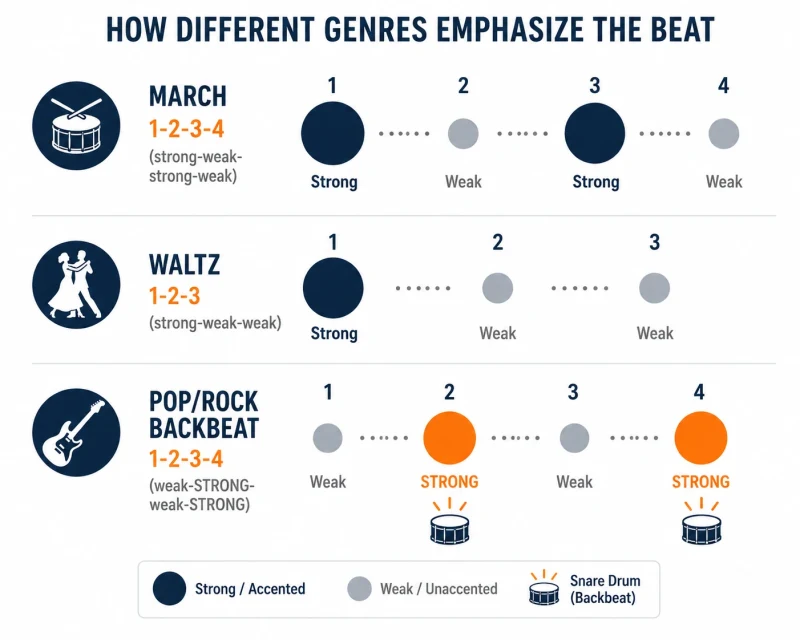
A practical example makes this clearer. In a military march, performers deliberately reinforce the natural strong beat with a firmer articulation, which is part of why marches feel so rhythmically confident and easy to walk to. In a slow waltz, performers often lean slightly into beat one while allowing beats two and three to feel lighter and more suspended, reinforcing the graceful, circular quality associated with the style. In many contemporary pop songs, producers and drummers sometimes shift emphasis toward beat two and beat four instead of beat one and beat three, creating the backbeat feel that defines much of modern popular music.
Quick Answer: Conductors and performers use beat emphasis to stay together, communicate phrasing, and shape the character of a piece, whether that means reinforcing the natural hierarchy or intentionally shifting it for stylistic effect.
Listening for Strong and Weak Beats in Real Music
Training your ear to hear strong and weak beats is a skill that develops through active, repeated listening rather than passive exposure, and it becomes noticeably easier once you know what specific cues to listen for.
Starting With Marches and Waltzes
A helpful starting exercise involves listening to a march, since marches are built almost entirely around clear, reinforced downbeats. Listen for the beat that feels like a footstep hitting the ground, then notice how the beats around it feel lighter by comparison. Once that feeling is familiar, try the same exercise with a waltz, paying attention to how the three-beat grouping creates a very different, more circular sense of motion compared to the march's steady, grounded feeling.
Listening for the Backbeat in Pop and Rock
Pop and rock music offer a slightly different listening challenge, because backbeat emphasis often shifts weight toward beats two and four rather than one and three. A useful listening cue is the snare drum, which in most pop and rock drumming lands specifically on beats two and four, effectively creating a secondary layer of strong-beat emphasis that works alongside the more traditional downbeat.
A Simple Three-Step Listening Framework
Here is a simple three-step listening framework that music teachers commonly use with beginner students:
- Find the pulse. Tap along steadily without worrying about strong or weak beats yet.
- Identify the anchor. Notice which tap feels like the point everything resolves toward.
- Compare the surrounding beats. Notice how the other beats feel lighter or more transitional by comparison.
Quick Answer: To hear strong and weak beats, listen for the point where the music feels like it "lands," then compare how the surrounding beats feel lighter by contrast. Marches, waltzes, and pop songs each demonstrate this differently.
With consistent practice, most musicians find that this awareness becomes automatic, to the point where strong and weak beats are felt intuitively rather than consciously analyzed during performance or listening.
Understanding Beat Patterns Before Counting Beats
Recognizing strong and weak beats gives you the musical instinct needed to understand why a piece feels the way it does, but eventually every musician also needs to understand exactly how many beats exist within each bar and how those beats are organized by the time signature. That numerical structure is a separate skill from beat emphasis, and it is where a dedicated calculator becomes genuinely useful.
It is worth keeping beat hierarchy separate in your mind from another closely related idea: tempo. Beat emphasis shapes how a bar feels internally, while tempo determines how fast or slow that entire pattern moves. If you would like to see how expressive tempo works alongside beat structure, our guide to understanding tempo markings covers that relationship in depth.
Once you understand beat hierarchy, use our Beats Per Bar Calculator to see how different musical meters organize those beats within each bar. Rather than manually working out how many beats a 3/4, 4/4, or 6/8 bar contains, the calculator handles that structural counting instantly, freeing you to focus on the musical feeling you have just learned to recognize.
Continue Learning
- Why Music Is Divided Into Bars
- Why Composers Use Tempo Markings Instead of BPM Numbers
- How to Set Delay Time for Electric Guitar Without Guesswork
- How to Find the BPM of Any Song
- How DJs Calculate BPM Before Mixing Songs
Understanding strong and weak beats helps you feel the natural flow of music. When you're ready to see how those beats are organized in different meters, use our Beats Per Bar Calculator.
This article has been researched, written, and reviewed according to our Editorial Policy.
Frequently Asked Questions
Common questions about finding the BPM of a song.