
Stereo Delay Explained: How to Create Wider and More Professional Mixes
Stereo delay explained: how it compares to mono and ping-pong delay, and how to use it on vocals, guitars, and synths without losing mono compatibility.
Quick Answer
Stereo delay uses separate left and right delay paths, so even a mono source can spread across the stereo field for added width and depth. It differs from ping-pong delay, which specifically alternates repeats between channels, and from mono delay, which stays centered on the source. Width comes from timing offsets, panning, and independent left/right settings, and any stereo delay should be checked in mono to catch thinning or phase cancellation. Applied with controlled feedback, filtering, and wet/dry balance, it works well on vocals, guitars, synths, leads, and pads without cluttering the mix.
Stereo delay is one of the fastest ways to add width, depth, and movement to a mix. It's also one of the easiest effects to overdo, since a delay that spreads too far can clutter a mix or thin out badly once the track is checked in mono.
This guide covers what stereo delay actually does, how it differs from mono delay and ping-pong delay, and how timing, panning, feedback, and filtering combine to create the sense of space you hear on professional records. You'll find guidance on where stereo delay works best across vocals, guitars, synths, leads, and pads, how to keep it clean instead of cluttered, and how to protect a mix from mono compatibility problems. By the end, stereo delay explained in practical terms should feel less like a mysterious effect and more like a set of predictable, controllable decisions.
What Is Stereo Delay and How Does It Work?
Stereo delay is built around separate left and right signal paths rather than a single, centered echo. Depending on the plugin or hardware unit, some or all of the timing, level, feedback, and filtering settings for each channel can be adjusted independently, and that separation is what lets a delay occupy space in the stereo field instead of sitting directly on top of the source.
A mono source doesn't need to already be stereo to benefit from this. Because the two channels can be timed or positioned differently, a stereo delay plugin can take a single vocal take or a mono synth line and return a wet signal that spreads across the stereo image, while the dry signal stays centered and focused. A narrow track in the session can gain real width without ever being recorded or programmed in stereo.
Every stereo delay setup shares a few building blocks. The dry signal is the untreated original sound, and it typically stays centered so the listener can clearly locate the source. The wet signal is the delayed copy, and it's this signal that gets pushed left, right, or somewhere in between. Delay time controls how far behind the original each repeat lands, feedback controls how many repeats occur and how long they persist, and crossfeed, where available, lets one channel's repeats bleed into the other channel's delay path for additional movement between the two sides.
Quick Answer: Stereo delay uses separate left and right delay paths, sometimes with independently controllable timing, level, and filtering, which lets even a mono source generate a wet signal that spreads across the stereo field while the dry signal stays centered.
Think of it as two parallel lanes rather than one. In a mono delay, everything travels down a single lane and returns to the same place. In a stereo delay, the source can split into two lanes running at different speeds, different volumes, or different positions, and it's the difference between those lanes, not the delay itself, that the ear reads as width.
Stereo Delay vs Mono Delay
A mono delay uses a single delay path rather than separate left and right paths. In a typical centered mix, its repeats stay close to the source's original position, which keeps the effect focused and less likely to disturb the stereo balance. A stereo delay splits the signal across two paths that can differ in timing, level, or position, which allows the repeats to spread across the stereo field instead of staying locked to the center.
Neither format is automatically the right choice. A mono delay suits elements that need to stay narrow and stable, such as a kick drum or a bass-heavy synth line. A stereo delay tends to suit sources that can afford to open up without pulling attention away from the core of the arrangement, such as a lead vocal's supporting repeats or a pad that needs to feel larger than the speakers themselves.
| Feature | Mono Delay | Stereo Delay |
|---|---|---|
| Signal path | Single delay path | Separate left and right paths |
| Perceived position | Stays close to the source | Can spread across the stereo field |
| Typical use | Focused, stable elements (kick, bass-heavy synths) | Elements that benefit from width or depth (vocals, pads, leads) |
| Mono-compatibility risk | Low | Higher, depending on timing and level |
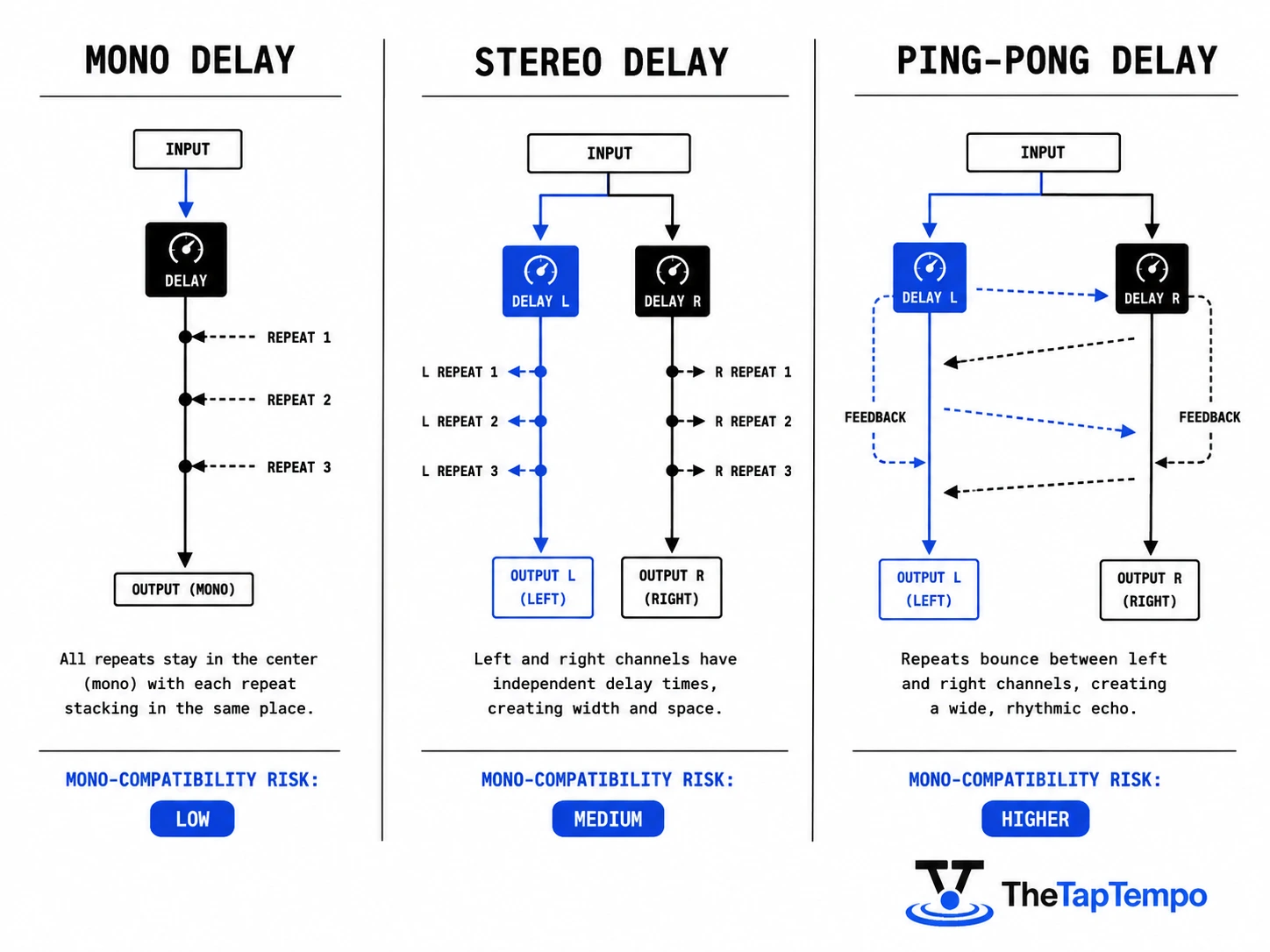
One common misconception is worth clearing up: stereo delay doesn't automatically mean the repeats alternate between left and right. That specific alternating pattern is its own technique, covered next. A stereo delay can just as easily keep independent, non-alternating repeats on each side, with the left channel repeating at one rate and the right at another, or with both channels repeating at the same rate but panned to different positions. The defining feature of stereo delay is channel independence, not movement.
Choosing between the two usually comes down to how much space a given element is allowed to occupy. A dense mix with many competing parts often benefits from reserving stereo width for one or two focal elements, while narrower mono delays support the rest of the arrangement without adding clutter.
How Stereo Delay Creates Width in a Mix
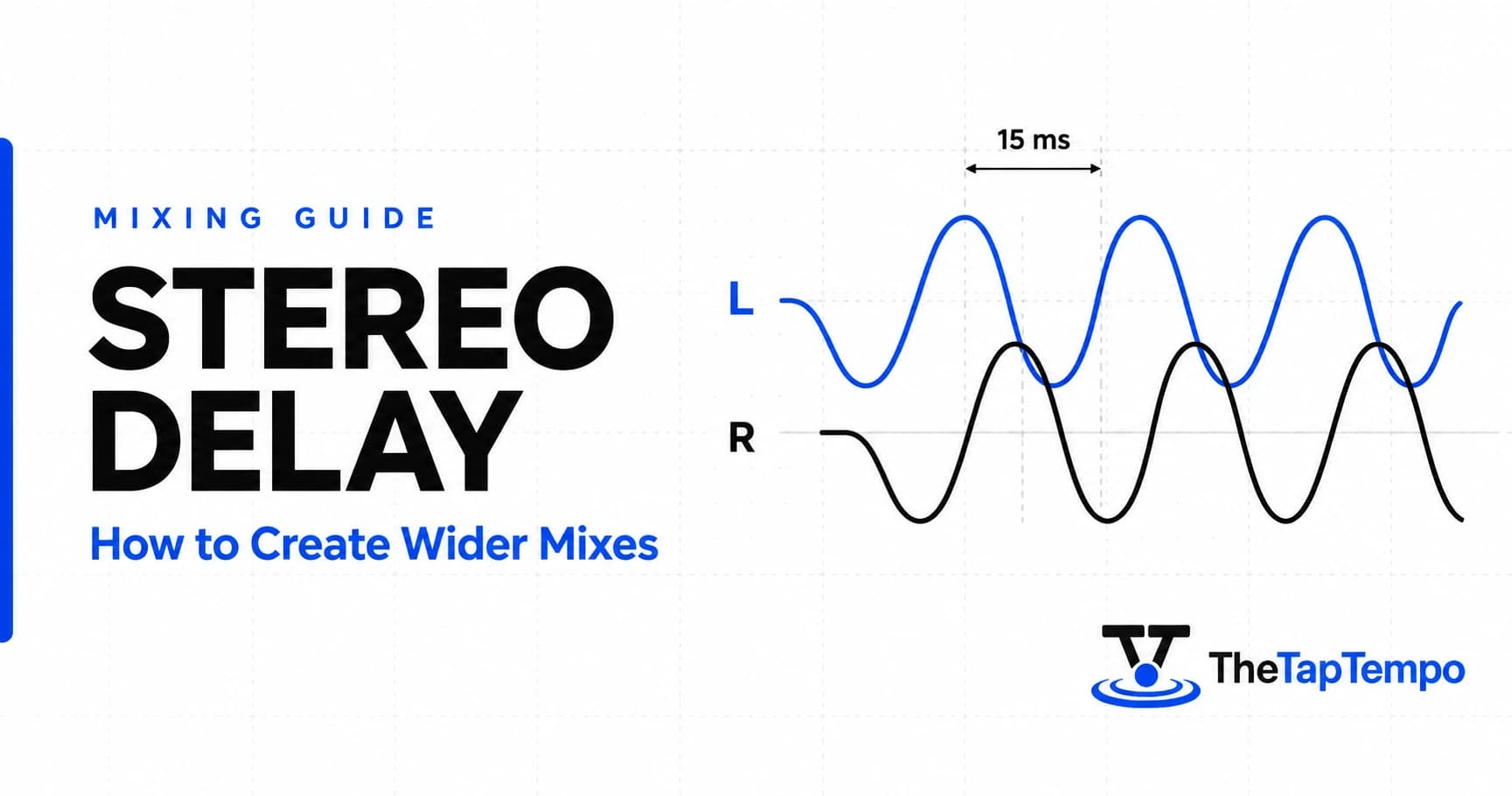
Stereo delay doesn't create width on its own. Perceived width results from a difference between the left and right channels, and that difference can come from timing offsets, level differences, panning position, or a different delay time assigned to each side. Most professional-sounding stereo delay effects combine at least two of these rather than relying on one alone.
Timing differences are one of the more effective ways to create spatial separation. When the same sound arrives at each ear with a very short gap between them, the auditory system tends to localize it toward whichever side arrived first, a phenomenon tied to the precedence effect and commonly discussed under the name Haas effect, after researcher Helmut Haas. A short offset between the left and right delay paths can make a source feel wider or shifted, even when both channels carry essentially the same material.
This deserves some caution. No single millisecond value guarantees a safe or superior result. The audible outcome depends on the timing chosen, the level of the delayed signal relative to the dry signal, the source material itself, the polarity relationship between channels, how dense the surrounding arrangement is, and what happens when the mix sums to mono. A short offset that sounds wide in stereo can thin out or partially cancel certain frequencies once both channels combine, an effect generally known as comb filtering. Any specific timing figure mentioned in mixing tutorials, including this one, should be treated as a starting point to test by ear, not a fixed rule.
Panning offers a more predictable route to width than short inter-channel timing alone. Because panning primarily redistributes level rather than introducing a delayed copy of the signal, it tends not to trigger the same comb-filtering interactions associated with Haas-style widening. Even so, the full routing should still be checked in mono, since level imbalances and other factors can still shift the result.
Quick Answer: Perceived width in stereo delay comes from a difference between the left and right channels, whether through timing offsets, panning, or different delay behavior on each side. Short timing offsets can feel dramatically wide in stereo but carry a real risk of thinning once summed to mono.
A useful way to hear this: start with a centered mono vocal, apply a subtle timing offset to just one delayed side, and listen to how the vocal seems to expand outward. Switch to mono monitoring and listen again. If the widened section noticeably thins out or loses presence compared to the stereo version, that's the audible signature of phase interaction, and it's a signal to reduce the wet level, adjust the timing, or lean more on panning-based width instead.
Understanding Ping-Pong Delay
Ping-pong delay is a specific stereo-delay configuration where each repeat alternates sides, bouncing from left to right and back rather than staying on one channel or repeating independently on both. That alternating movement comes from routing the feedback of the left delay path into the right channel and vice versa, so each successive repeat physically shifts position instead of decaying in place.
This differs from the independent stereo delay described earlier. Independent stereo delay can keep separate settings on each side without ever crossing channels, producing width without motion. Ping-pong delay is defined specifically by that cross-channel movement, and the repeats become a rhythmic, spatial event that draws the ear from one side of the stereo field to the other.
Ping-pong tends to work best in arrangements with room for the movement to register clearly. A sparse synth pattern, a plucked arpeggio, or a lead line with clear gaps between phrases gives the alternating repeats space to be heard as a deliberate gesture rather than background noise. That same movement can become a liability in a dense arrangement: on a busy lead vocal, or in a track already full of competing rhythmic elements, constant left-right bouncing can pull attention away from the performance. When that happens, reducing feedback, shortening the decay, lowering the wet level, or switching to a less mobile stereo-delay approach can restore clarity without losing width entirely.
Best Uses for Stereo Delay on Different Instruments
The right stereo-delay approach depends on what the source needs to accomplish in the mix. The sections below focus on mixing decisions rather than equipment, since the same principles apply whether the delay runs as a plugin insert or an outboard processor.
Vocals
On a lead vocal, stereo delay usually exists to add depth around the performance without pulling focus away from it. The dry vocal generally stays clear and intelligible while the delayed repeats sit slightly behind it, supporting the phrase rather than competing with the words.
Filtering the repeats, typically rolling off some high frequencies and often some low frequencies, keeps the delay from crowding the same range as the vocal's consonants and sibilance. Because a lead vocal is often the most important mono-compatible element in a mix, it deserves particular attention during a mono check; a vocal that thins out or loses presence is a far more noticeable problem than most other elements losing width.
Guitars
Stereo delay on guitar typically adds separation or width to a part that would otherwise sit narrowly in the mix. A single mono guitar track can gain a real sense of space through independent left/right delay, while an already double-tracked, genuinely wide guitar part usually needs a lighter touch, since stacking additional width on top of existing width quickly becomes excessive.
Watch for conflict with other wide elements already competing for the same space, particularly other guitars, synths, or vocal effects. Keeping the delayed repeats musically subordinate to the main performance, and reserving heavier stereo processing for parts that are genuinely narrow to begin with, tends to produce cleaner results. For detailed guidance on setting practical delay times for electric guitar, see How to Set Delay Time for Electric Guitar.
Synths
Synths often benefit from stereo delay because a mono synth patch can sound flat next to wider elements in an electronic arrangement. Independent left/right timing or a light ping-pong effect can introduce rhythmic movement and stereo interest without touching the patch itself.
Low-frequency buildup is the biggest risk with synths, particularly on bass-adjacent patches, where excessive stereo width or feedback can blur the low end and destabilize the mix in mono. Checking whether the dry center of the synth remains solid, especially in the low-mid and bass range, matters whenever stereo delay is applied to anything foundational in the arrangement.
Lead Instruments
Lead lines, whether played on synth, guitar, or another instrument, generally benefit from stereo delay used to open up space around a centered melodic idea rather than to widen the lead itself. The repeats can extend phrases and fill silence between notes, particularly during held notes or gaps in a melody.
The most frequent failure here is repeats competing with new notes as the phrase continues, muddying the line instead of supporting it. Managing feedback and wet level so the repeats fade before the next important note arrives keeps the lead dominant and the delay in a supporting role.
Pads and Background Elements
Sustained pads are among the more forgiving places to apply stereo delay, since their role is often texture and depth rather than rhythmic or melodic focus. Filtering the repeats prevents a sustained wash of delay from filling the entire frequency spectrum, which can otherwise mask foreground elements like vocals and leads.
Pads are frequently judged in isolation during mixing and then forgotten once the full arrangement comes in. Re-check a heavily delayed pad against the complete mix, not just on its own; an already-wide pad pushed through a wide stereo delay can quickly become diffuse and unstable, particularly if it carries important harmonic or low-frequency content.
How to Keep Stereo Delay Clean, Wide, and Balanced
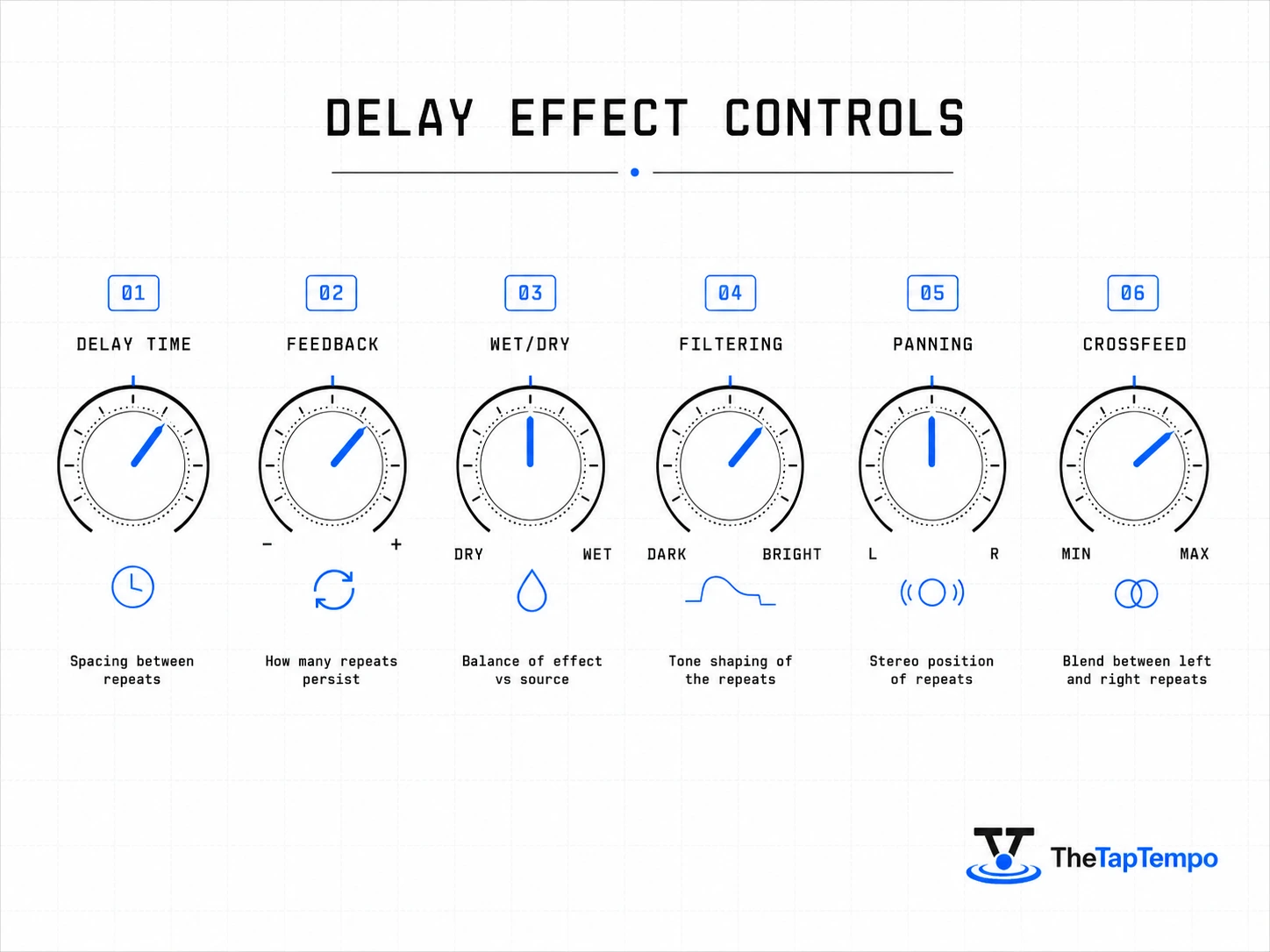
Every stereo-delay control connects to an audible result and a specific mixing purpose. The breakdown below covers what each one changes, why it matters, and what tends to go wrong when it's pushed too far.
Delay Time
Delay time changes the spacing between the source and its repeats, shaping whether the effect feels fused to the performance, rhythmically distinct, or more like an ambient wash. Poorly chosen timing can clash against the track's tempo or rhythm and create clutter rather than support.
Many engineers synchronize delay time to the track's tempo so the repeats land in a musically related place. Once you know the rhythmic subdivision you want, the Delay & Reverb Time Calculator can convert that musical timing into a precise millisecond value. The calculator supports the decision after it's been made by ear; it doesn't replace listening.
Left/Right Timing
Left/right timing differentiates the two channels and, as covered earlier, is one source of perceived width. Used moderately, it adds separation and interest. Pushed too far, it risks instability and mono cancellation.
Wet/Dry Balance
Wet/dry balance determines how loud the repeats are relative to the original. Keeping the wet signal at a supporting level preserves the source's focus, while excessive wet signal can obscure the dry sound and make the effect feel detached from the performance.
Feedback
Feedback controls how many repeats occur and how long they persist, shaping ambience and rhythmic density rather than stereo width directly. Too much feedback is a common cause of a cluttered mix, since it stacks repeats on top of new musical events before the previous ones decay.
Filtering
Filtering shapes the tonal character of the repeats, typically removing some low end to prevent buildup and some high end to keep the repeats from sounding harsh. Too little filtering leaves repeats competing directly with the source; too much can make them feel weak or indistinct.
Panning
Panning positions the dry or wet signal within the stereo field and, as discussed earlier, offers a more predictable path to width than timing offsets alone, though the result should still be confirmed in mono.
Crossfeed
Where available, crossfeed lets one channel's repeats or feedback bleed into the opposite delay path, creating connected movement between the two sides. Excessive crossfeed can blur the distinction between channels and add more repeat density than the arrangement can comfortably support.
Quick Answer: A dependable workflow: establish the dry source, bring in the wet signal quietly, choose independent stereo or ping-pong behavior based on the part's role, adjust timing and feedback while listening in context, filter the repeats, confirm the stereo image, and finish with a mono check.
Common Stereo Delay Mistakes
Width and stereo-field problems
- Pushing timing offsets or panning too far can make an element feel disconnected from the rest of the mix; dial the width back if a part starts to sound like it's floating outside the stereo image.
- Extreme left/right timing chosen without a mono check can create instability that only shows up on a mono speaker or a phone.
- Applying stereo delay to every track at once tends to flatten depth rather than enhance it, since nothing stands out as intentionally wide when everything is. Reserve it for the elements that genuinely benefit.
- Multiple wide elements competing for the same space can leave the mix feeling busy and undefined; evaluate width decisions against the full arrangement, not the isolated track.
Delay-level and feedback problems
- Long, dense repeat trails build up quickly in busy arrangements and can bury upcoming musical events under the tail of the previous phrase. Reduce feedback until the repeats support the performance instead of overwhelming it.
- When the wet signal becomes as loud as, or louder than, the dry source, the effect starts to sound detached rather than integrated.
- Full-range, unfiltered repeats build up energy across the spectrum and compete with other elements; filtering is a small adjustment that meaningfully improves clarity.
Arrangement and musical problems
- Repeats landing on strong beats or important syllables can compete directly with the source instead of supporting it. Nudging the delay time or reducing feedback usually resolves this.
- Alternating ping-pong movement is exciting in the right context and distracting in the wrong one; judge it against the arrangement's density rather than defaulting to it.
- A stereo delay that sounds impressive in isolation can behave very differently once other elements are competing for the same stereo space, so always evaluate width decisions in the context of the full mix.
Mono compatibility problems
- Treating mono checking as optional is a costly habit with stereo processing generally, not just delay. A wide effect that disappears in mono can mean a listener on a single speaker or a club system loses an important part of the mix.
- Width should serve a musical purpose, such as separation, depth, or movement. A mix built entirely around maximum width often ends up sounding less focused than one that uses width selectively.
Continue Learning
These guides expand on the concepts and decisions covered in this article:
- Delay vs Reverb: Which Effect Should You Use? — for readers deciding between the two effects more broadly.
- How to Find the BPM of Any Song — for determining a track's tempo.
- How BPM Affects the Feel of a Song — for understanding how tempo shapes musical feel.
Once you know your project's tempo, the Delay & Reverb Time Calculator converts that tempo into precise, ready-to-use delay times, so the techniques covered here land exactly where they should.
This article has been researched, written, and reviewed according to our Editorial Policy.
Frequently Asked Questions
Common questions about finding the BPM of a song.