
Why Small BPM Changes Can Completely Change the Feel of a Song
A 2–10 BPM shift can transform a song's energy, groove, and emotion. Learn why tiny tempo changes matter and when to experiment with different BPMs.
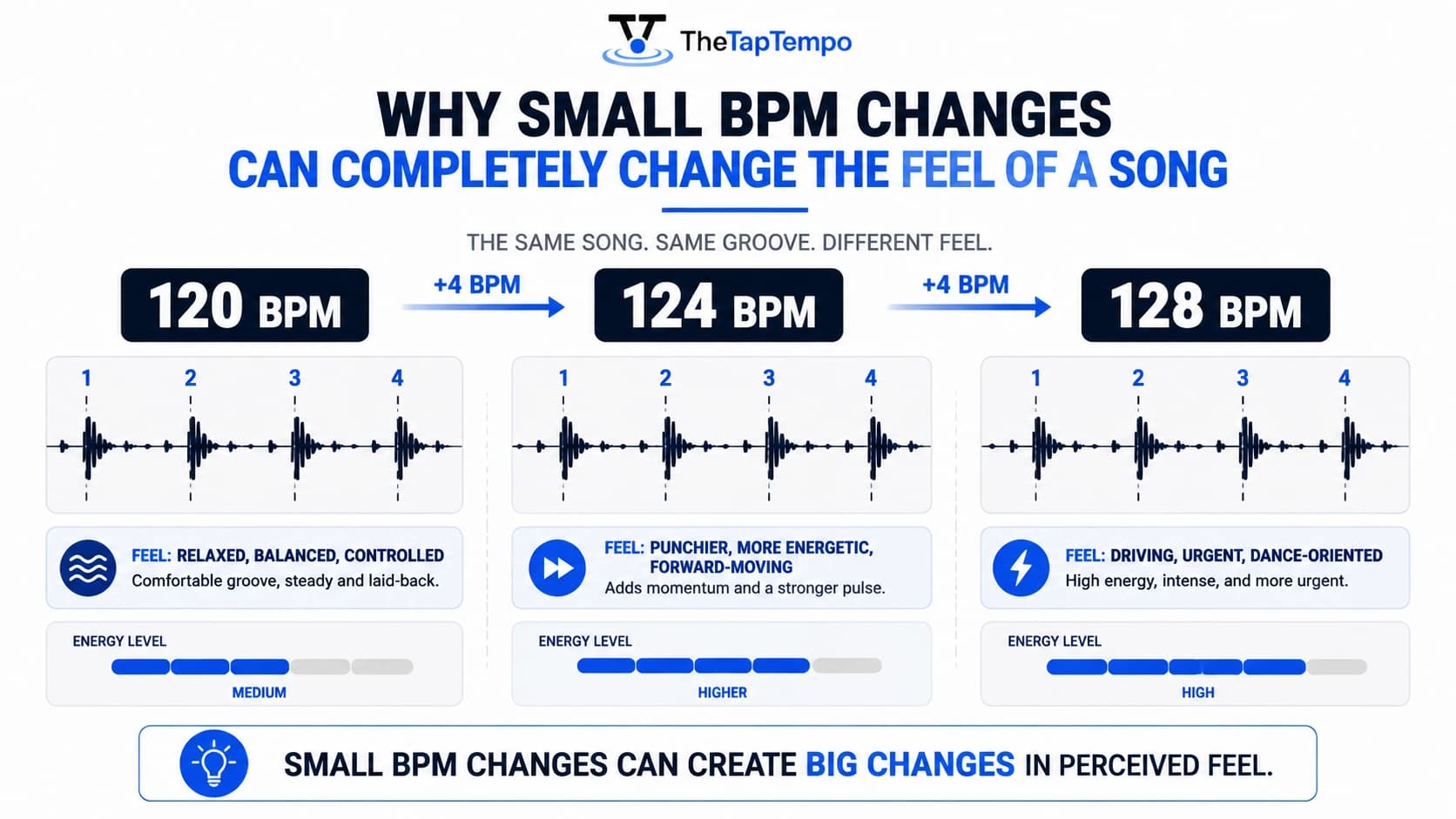
Two versions of the same song, identical in every way except a five-BPM difference, can feel like two different pieces of music entirely. One might feel confident and driving, the other rushed or oddly flat, even though nothing else in the arrangement changed.
This is not a matter of taste or imagination. Small tempo shifts genuinely change how a listener perceives energy, emotion, and groove, and understanding why is one of the most useful creative skills a songwriter, producer, or performer can develop. This article looks at what actually happens, musically and psychologically, when BPM shifts by just a few beats per minute.
Why Your Brain Notices Tiny Tempo Changes
The brain is highly sensitive to rhythmic timing, and even a small tempo shift changes the physical rate at which a listener's body wants to move, breathe, or nod along. Rhythm perception research consistently finds that listeners can detect tempo differences of just a few BPM, particularly in music with a strong, steady pulse like most pop, dance, and hip-hop production.
This sensitivity exists because rhythm engages the body directly, not just the ears. Walking pace, heartbeat, and breathing all sit within familiar tempo ranges, and music that moves noticeably faster or slower than those internal rhythms registers as a shift in energy, even when the listener cannot consciously name why a track suddenly feels different.
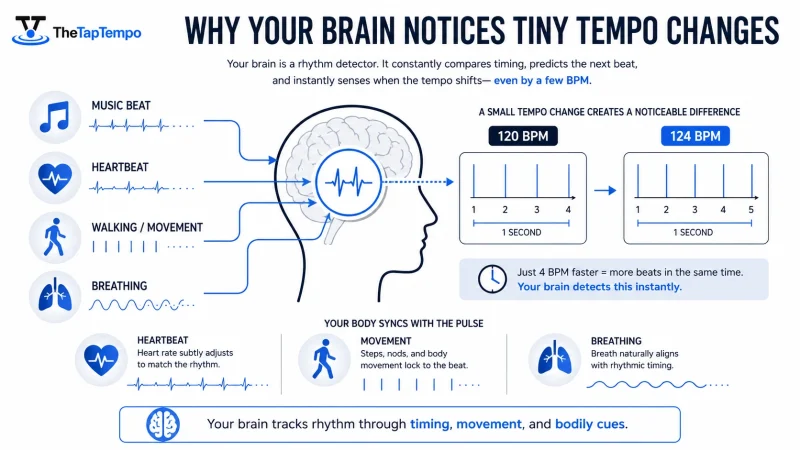
A track sitting at 120 BPM and the same arrangement nudged to 124 BPM will often be described by listeners as "punchier" or "more energetic," despite the two versions sharing identical instrumentation, melody, and lyrics. Nothing musically complex changed; only the rate at which the beat repeats did, and that was enough to shift the emotional read of the whole track.
Quick Answer: The brain tracks rhythm through physical, bodily cues like heartbeat and movement, which is why even a small BPM shift is often noticeable, even to listeners who could not explain the change in technical terms.
How BPM Changes Affect Emotion
Tempo is one of the most direct tools music has for shaping emotional response, because faster and slower paces trigger different physiological states in a listener almost automatically. Increasing tempo tends to raise a track's perceived energy, urgency, or excitement, while decreasing it tends to create space, intimacy, or tension, depending on the surrounding arrangement.
This is why the same chord progression and melody can feel celebratory at one tempo and melancholic at a slightly slower one. A ballad sitting at 68 BPM often reads as reflective or sorrowful, while the same chords and melody nudged up to 82 BPM can start to feel hopeful or determined instead, purely because the pacing changed how the listener's body and attention engage with it.
Producers frequently exploit this deliberately. A chorus is sometimes tested a few BPM faster than the verse feels natural at, specifically to create a subtle lift in energy without the listener consciously noticing a tempo change occurred, only that the song "opened up." This kind of micro-adjustment is a common, if rarely discussed, production technique.
| Tempo Direction | Common Emotional Shift | Typical Use Case |
|---|---|---|
| Small increase (2–5 BPM) | Slightly more urgency or excitement | Lifting a chorus, building momentum toward a drop |
| Small decrease (2–5 BPM) | Slightly more space or restraint | Softening a bridge, easing tension after a chorus |
| Larger shift (8–10+ BPM) | Noticeable change in genre feel or mood | Reworking a ballad into an upbeat version, or vice versa |
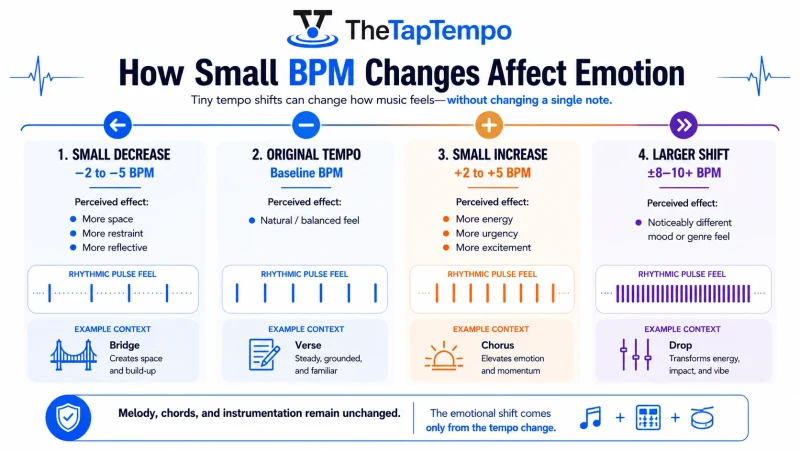
Quick Answer: Small tempo increases tend to raise perceived energy and urgency, while small decreases create space and restraint. The effect is often felt before it is consciously identified as a tempo change.
Why Vocal Performances Improve at Certain Tempos
A vocalist's phrasing, breath control, and emotional delivery are all tied closely to tempo, which means the "right" BPM for a vocal take is rarely just about the beat feeling good instrumentally. A tempo that forces a singer to rush a phrase, or stretches a line further than a comfortable breath allows, will change the vocal performance itself, not just the instrumental groove underneath it.
At a tempo that is a few BPM too fast, singers often compress consonants and clip the ends of phrases just to keep pace, which can make a performance feel strained even if the pitch and rhythm are technically correct. At a tempo that is a touch too slow, the same phrase can start to feel disconnected, with gaps between words that were never meant to have space in them.
Recording sessions frequently reveal this directly: the same vocal take, recorded a few BPM apart, can shift from stiff and mechanical to relaxed and expressive with no change to the lyrics, melody, or singer. This is a major reason experienced producers test a range of nearby tempos before committing to a final take, rather than locking the tempo in before the vocalist has had a chance to sing against it.
Session vocalists often describe this as a tempo simply feeling "singable" or not, a distinction that has little to do with technical difficulty and everything to do with where the natural breath points in a phrase land against the beat. A verse that requires an awkward, mid-word breath at one tempo can suddenly breathe naturally just a few BPM slower, with no change to the lyric itself.
The Relationship Between BPM and Groove
Groove is the sense of forward motion and physical feel a rhythm creates, and it is often the first thing a listener notices when a tempo shifts, even before they notice a change in energy or emotion. A small BPM adjustment can move a beat from feeling locked-in and danceable to feeling slightly stiff, or from feeling relaxed to feeling sluggish.
Danceability
Dance-oriented genres are especially sensitive to small tempo shifts because groove depends on a listener's body syncing naturally with the beat. A house or pop track that sits comfortably in a dancefloor tempo range can feel noticeably harder to move to just a few BPM outside that range, even though the track is technically still danceable on paper.
Instrument Performance
Tempo also changes how individual instruments physically sit in a mix. A bassline built around short, punchy notes can start to feel cluttered at a slightly faster tempo, while the same pattern might feel sparse or disconnected if the tempo drops too far. Drummers often describe certain grooves as only "locking in" within a narrow tempo window, a few BPM in either direction, even though the pattern itself never changes.
Quick Answer: Groove is highly tempo-sensitive. The same rhythmic pattern can feel locked-in and danceable at one BPM and stiff or sluggish just a few BPM away, which is why small tempo tests matter as much as arrangement choices.
Real Examples of Songs Tested at Different BPMs
Producers rarely commit to a single tempo without testing nearby alternatives first, precisely because the difference between two close BPM values is often larger than expected until it is heard directly.
Upbeat and Dance-Oriented Genres
A common A/B test in production looks like this: the same instrumental is bounced at three tempos, for example 122, 125, and 128 BPM, and played back to back for a small group of listeners without telling them a change occurred. In these informal listening tests, listeners frequently agree that one version "feels right" and the others feel slightly off, even though most cannot immediately identify BPM as the variable that changed. In dance and pop production specifically, this narrow "sweet spot" often sits within a two- or three-BPM window, which is why producers working in these genres treat tempo testing as a standard part of finishing a track rather than a formality.
Ballads and Vocal-Driven Genres
A similar pattern shows up in vocal-driven genres. A ballad tested at both 70 and 76 BPM might sound almost identical on paper, since the difference is small, but the faster version often reads as more hopeful or forward-moving, while the slower version reads as heavier or more introspective. Neither version is objectively better; they simply serve different emotional intentions, which is exactly why testing multiple tempos before finalizing a mix is considered standard practice among experienced producers rather than an optional extra step.
Quick Answer: A/B testing nearby tempos, often within just a few BPM of each other, regularly reveals a clear "best fit" tempo for a song's energy and emotion, even when the difference looks negligible written down as a number.
When You Should Experiment With Tempo
Tempo experimentation is most valuable after the core song, melody, and arrangement are already in place but before the final mix is locked, since that is the point where a small BPM shift can still be tested without reworking the entire production.
A practical way to approach this stage:
- Finish a rough version of the song at your initial working tempo.
- Bounce or export two or three nearby tempo variations, typically within 2–10 BPM of the original.
- Listen to each version back to back, ideally on different days or with fresh ears, rather than judging them immediately after finishing the mix.
- Pay attention to how the chorus energy, vocal comfort, and groove feel at each tempo, not just whether the track "sounds fine."
- Compare tempo ranges for your genre using a resource like our Tempo Markings guide to check whether your chosen BPM aligns with listeners' typical expectations for that style.
If you are unsure how a familiar reference track achieves a certain feel, tapping along to it with a Tap Tempo tool can help you identify the tempo range you are instinctively responding to. And once you are ready to test your own tempo variations side by side, our BPM Calculator makes it easy to compare multiple BPM values while you experiment.
Quick Answer: The best time to experiment with tempo is after the arrangement is finished but before the mix is locked. Test two or three nearby BPM values, listen with fresh ears, and judge based on energy, vocal comfort, and groove rather than instinct alone.
Experiment with multiple tempos using our BPM Calculator to discover which BPM gives your song the strongest emotional impact.
Continue Learning
Explore more guides on tempo, energy, and music production:
This article has been researched, written, and reviewed according to our Editorial Policy.
Frequently Asked Questions
Common questions about finding the BPM of a song.