
Why Your Timing Falls Apart Without a Metronome
Learn why tempo drifts when the click stops, how to tell rushing from dragging, and how to test and train independent timing with simple exercises.
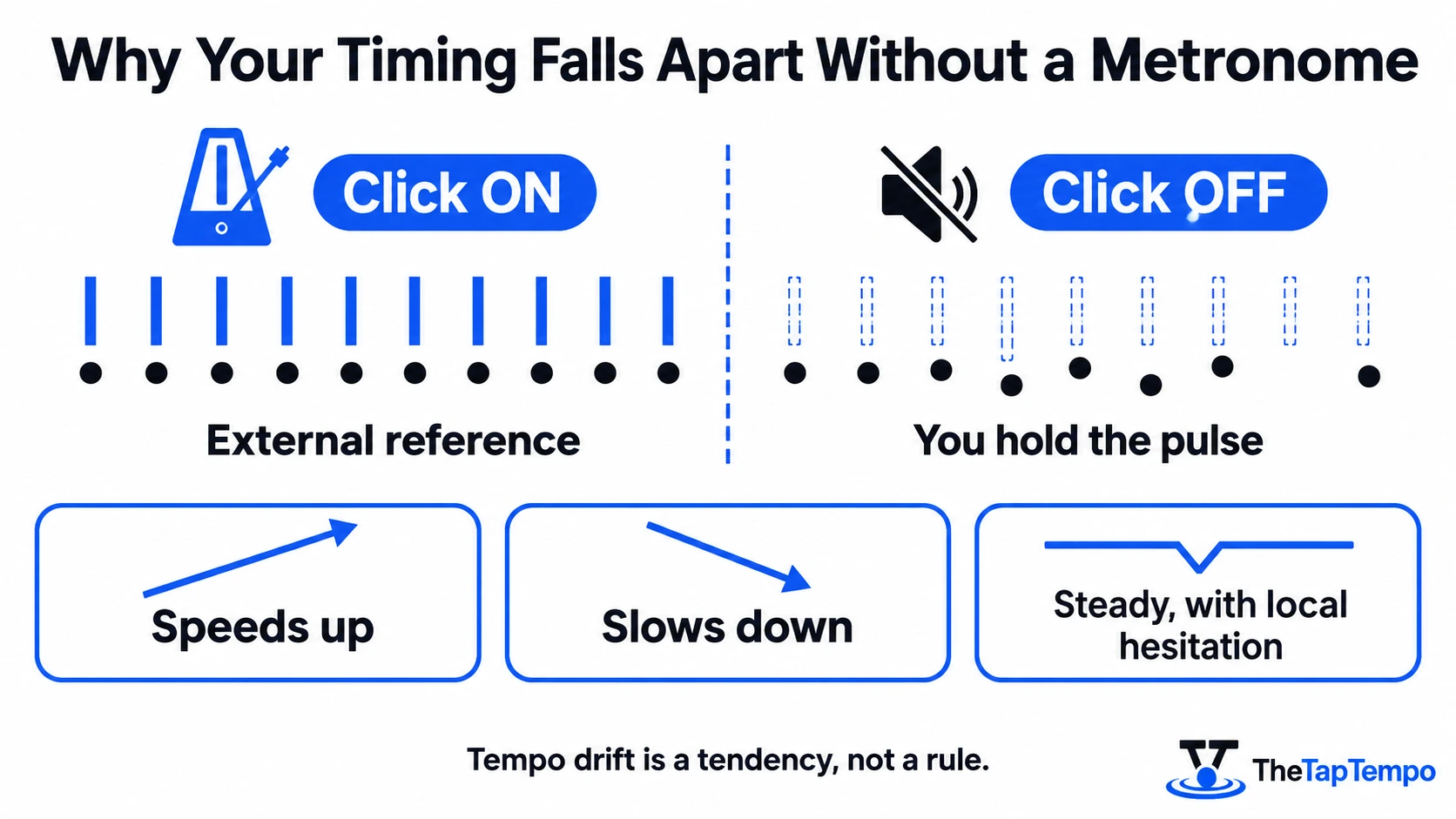
You play a passage along with the click and it feels solid. Then the click stops, and within a few bars the music seems to speed up, sag, or lose its shape. When you turn the metronome back on, you are suddenly early or late.
This does not mean you lack musical ability. It means the click was doing a job you were not aware of, and removing it exposed how much of your steadiness was borrowed. This article explains what changes when the external pulse disappears, how to tell rushing from dragging from expressive playing, and how to test and train your independent timing in a measured way.
What Changes When the Metronome Stops?
When a metronome stops, the external timing reference disappears and you must maintain the pulse yourself. Attention, prediction, motor control, and what you hear from your own playing all take on a bigger role. Small timing differences that were easier to notice and adjust against the external click can now accumulate into a noticeable change in tempo.
Quick Answer: With a click, the beat is supplied for you. Without it, you supply the beat, and small errors can accumulate instead of being corrected.
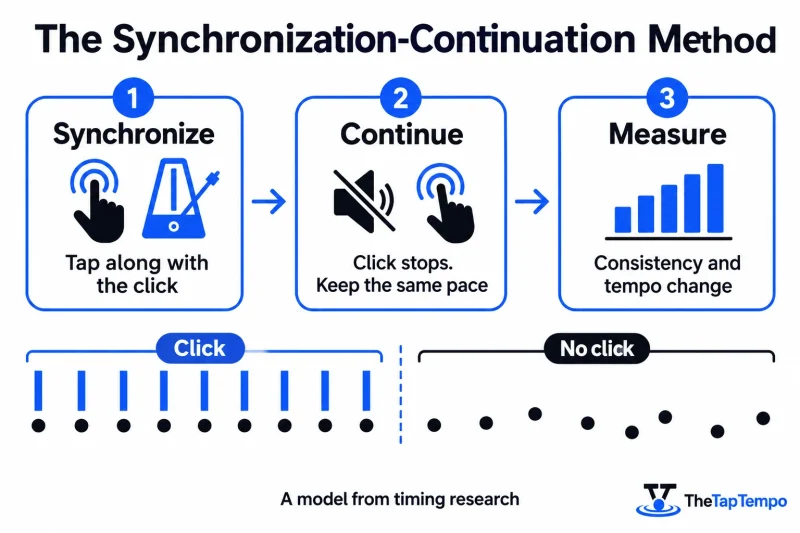
Researchers study this moment with a method called the synchronization-continuation paradigm. A participant first taps along with a metronome (synchronization). The metronome then stops, and the participant keeps tapping at the same pace (continuation). The researchers measure how consistent the tapping stays and whether the tempo changes. Because the pacing signal is gone, the continuation phase gives a window into independent timing.
Different people drift in different directions. Some speed up without noticing. Others slow down. Some keep a roughly steady tempo but stumble locally, for example at a difficult chord change. The sections below separate these cases, because the fix depends on which one you are dealing with.
Your Internal Sense of Pulse vs. an External Beat
Following an external beat means reacting to a pulse that keeps arriving from outside you. Maintaining an internal pulse means remembering a tempo and predicting where the next beat belongs, with nothing outside you confirming it. The two feel similar while the click plays and very different once it stops.
You will often see the phrase "internal clock" used to describe this ability. In research it is a model, not a literal organ and not a single settled mechanism in the brain. In this article, "internal timekeeping" simply means your working ability to hold a pulse on your own.
When timekeeping slips, the result is tempo drift: an unintended, gradual change away from the tempo you meant to play. Drift can be acceleration or deceleration. Researchers also describe two kinds of correction that keep performers on track. Phase correction adjusts the timing of an action relative to a pulse, and period correction adjusts the tempo you are holding. You do not need these terms to practice, but they explain why a click helps so much: it provides constant feedback for both.
Quick Answer: An external beat tells you where the pulse is. Independent timing means you hold it yourself, and drift is what happens when that hold slowly loosens.
Does Tapping Research Apply to Real Instruments?
Finger-tapping studies support the principle that timing changes once an external pulse disappears, but they do not guarantee that a specific exercise will fix your guitar, piano, drum, or vocal timing. Tapping is easy to measure, which is why researchers use it. Playing an instrument adds many more demands.
Real performance involves note selection and reading, technique, coordination between hands or limbs, dynamics, articulation, breathing, phrasing, and constant expressive decisions. Any of these can affect timing in ways a simple tapping task cannot show. Self-paced tapping rate has been studied on its own as well (Lorås et al., 2019), but those are small laboratory tasks. The same caution applies to the studies discussed below.
A few quick examples show how this plays out:
| Instrument | What it can look like |
|---|---|
| Guitar | A chord change causes a brief hesitation. That is different from gradual slowing across an entire passage. |
| Piano | A difficult leap or hand coordination disrupts one transition without changing the overall tempo. |
| Drums | A groove feels steady, but a fill or transition reveals that the tempo has crept. |
| Vocals | Flexible phrasing can be expressive. It is not automatically poor timing. |
Two of the studies discussed next carry their own limits. A 2026 study of tapping in a museum setting measured finger tapping, not instrument playing. A piano-duet study examined two players hearing each other through delayed audio, not one player practicing alone. Both are useful, and both need to be read with that in mind.
Why Musicians Rush, Drag, or Lose Their Pulse
There is no single cause of unsteady timing without a click. Research points to several different influences, some measured in laboratories and some better described as practical possibilities. Separating them helps you work out which one applies to you.
Why tempo may drift toward your preferred tempo
When external pacing stops, tempo can slowly move toward the rate that feels most natural to you. In a 2026 study, Serré and colleagues tested finger-tapping synchronization and continuation in a real-world museum setting. Of 335 visitors who initially took part, 236 remained after exclusions. Participants tapped at their preferred tempo and at tempos 20% faster and 20% slower than that.
The study found that timing error and variability were lower among participants with music experience. After the pacing stopped, tempo tended to move toward each person's individual preferred tempo. Participants paced 20% faster than their preferred rate tended to slow down during continuation. The matching speed-up after slower pacing did not reach statistical significance, and drift did not differ significantly between musicians and non-musicians.
For a player, this suggests that if you practice at a tempo faster than your personal comfort zone, you may find the pulse sagging once the click is gone. It is a tendency, not a rule. Your comfortable tempo is individual, and it may be above or below the tempo you are aiming for.
Why rushing can happen during ensemble playing
Rushing is well documented in group settings. Wolf and Knoblich (2022) found that joint rhythmic tapping produced an unintended tempo increase, while the same systematic increase was not observed when people tapped alone. When partner auditory feedback was interrupted, the acceleration stopped, yet participants did not snap back to the original tempo. Musicians showed better stability and synchronization on some measures, and musical expertise did not eliminate joint rushing.
This is evidence about playing together. It does not show that solo musicians automatically rush without a click. If you mostly notice rushing in band rehearsals, the ensemble dynamic may be part of the explanation, and recording yourself alone is a good way to test whether the same tendency appears.
Quick Answer: Research supports a drift toward your preferred tempo and a real tendency to rush when playing together. Neither is proof that every solo player rushes or drags.
Why a difficult passage can disrupt local timing
Technically demanding moments often cause small, local timing problems. Chord changes, awkward transitions, fills, reading demands, tension, and losing track of the subdivisions between beats can all pull a performance off the pulse. These are reasonable practical explanations from teaching experience, but the research summarized here does not establish each one as a proven independent cause of dragging.
The key distinction is local versus gradual. A hesitation at one chord change is a local event. The tempo can recover afterward and the overall pulse may be fine. Gradual drift is different: the whole passage creeps faster or slower from start to finish.
Why auditory feedback can affect timing
What you hear while you play can nudge your tempo. Washburn and colleagues (2021) had 24 pianists perform duets in 12 pairs under different acoustic transmission delays. At a 10 ms delay, tempo gradually increased. At 20 ms, tempo was relatively maintained. At 40 ms, the duets showed progressive slowing, and longer delays also increased timing asynchrony. Remember the limit: this was a duet with delayed partner feedback, not a solo player without a metronome.
Matsuo and Sakaguchi (2024) studied tapping at a fixed 132 BPM over a 150-second continuation phase. Rhythm and accent patterns affected tempo deviation, generally by several percent over the tested duration, and changes to the auditory response tone also affected tempo maintenance. Local fluctuations from tap to tap did not clearly predict long-term drift. So one uneven chord or one hesitant bar does not, by itself, explain why a passage speeds up or slows down overall.
Expressive timing vs. accidental drift
Not every tempo change is a problem. Before judging your playing, ask whether the change was a choice:
- Accidental acceleration or deceleration: the tempo changed and you did not intend it.
- Intentional accelerando or ritardando: you shaped the tempo on purpose.
- Expressive rubato: flexible timing used for musical effect.
- Brief local hesitation: a small stumble, often technical, that may not change the overall tempo.
Only the first is unintentional tempo drift. If your goal is a steady pulse, such as in a groove or an etude meant to stay in time, the others should be intentional and controlled.
How to Tell Whether You Are Rushing or Dragging
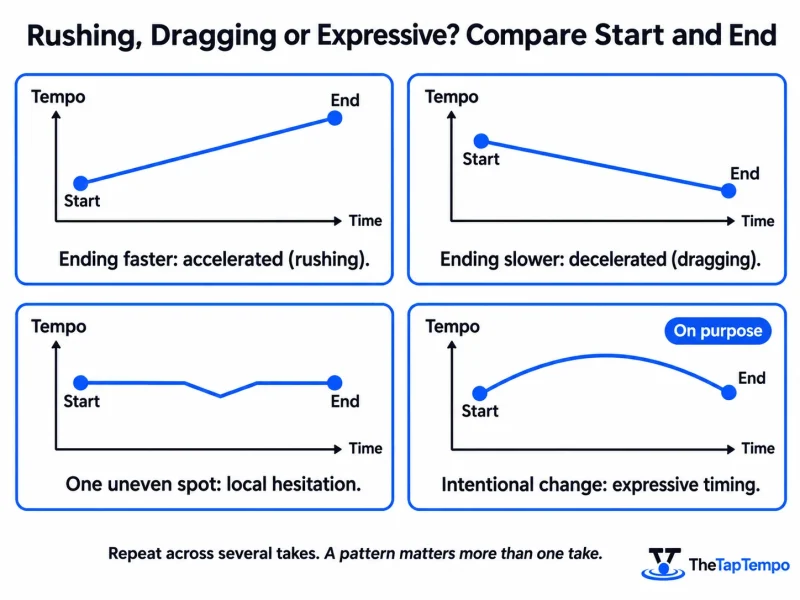
To tell whether you are rushing or dragging, compare the beginning and the end of a passage that was meant to stay steady. If the ending is faster than the start, you accelerated. If it is slower, you decelerated. If only one spot sounds uneven while the rest holds, you are likely dealing with a local hesitation rather than tempo drift.
Here is a practical way to diagnose it:
- Set the metronome and play the passage along with it, so you have a clear starting reference.
- Stop the click and keep playing the same passage.
- Turn the click back on and listen to how the ending compares with the pulse you started from.
- Repeat across several takes. A tendency that appears again and again is more meaningful than a single uneven take.
- Ask whether any change was intentional.
A single rushed note, late chord, or hesitant bar is not automatically evidence of long-term tempo drift. Look for the pattern across the whole passage and across several attempts.
When you are ready to check yourself, use the free online Metronome as a temporary reference. Set a pulse, play a short passage without it, then return to the click to hear whether your tempo stayed steady.
Quick Answer: Compare the start and end of a passage meant to stay steady, repeat it across takes, and rule out intentional changes before calling it rushing or dragging.
How to Correct Rushing and Dragging
You correct rushing and dragging by repeatedly comparing your independent playing against a reference and noticing which way your tempo moves. This approach builds awareness and control, but no method guarantees the problem will stop. The aim is to manage independent timing, not to depend permanently on a click.
A simple cycle looks like this:
- Establish a clear reference pulse. If you need a refresher, see how to practice with a metronome before you start.
- Choose a short passage you can play comfortably.
- Play it with the reference.
- Continue independently for a short section.
- Reintroduce the reference.
- Note whether your tempo ended faster or slower than it began.
- Repeat under similar conditions and compare.
If the passage is too hard, the technical demands will hide the timing signal. Shorten the passage or choose an easier one so the timing question becomes visible. When your results look confusing, check whether a setup problem is the cause. Several common metronome mistakes can make a timing problem look worse than it is.
Exercises to Reveal and Train Independent Timing
The exercises below are practical adaptations of the synchronization-continuation idea. They are not scientifically proven treatments. Each one is a way to reveal a tendency, and each has limits that are noted with it.
Exercise 1: Synchronize, Pause, Continue
This exercise shows whether you can keep a pulse after the external reference disappears.
- Play several bars with the metronome.
- Stop the click for a short section and continue playing independently.
- Restart the click.
- Compare the returning tempo with the original pulse.
This directly mirrors the synchronization-continuation design. The limit is that a single attempt is not a definitive measurement, so repeat it a few times.
Exercise 2: Silent-Measure Test
This exercise checks pulse continuity during a gap in external guidance.
- Play four bars with the metronome.
- Leave one or two bars silent, then keep your pulse going through them.
- Resume the click.
- Listen for whether your re-entry is early, late, faster, or slower.
It is a practical adaptation of the continuation paradigm. The limit is that the moment of re-entry can influence what you hear, so repeat it and record yourself when possible.
Exercise 3: Ending-Tempo Comparison
This exercise identifies gradual acceleration or deceleration.
- Establish a starting reference pulse.
- Record a short passage intended to stay steady, played without continuous click support.
- Compare the ending tempo with the starting tempo.
Tempo change is a central measure in continuation research. The limit is that intentional expressive timing can change the result, so choose a passage meant to hold one tempo.
Exercise 4: Record and Review Repeated Takes
This exercise replaces gut feeling with a record of recurring patterns.
- Record several short performances under similar conditions.
- Compare the same passage across the recordings.
- Listen for repeated acceleration, deceleration, or local hesitation.
Researchers use objective timing measurements to study change over time. Casual listening to phone recordings will not show small differences, so do not expect laboratory precision from this.
Two supporting techniques
Internal subdivision counting
Silently count "1 and 2 and" while holding the pulse. This can help you stay aware of the space between beats, but the research supplied here does not establish it as a treatment for tempo drift. If you want to hear those in-between beats instead of only counting them, a metronome with subdivisions can click the "ands" for you while you build the habit. You can remove it later.
Clap or tap the pulse first
Clap or tap a short passage before playing it on your instrument. This separates pulse awareness from some of the technical demands of playing. Accurate clapping does not guarantee accurate performance on the instrument, so treat it as a stepping stone.
Quick Answer: Use a reference, continue without it, then compare. Repeat and record. These are practical checks, not proven cures.
How to Test Your Timing Without a Metronome
A simple self-test for timing without a metronome follows the same pattern each time: set a reference, play a short passage, continue without the click, record, and compare the start with the end. Repeating it on different days gives you far more reliable information than a single attempt. It is a practical self-check, not a laboratory measurement.
- Establish a reference pulse.
- Play a short, manageable passage.
- Continue without the click.
- Record the performance.
- Compare the beginning and the ending.
- Repeat the test on more than one occasion.
Use the free online Metronome only as a starting and finishing reference. The click is a diagnostic tool here, not something to lean on during the test.
How to Interpret Your Results
One uneven bar does not necessarily mean the whole passage is drifting. Repeated trends across several performances are far more meaningful than any single take. Intentional rubato is not automatically a timing error, so check whether the change was a choice.
Comparing your ending with the original reference can reveal a possible tempo difference. Short tests tend to work better than one long, tiring test, because fatigue may add its own timing problems. Keep your conclusions modest and let the pattern build up over several sessions.
Do Professional Musicians Still Use Metronomes?
Usually, yes. Musical experience does not remove the value of an external timing reference or deliberate timing awareness. Research associates experience with better performance on some timing measures, but it does not make musicians immune to timing instability.
Musicians can show better timing stability than non-musicians. In the 2026 museum study, timing error and variability were lower among participants with music experience. Repp (2010) similarly examined how music training and task experience affect synchronization and the perception of timing. Yet training does not make every timing problem disappear, and in the Wolf and Knoblich study, expertise did not eliminate joint rushing.
Independent timing and an external reference serve different purposes. One is the ability to hold a pulse on your own. The other is a way to check it. This article does not make claims about how often professionals use metronomes, only that experience does not remove the value of a reference.
Continue Learning
A metronome provides an external reference, while independent timing is the ability to hold the pulse once that reference disappears. Use the click to check yourself, then practice carrying the beat on your own. These guides build on that idea:
- How to Practice with a Metronome (Without Getting Bored)
- Common Metronome Mistakes That Slow Down Your Progress
- Best BPM for Beginners: A Practical Practice Speed Guide
- How to Increase Playing Speed With a Metronome
- Why Slow Practice Makes You a Better Musician
Metronome tools for your instrument and practice style:
- Metronome with subdivisions for hearing the beats between the beats
- Metronome for guitar practice for checking chord changes and passages
- Metronome for drummers for testing grooves, fills, and transitions
- Metronome for piano practice for checking hand coordination and difficult leaps
This article has been researched, written, and reviewed according to our Editorial Policy.
Frequently Asked Questions
Common questions about finding the BPM of a song.