
Best BPM for Beginners: A Practical Practice Speed Guide
Find the best BPM for beginners. Learn the right starting practice tempo for your instrument and how to increase it safely with a metronome.
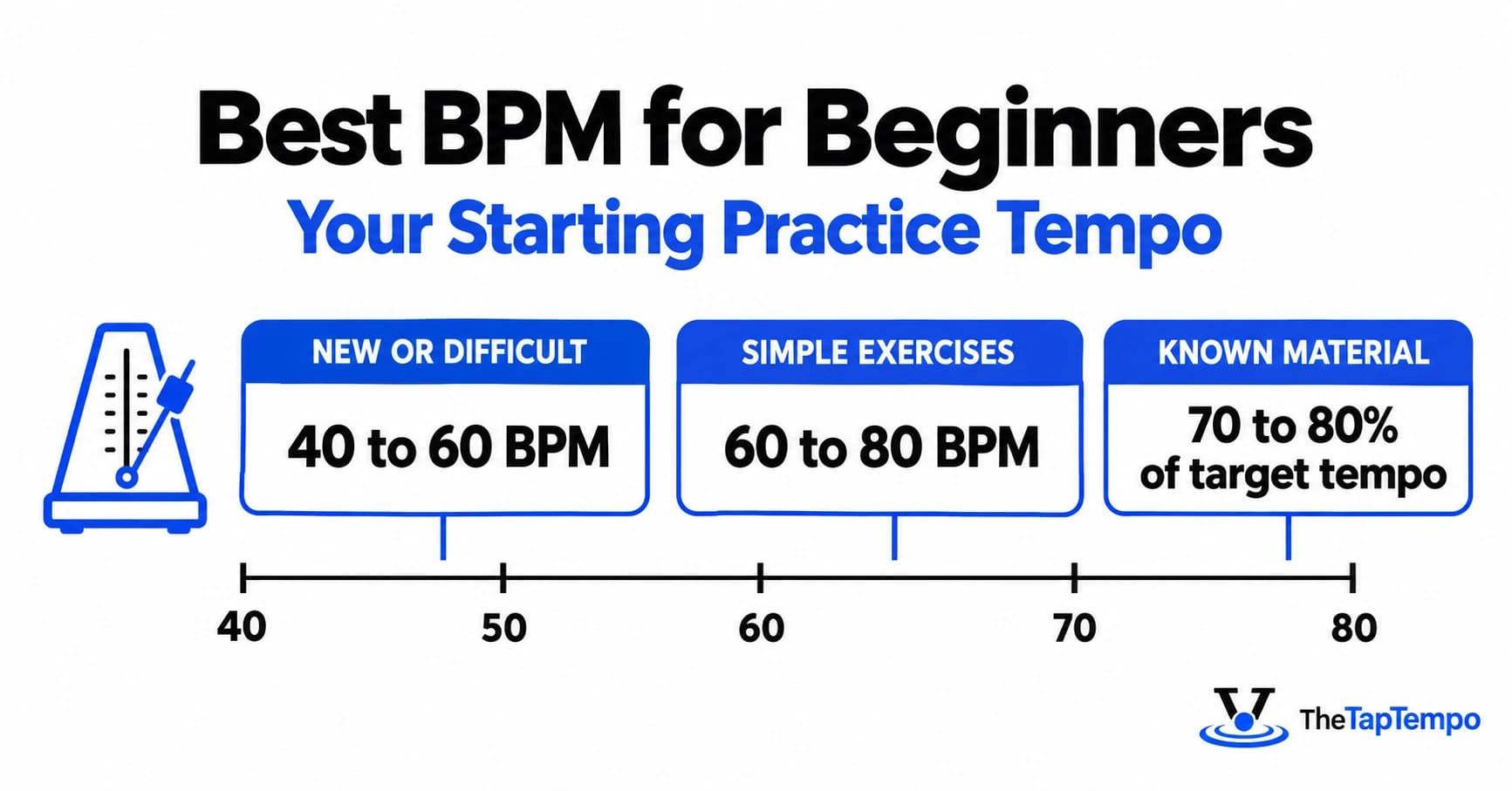
The best BPM for beginners is usually 60 to 80 BPM for simple exercises and 40 to 60 BPM for anything new or difficult. That range is a starting point, not a rule. Your real starting tempo is the slowest speed at which you can play the material cleanly, relaxed, and in time.
Many beginners choose a tempo that matches how fast the music should eventually sound. Good practice works the other way around. You pick the tempo your hands, voice, or feet can currently control, and you let speed grow from there.
This guide shows you how to choose that first tempo for your skill level and instrument, and how to move it upward without losing accuracy. To follow along, open our free online Metronome tool and set it as you read.
Why Starting BPM Matters
Your starting BPM decides what you are actually rehearsing. If you practice a passage faster than you can control it, you rehearse hesitation, rushed notes, and tension instead of the passage itself. Repetition then makes those errors more automatic, which is why a well-chosen starting tempo shapes everything that follows.
Picture a guitarist working on a change from G to C at 100 BPM. The fingers arrive late on every change, so the player begins to anticipate the mistake and tense up before it happens. At 60 BPM the same change lands on time, and the player rehearses a clean movement instead of a rescue. The notes are identical, but the habit being built is completely different.
Quick Answer: A starting BPM that is too fast trains mistakes into your playing. A starting BPM you can control trains the correct movement, and that movement is what you later speed up. A good practice tempo is the fastest speed at which you can still play accurately, stay relaxed, and follow the click.
A good starting tempo also protects your motivation. Beginners who start too fast often feel they are "bad at timing" when the real issue is a tempo set above their current ability. Timing improves quickly once the click becomes something you can follow rather than chase. Your beginner metronome speed should reflect what you can control today, not the speed you want to perform at eventually.
The full reasoning behind slow practice has its own guide, Why Slow Practice Works. Here the focus stays on a practical question: which number should you type into the metronome today?
Recommended BPM by Skill Level
Beginners should start between 60 and 80 BPM for simple, familiar material, and between 40 and 60 BPM for new or technically difficult material. Material you already know well can often be practiced at roughly 70 to 80 percent of its final performance tempo, depending on how secure it already feels. These ranges align with common guidance from music educators and metronome-practice resources, which generally advise starting slowly, practicing only at a tempo you can control, and increasing speed in small steps. For example, many guitar teachers use 60 to 70 BPM as an early baseline, while piano scale practice often begins around 50 to 60 BPM with one note per click. Treat them as starting points that you adjust to what you can actually play.
| Situation | Suggested starting BPM | Main goal |
|---|---|---|
| First metronome session, clapping or simple counting | 60 BPM | Build steady beat awareness |
| New scale, chord change, or easy exercise | 60 to 80 BPM | Play cleanly with relaxed timing |
| Difficult new passage or fast target tempo | 40 to 60 BPM | Remove mistakes before adding speed |
| Material you already know well | 70 to 80% of target tempo | Keep accuracy while approaching performance speed |
Think of it as three tempo zones. New or difficult material starts at 40 to 60 BPM, or about 50 to 70 percent of the target tempo. Known material you are polishing sits at about 70 to 80 percent of the target. In the speed-building phase, you work at a reliable tempo just below your clean-performance limit, plus an occasional challenge tempo.
Absolute Beginners
If you have never practiced with a metronome, start at 60 BPM and use your first sessions to clap or count along before touching your instrument. At 60 BPM the clicks arrive once per second, which leaves plenty of room to notice whether you are early or late.
Is 60 BPM too slow? No. It may feel almost uncomfortably slow, but that gap between clicks is where timing awareness develops. If the clicks feel too far apart to follow, count subdivisions between them or temporarily double the metronome speed while keeping the same musical pulse. Beginners who find 60 BPM easy should move to 70 or 80 BPM after a few clean sessions rather than skipping straight to a fast tempo.
Beginners Learning a New Piece
A new piece or passage should start well below its final speed, often at 40 to 60 BPM or around 50 to 70 percent of the target tempo. For example, if the finished piece is meant to be played at 120 BPM, a sensible first session sits near 60 to 84 BPM. The percentage depends on how demanding the passage is.
If you want exact numbers, a BPM Calculator can turn a target tempo into 50, 60, or 70 percent values so you are not guessing. This is especially helpful when a piece comes with a printed target tempo and you need practice steps below it.
Quick Answer: Use 60 to 80 BPM for easy exercises. Drop to 40 to 60 BPM, or about 50 to 70 percent of the target, for anything new or hard.
Beginners Building Speed
Once a passage is clean at a slower tempo, the working range moves to about 70 to 80 percent of your goal. A practical method used in guitar teaching communities is to find the highest tempo at which you can play cleanly, then work mainly a little below that level, often around 10 to 20 BPM lower, depending on the passage. That lower number becomes your reliable practice tempo, and the faster number becomes your occasional challenge tempo.
Two tempos are more useful than one. At the reliable tempo you build consistency, and at the challenge tempo you find out where control starts to break down. Keep most of your practice time at the reliable speed, because that is where habits are formed.
For example, if you can play a passage cleanly at 80 BPM but begin to rush at 85 BPM, practice mainly at 75 to 80 BPM. Use 85 BPM only for short, controlled attempts to locate the point where accuracy breaks down.
Instrument Examples
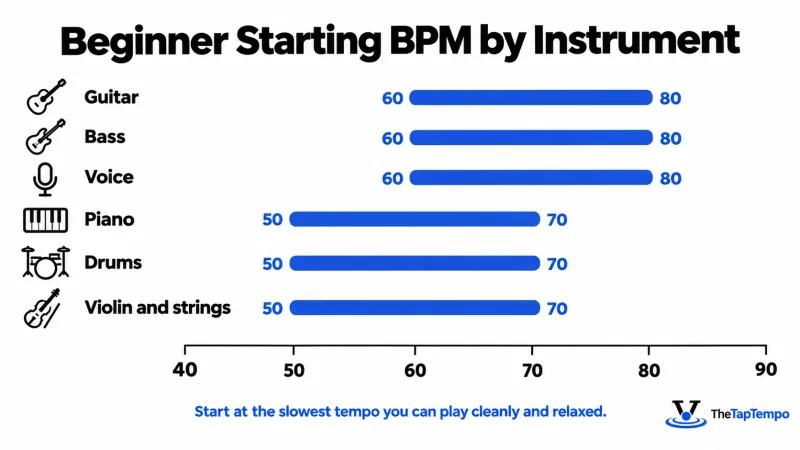
Instrument ranges for beginners are similar, usually 50 to 80 BPM, but each instrument has a different physical bottleneck that decides how slow you should go. A guitarist is limited by chord changes, a pianist by finger independence, and a drummer by coordination between hands and feet. Choose the tempo that suits your bottleneck, not the one that sounds impressive.
| Instrument | Beginner starting range | Practical example |
|---|---|---|
| Guitar | 60 to 80 BPM | A chord-change drill with one chord per click at 60 BPM, then 65 to 70 BPM after several clean cycles |
| Piano | 50 to 70 BPM | A scale with one note per click at 50 to 60 BPM before grouping notes |
| Drums | 50 to 70 BPM | A basic groove slow enough to coordinate hands and feet without rushing |
| Bass | 60 to 80 BPM | A simple riff or scale with even spacing between notes |
| Violin and other strings | 50 to 70 BPM | Bow control and intonation at a tempo that stays relaxed |
| Voice | 60 to 80 BPM | A simple scale or interval exercise at a tempo that leaves time for accurate pitch and breath control |
Guitar
Guitar learners usually do well between 60 and 80 BPM. Guitar teaching guidance often points to 60 to 70 BPM as an early baseline, which fits what many teachers recommend for early chord and scale work. Chord changes are the usual limit, so a dedicated chord-change drill gives each chord its own click. Play G on click one, C on click two, then repeat. This is separate from strumming a full song pattern, where you would not change chords every beat. At 60 BPM, when five consecutive changes are clean and your fretting hand stays loose, move to 65 or 70 BPM.
Piano
Pianists often start lower, around 50 to 60 BPM for scales and technical exercises. Many piano teachers use one note per click at this stage, so the metronome gives you feedback on every single note rather than only on the beat. This is useful because uneven fingers show up immediately when each note has its own click.
Note that "one note per click" and "one beat per click" are different setups. If you play four notes per beat, a tempo of 60 BPM would put four notes between each click. Beginners usually learn faster by giving every note a click first and grouping notes later.
Drums
Drummers can start between 50 and 70 BPM. At these speeds you can hear whether your hands and feet land together, which is the real skill behind a steady groove. A beginner who rushes the kick drum at 90 BPM will often play it evenly at 60 BPM, because the slower tempo gives the brain time to coordinate each limb.
Bass and Strings
Bass players generally fit the 60 to 80 BPM range. The focus is even spacing between notes, since a bass line that wavers by a few milliseconds is noticeable in a band. Violinists and other string players usually begin around 50 to 70 BPM, where bow control and intonation have room to settle before speed is added.
Singers can usually begin around 60 to 80 BPM. The priority is not speed but accurate pitch, steady breath support, and clean transitions between notes.
Quick Answer: Guitar and bass start near 60 to 80 BPM. Piano, drums, and strings usually start lower, around 50 to 70 BPM, because coordination and control come first.
What Comes After Choosing Your Starting BPM
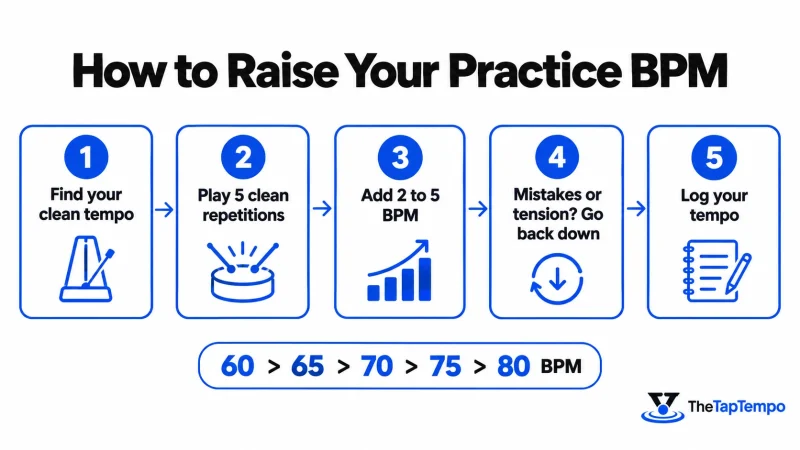
Once you have a starting BPM, raise it only when the current tempo is consistently clean, and raise it in small steps. A common standard is three to five clean repetitions in a row before any increase. The increase itself is usually 2 to 5 BPM, or 1 to 2 BPM when you are close to your limit.
How to Know When to Increase
You are ready to move up when you can play the passage several times in a row with no wrong notes, no hesitation, no rushing, and no physical tension. Five consecutive clean repetitions is the stricter and more reliable benchmark. If your shoulders rise, your breathing tightens, or your hand cramps, treat that as a sign the tempo is still too high, even if the notes are correct.
Playing the correct notes is not the same as playing in time. A passage is not ready for more speed if you rush the easy parts, drag the hard ones, or drift away from the click and snap back to it.
How Much to Increase
Small steps are safer than large jumps. Add 2 to 5 BPM for normal practice, and use 1 to 2 BPM when a passage is at the edge of your control. Easier, well-learned material can sometimes take 4 to 8 BPM, but jumping by 10 or 20 BPM usually breaks the technique you just built.
This section only covers choosing the step size. If you want a full method for raising tempo while protecting accuracy, read How to Increase Speed Without Losing Accuracy.
A Simple Progression Chart
The chart below shows one way to move a single scale from 60 to 80 BPM. Treat it as a pattern to copy, not a fixed schedule. If a day goes badly, repeat the same tempo or step back.
| Day | Exercise | Starting BPM | Next BPM | Promotion rule |
|---|---|---|---|---|
| Day 1 | C major scale | 60 | 65 | 5 clean repetitions |
| Day 2 | C major scale | 65 | 70 | 5 clean repetitions |
| Day 3 | C major scale | 70 | 75 | 5 clean repetitions |
| Day 4 | C major scale | 75 | 80 | 5 clean repetitions |
If mistakes or tension appear at any step, return to the previous BPM and rebuild consistency. Going down is part of the process, not a failure.
Tracking Your Improvement
A practice log turns a vague feeling of progress into evidence. Write down the exercise, the date, the BPM, and how many clean repetitions you achieved. Within a couple of weeks you will see which tempos are stable, which are still shaky, and where you stall.
| Date | Exercise | BPM | Clean repetitions | Notes |
|---|---|---|---|---|
| Week 1, Mon | G to C chord change | 60 | 5 | Relaxed, ready for 65 |
| Week 1, Wed | G to C chord change | 65 | 3 | Late on the fourth change |
| Week 1, Fri | G to C chord change | 65 | 5 | Clean, move to 70 |
Teachers often ask students to keep a log like this because it shows the true working tempo, not the tempo a student hopes to be at. Keep it simple, since a log that takes two minutes to fill in is a log you will actually use.
Common Beginner Mistakes
Most beginner tempo problems come from the same few habits. Starting too fast is the most common, because speed feels like progress. Raising the BPM after one lucky repetition is a close second.
Watch for these patterns:
- Using one BPM for every exercise. An open-string warm-up may be fine at 80 BPM, while a hard chord change may need 40 to 50 BPM.
- Ignoring tension. Tight hands or held breath mean the tempo is too high, regardless of how the notes sound.
- Practicing at only one tempo. Alternate between a comfortable tempo and a slightly challenging one to build control.
- Treating the metronome like a race. The click is feedback, not a competitor. If you cannot stay with it, lower the BPM until you can.
For a wider look at setup and habits, see Common Metronome Mistakes.
You now have a starting number, a step size, and a way to track results. The next step is to try them on a real exercise. Start practicing today with our free online Metronome tool.
Continue Learning
Continue building your practice routine with these guides:
This article has been researched, written, and reviewed according to our Editorial Policy.
Frequently Asked Questions
Common questions about finding the BPM of a song.