
Italian Musical Terms: Why Italian Became Music's Language
Discover how Italian musical terms became the standard language of tempo markings in Western classical music, from Renaissance roots to modern use.
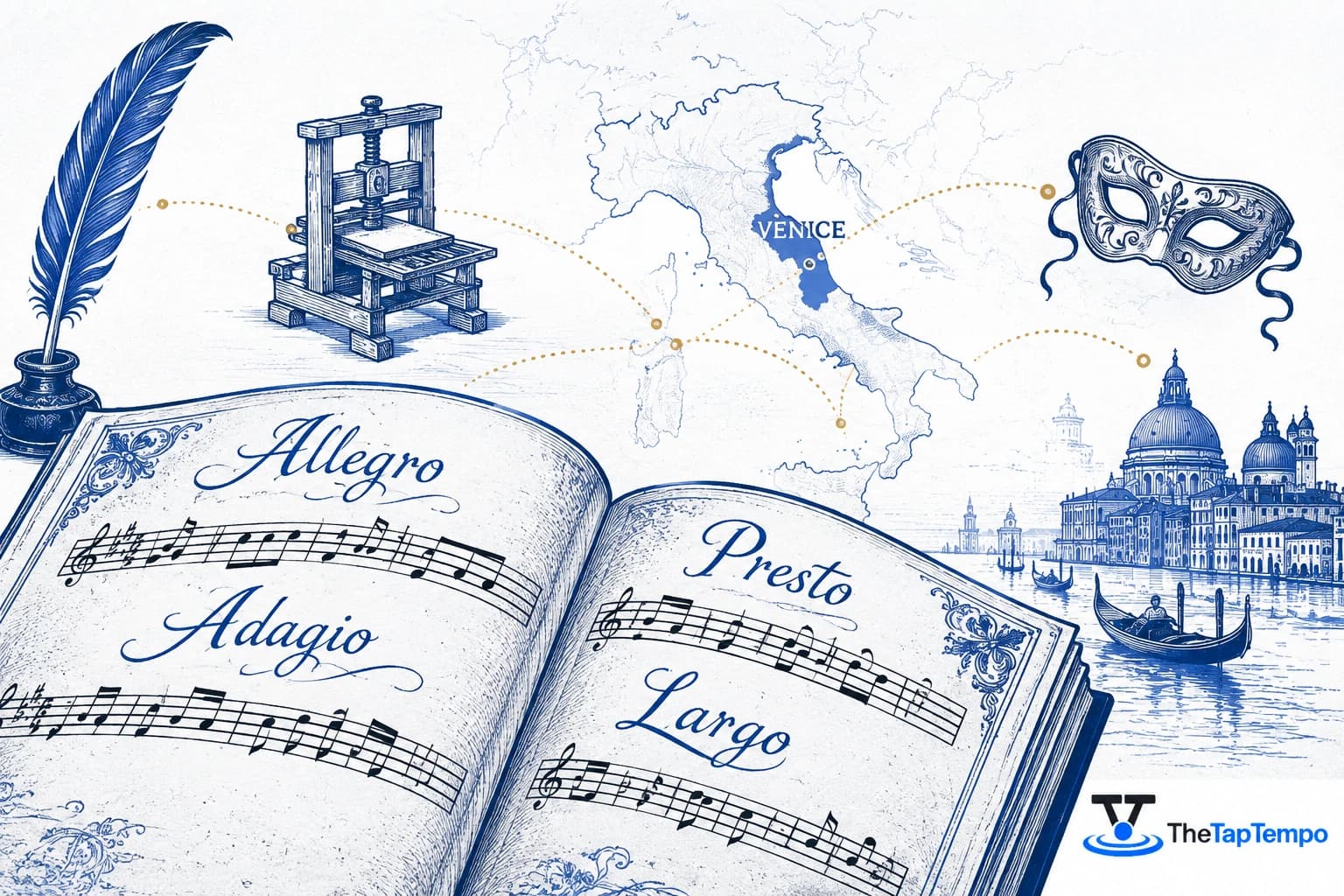
Open almost any piece of Western classical sheet music, and you'll find a word above the first measure that isn't in English, German, or French. Allegro. Adagio. Presto. Largo. Musicians who grew up reading these terms rarely stop to ask why they're there. But it's a good question. Why did Italian, specifically, become the language musicians across Europe used to describe how a piece should move and feel?
The short answer is that nobody decided it. Italian musical terms developed gradually, through overlapping strands of musical life across two centuries, and became a shared convention rather than a rule anyone imposed. Understanding how that happened changes how you read a score, because it reveals something important: these words were never meant to be precise numbers. They were, and still are, part of a living tradition shaped by generations of shared musical practice in Western classical music.
This is the story of how Italian musical terms became the common vocabulary of tempo and expression across Europe, and why that history still matters to anyone reading a score today.
Key Takeaways
- Italian musical terms developed gradually over centuries; no single person, composer, or institution created them.
- Sixteenth- and seventeenth-century Italian music, printing, opera, traveling musicians, and educational networks all helped spread words like allegro, adagio, and presto across Europe.
- Early tempo markings often described character and manner of performance as much as speed, and their meanings varied by composer and region rather than following one fixed definition.
- Italian remains the dominant convention in Western classical notation, but composers have always been free to use German, French, English, or other languages instead.
- Understanding this history helps musicians read Italian tempo terms as flexible, expressive instructions rather than fixed numerical values.
Music Before Standard Tempo Markings
Long before composers wrote tempo words above a piece, performers already knew roughly how a piece should move. That information came from the notation itself.
Note values, rhythmic patterns, and the conventions attached to a particular genre told a trained musician what to expect. A dance movement carried its tempo in its rhythmic shape. A sacred vocal work implied its pace through style and function. Performers were expected to read these signals the way a modern musician reads a time signature or a style label like “waltz,” inferring tempo from the character of the music rather than being told outright.
Verbal instructions weren't unheard of during this period, but they were occasional and inconsistent rather than part of any shared system. There was no widely shared vocabulary for tempo and expression comparable to the later Italian convention, and no expectation that a composer would leave a word at the top of a piece describing its speed or mood.
Performance during this era depended heavily on shared training, rhythmic conventions, genre, and other cues within the written music. That habit took shape later, and slowly.
How Italian Tempo Terminology Began to Develop
During the sixteenth century, musicians and theorists across Europe began writing verbal performance instructions more often, and a significant share of this activity came from Italy, alongside similar developments happening elsewhere.
Early Evidence Beyond Italy
Two sixteenth-century publications are often cited here, and it's worth being precise about what each one actually shows.
Luis Milán's Libro de música de vihuela de mano, published in Valencia in 1536 under the title El Maestro, is an early example of a musician giving verbal guidance about relative speed and manner of performance. Milán was Spanish, not Italian, and his work is best understood as evidence that this kind of instruction was emerging in multiple places at once, not as proof that an Italian system already existed.
Italian Sources in the Sixteenth Century
A more directly Italian source from the same decade is Silvestro Ganassi's Opera intitulata Fontegara, published in Venice in 1535. It's a valuable window into sixteenth-century instrumental teaching and the developing language musicians used to describe how music should be performed. It shows Italian musical vocabulary taking shape, though it's a snapshot of an emerging practice rather than evidence of a finished, standardized system.
A generation later, Gioseffo Zarlino's Le Istitutioni Harmoniche, published in Venice in 1558, stands as one of the major Italian theoretical treatises of the century. Zarlino's writing reflects the intellectual environment in which Italian musical vocabulary continued to develop, part of a broader tradition of Italian musical thought rather than a single documented breakthrough in tempo notation.
Read together, these sources tell a consistent story. Sixteenth-century Italy was one of the places where verbal performance instruction was actively taking shape, alongside comparable developments elsewhere in Europe. It was the early stage of Italian musical terms as a working vocabulary, not the arrival of a finished system.
Seen across the centuries, this stretch of the history of musical notation follows a broad, gradual shape rather than a series of sudden breakthroughs:
- 11th century, Guido d'Arezzo's work on pitch notation and sight-singing lays groundwork for how Western music is written down, though it belongs to the history of notation rather than tempo terminology specifically.
- 1535, Ganassi's Fontegara reflects the developing language of Italian performance instruction.
- 1536, Luis Milán's El Maestro, published in Valencia, shows similar verbal guidance emerging in Spain.
- 1558, Zarlino's Le Istitutioni Harmoniche documents the theoretical language of Italian music.
- Early 17th century, Italian opera and instrumental writing expand, and Italian performance terms appear more frequently in scores.
- 1610, Monteverdi's Vespro della Beata Vergine offers an important printed snapshot of the period's notation.
- 18th century, Italian tempo terms become widely conventional across European art music, without ever becoming compulsory.
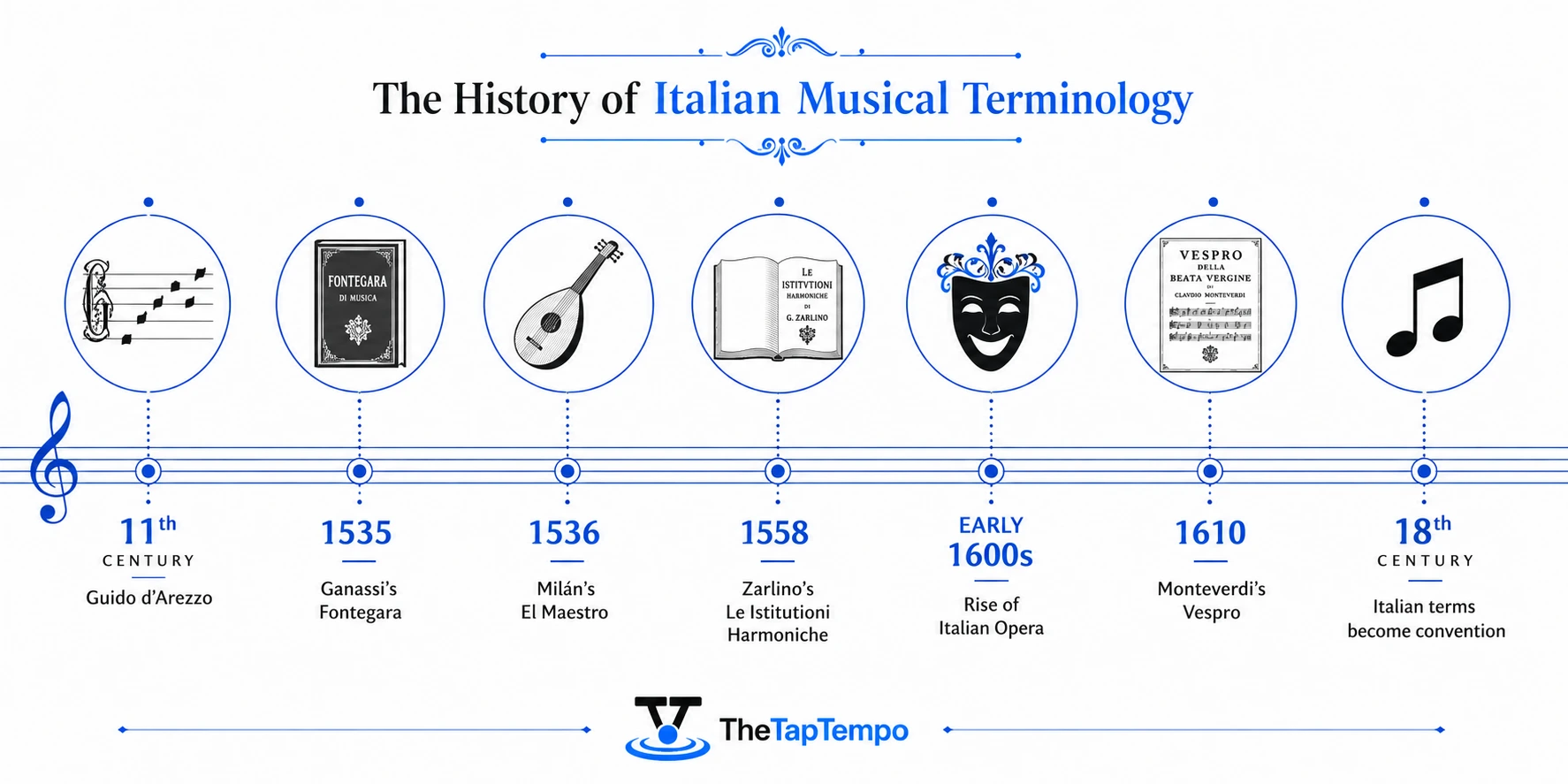
This is a gradual arc, not a sequence of fixed turning points. Each entry marks a stage in a slow-moving development rather than a single moment of change.
How Italian Terms Spread Across Europe
By the seventeenth century, Italian words such as adagio, allegro, presto, and largo were appearing more and more often as directions at the start of pieces or sections. This was an important stage in building the convention musicians rely on today, but it happened gradually rather than at any single moment.
These terms didn't always mean strictly “speed” in the way a modern player might assume. Earlier usage could describe character or general manner of performance just as easily as pace, and meanings varied between composers and regions rather than following one fixed definition.
Claudio Monteverdi's Vespro della Beata Vergine, published in 1610, is a significant printed source from this period, useful for studying notation, instrumentation, and how written indications related to actual performance. It offers a valuable window into early seventeenth-century musical practice, though it represents one moment within a longer, still-developing tradition rather than proof that Italian tempo markings were already fixed and universal.
How did this developing vocabulary reach musicians outside Italy? Not through one channel, but through several that reinforced each other over time.
Italian Musical Influence
Italian musical influence during the late Renaissance and Baroque period was considerable, particularly in vocal music, opera, instrumental writing, and theory. Composers such as Claudio Monteverdi, Arcangelo Corelli, and Antonio Vivaldi worked within this broader Italian musical culture, and their scores reflect the same evolving vocabulary of Italian musical terms that was circulating more widely during the period, without any one composer having personally created or fixed that vocabulary.
How the Vocabulary Traveled
Their influence traveled through multiple routes at once:
- Musicians on the move. Performers and composers traveled between courts and cities, carrying musical practices and vocabulary with them.
- Music printing. Venice became a major center of music publishing, and Italian printers distributed scores and theoretical writing well beyond the Italian peninsula. Printing helped this vocabulary circulate, though it was one contributing channel among several rather than the reason on its own.
- Opera. Opera emerged from Italian musical and theatrical culture around the start of the seventeenth century and spread across Europe through touring singers, composers, and companies. It carried Italian musical language into new audiences, though it wasn't the sole reason tempo terminology caught on.
- Court and theatrical networks. Aristocratic and civic patronage connected musicians, composers, and audiences across national borders.
- Educational and professional circles. Musical training and professional collaboration created further pathways for shared vocabulary to travel.
Italian conservatories, particularly in Naples, became important centers of musical education during this era and formed part of these wider professional and educational networks. They were part of the ecosystem through which Italian musical practice circulated, rather than the single driving force behind the terminology's spread.
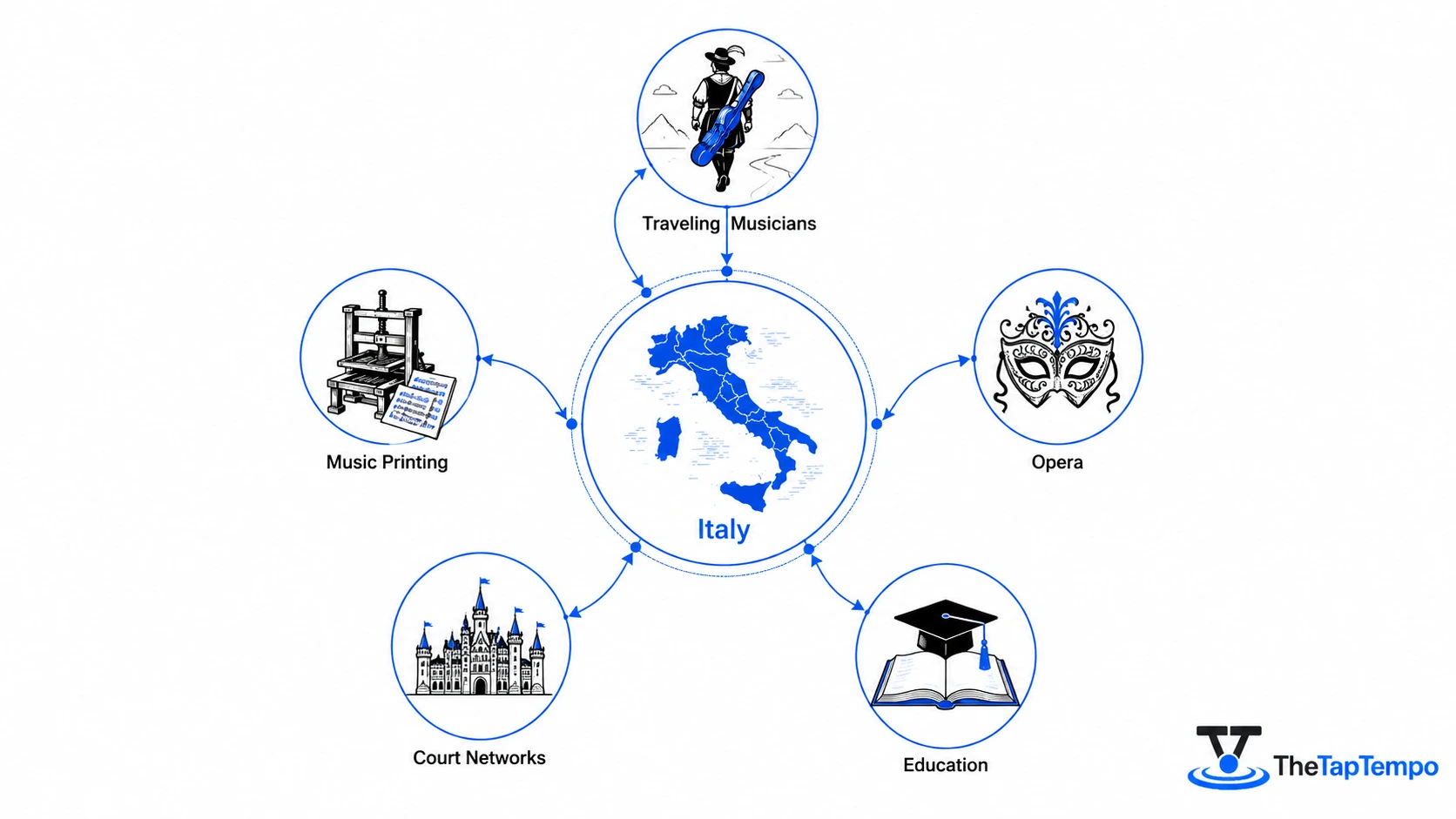
No one of these factors explains the outcome by itself. It was the overlap between them, repeated across decades of shared musical life, that gradually made Italian words familiar to musicians well outside Italy.
Printing and the Rise of Convention
Printing played a particular role in this process, though not as a single standardizing event. As Italian publishers issued more scores and theoretical writings using the same handful of Italian terms, those terms were copied, reprinted, and taught in similar form across different cities and generations.
Printed music also made these conventions easier to reproduce consistently across regions and generations. It did not create an official standard, but repeated publication helped familiar terms and notation practices become increasingly recognizable to musicians across Europe. No printer, composer, or institution formally standardized Italian tempo terminology. The consistency that emerged came from the same words being used again and again across a growing body of shared score markings.
Why Italian Tempo Markings Are Still Used Today
By the eighteenth century, Italian tempo terms were well established in scores, treatises, and teaching traditions across much of Europe. Meanings still weren't perfectly uniform, and national musical styles kept developing alongside this shared vocabulary rather than disappearing beneath it.
Italian had become a widely recognized convention for describing tempo and expression, but never an exclusive or compulsory one. Once you're comfortable with what these terms are communicating, our Metronome tool is a natural next step for turning that understanding into consistent practice.
From Repeated Use to Musical Convention
One plausible explanation for why the convention held is that repeated use, across shared institutions, printed music, and teaching traditions, reinforced itself over time. Once enough composers, publishers, and teachers were working with the same Italian vocabulary, it became the practical common language for tempo, even as individual composers kept writing in their own national styles.
This looks like a gradual process of habit becoming convention, rather than a single decision by any one figure or institution.
That history still shapes the page in front of you. When a musician today sees allegro at the top of a score, they're reading a term with centuries of accumulated use behind it, not a word invented for that piece alone.
Do Modern Composers Ever Use Other Languages?
Yes, regularly. Italian remains the most recognizable convention in Western classical notation, but it has never been a strict requirement.
Composers in different national traditions have also used German, French, English, and other languages when writing performance instructions, sometimes alongside Italian and sometimes in place of it. Many contemporary composers write plain-language descriptive phrases in English when they want an instruction more specific than a single traditional word can capture.
None of this displaces Italian as the dominant historical convention. It simply confirms what the history already suggests: Italian tempo terminology is a strong, widely shared tradition rather than a fixed rule. Composers have always chosen the language that best communicates their intent, and many still choose Italian because it connects their work to centuries of shared musical practice.
Using Historical Context to Better Interpret Sheet Music
Knowing where these terms came from changes how you approach them on the page. Italian tempo markings developed as verbal performance instructions rather than precise numerical tempo measurements. They emerged as a flexible vocabulary that could describe speed, character, and manner all at once, and that flexibility is still built into how the words are used today.
This is exactly why history matters for performance. A marking like allegro carries centuries of accumulated musical meaning rather than one fixed value, which is part of why performers, teachers, and conductors still interpret it with room for musical judgment instead of treating it as an exact instruction. If you want a quick, reliable reference for how these terms are used in current practice, our Tempo Markings Tool breaks down the most common Italian tempo markings and their typical modern performance references, so you can move from historical understanding straight into practical use.
Continue Learning
- Why Composers Use Tempo Markings Instead of BPM Numbers – explore why expressive language, rather than a fixed number, remains central to how tempo is communicated on the page. Read the guide
- How Tempo Affects Emotion in Music – see how the same historical terminology carries character and mood, not just speed. Read the guide
- Why the Same Tempo Marking Sounds Different – understand why a term like allegro can feel different from one piece, performer, or era to the next. Read the guide
- Why Slow Practice Makes a Better Musician – a practical follow-up for turning historical terms into consistent, disciplined practice. Read the guide
- Pitch Percentage & BPM: Technics vs. Pioneer Fader Behavior – see how pitch range and resolution make the same percentage feel different on different DJ decks. Read the guide
Understanding where these terms came from makes them far easier to interpret with confidence. Use our Tempo Markings Tool whenever you need a quick, reliable reference for the most common Italian tempo terms in modern performance.
This article has been researched, written, and reviewed according to our Editorial Policy.
Frequently Asked Questions
Common questions about finding the BPM of a song.