
Why Songs Don't Always Have One Fixed BPM
Not every song holds one steady BPM. Learn why tempo shifts in live music, jazz, and classical performance, and how to measure each section correctly.
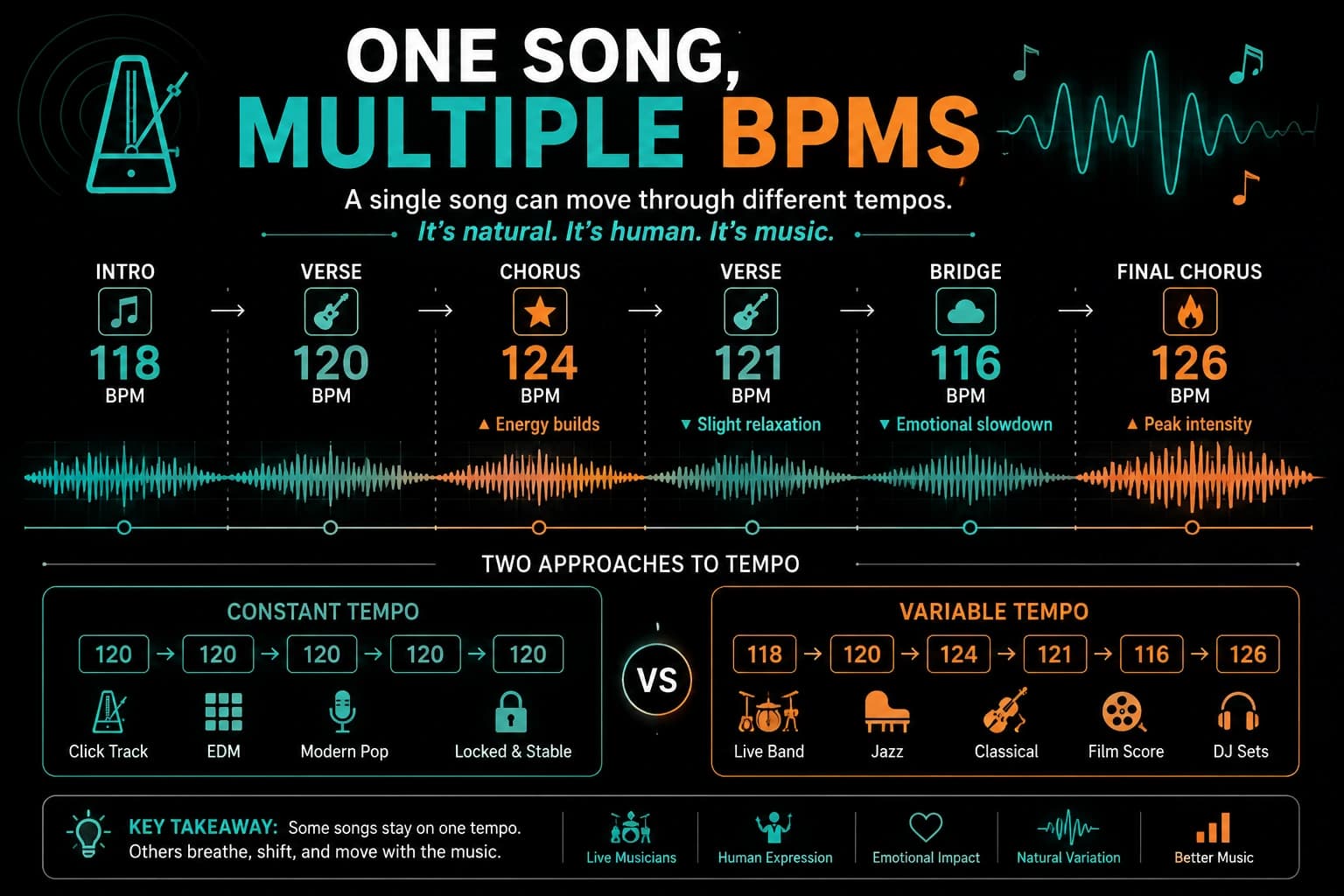
A single song can contain several different tempos, and that is not a flaw in the recording. It is a natural result of how humans perform music, how producers build arrangements, and how certain genres are meant to breathe. Anyone who has tapped along to a track and watched the reading shift from section to section has already noticed this in practice.
This article explains where those tempo changes come from, why some genres embrace them, and how musicians, DJs, and producers accurately work with songs that refuse to sit still.
Quick Answer
Not every song holds one steady BPM because human performers naturally vary their timing, producers intentionally program tempo automation, and certain genres are meant to breathe. To work with these tracks, check each section’s BPM separately using a Tap Tempo tool, build a tempo map for production, and fine-tune transitions by ear.
Constant Tempo vs Variable Tempo
Some songs hold one tempo from the first beat to the last. Others move through several distinct tempos, speeding up during a chorus, slowing into a bridge, or drifting gradually as a live band responds to the room. Neither approach is more “correct”; they simply serve different musical goals.
Constant tempo is common in electronic music, pop production, and anything built around a click track, because a fixed grid keeps loops, samples, and automation locked together. Variable tempo shows up wherever human expression, improvisation, or live performance take priority over mechanical precision. Film scores, orchestral works, jazz recordings, and unclicked live sets all fall into this category regularly.
A useful way to think about it: constant tempo treats the song as a grid, while variable tempo treats the song as a performance. Understanding which one you are dealing with changes how you should measure it, and it explains why a single BPM reading rarely tells the whole story of a track that shifts speed.
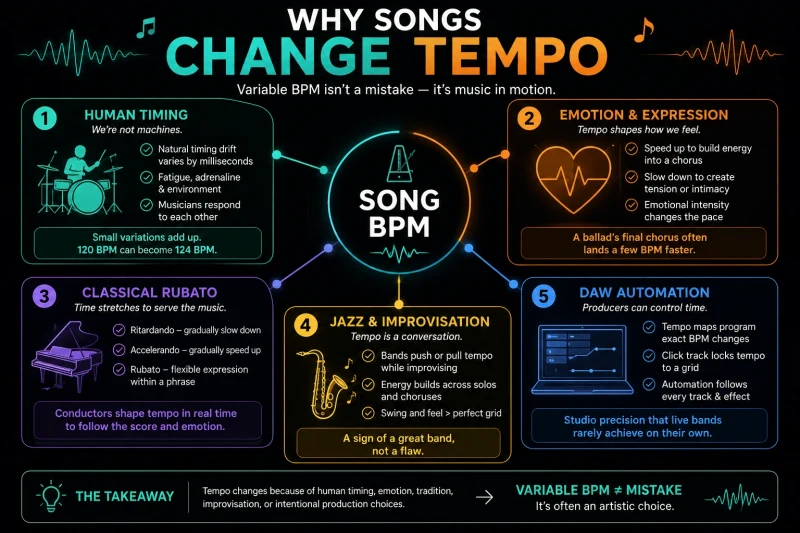
Why Live Performances Change Speed
Live tempo movement happens because musicians are not machines, and a live room is not a studio. Two forces drive almost every tempo shift in a live setting: the physical limits of human timing, and the emotional intent behind the performance.
Human Timing
Even highly trained musicians do not play with machine-level timing accuracy, and that is expected rather than a mistake. Research in music cognition consistently shows that human rhythmic timing includes small, natural fluctuations, even among professional performers who have played a piece hundreds of times. A drummer’s internal sense of tempo can drift slightly based on fatigue, adrenaline, room acoustics, or how the rest of the band is responding in the moment.
This is different from careless playing. A tight live band can still move a song from 120 BPM at the first verse to 124 BPM by the final chorus, purely through the accumulated effect of small, human timing variations. Anyone measuring that recording with a single BPM number is describing an average, not a fixed value.
Emotion & Expression
Tempo is also an emotional tool, and skilled performers use it deliberately. Pushing slightly ahead of the beat can build excitement heading into a chorus, while pulling back can create tension or intimacy in a quiet passage. A ballad’s final chorus often lands a few BPM faster than its opening verse simply because the emotional intensity of the performance has increased.
Quick Answer: Live tempo change usually comes from two sources: the natural, unavoidable timing variation of human musicians, and deliberate tempo shifts performers use to shape emotion and energy across a song.
Classical Music and Rubato
Rubato is the deliberate, expressive stretching and compressing of tempo within a phrase, and it is one of the clearest examples of tempo change being used as an artistic tool rather than an error. Classical performance uses this flexibility at two different levels: within a single performer’s phrasing, and across an entire ensemble.
Rubato in Solo Performance
A pianist performing a Chopin nocturne, for instance, may slow into an expressive phrase and then subtly recover the tempo on the way out of it, all without ever breaking the underlying pulse of the piece. This is rubato at its most personal: one performer stretching and compressing time to shape a single melodic line.
Conductors and Orchestral Tempo
Conductors apply a similar principle across an entire orchestra. A symphony rarely holds one exact tempo for its full duration; the conductor shapes tempo in real time based on the score’s markings, the acoustics of the hall, and the emotional arc the ensemble is building toward. According to standard classical performance practice, this kind of tempo flexibility is expected and often explicitly notated through terms like ritardando, accelerando, and rubato itself.
For anyone trying to measure a classical recording, this means a single BPM value can only ever represent one moment or one passage. A full performance will almost always contain a range of tempos rather than one number.
Jazz & Improvisation
Jazz treats tempo as something to be felt and negotiated between musicians in real time, which is part of why it is one of the most tempo-variable genres in recorded music. During an improvised solo, it is common for a rhythm section to gradually push the tempo forward as energy builds, especially in up-tempo swing or bebop settings. A trio that starts a standard at 200 BPM might be sitting closer to 208 BPM by the final chorus, driven entirely by the interplay between the drummer, bassist, and soloist.
This is not considered a flaw among jazz musicians and audiences; it is often read as a sign of a band genuinely listening and responding to one another. A jazz recording with a perfectly static tempo can actually feel stiff or over-produced to experienced listeners, because it removes the sense of a live conversation happening between the players.
Modern DAW Tempo Automation
Digital production tools handle tempo very differently from a live band, because a DAW can define tempo as data rather than as a lived performance. Producers have two main ways of working with tempo inside a session: programming it to change on purpose, or locking it down entirely.
Tempo Maps
Producers can draw tempo changes directly onto a timeline using a tempo map, telling the software to shift from 90 BPM to 96 BPM over a specific number of bars, and every track, loop, and plugin will follow that automation exactly. This approach is common in film scoring, hybrid orchestral productions, and any modern genre that blends programmed elements with live instruments. A composer might automate a gradual tempo increase to build tension across a scene, while a producer working with a live vocalist might create a tempo map that follows the natural push and pull of the vocal take rather than forcing the vocalist onto a rigid click.
Click Tracks and Session Recording
Session musicians recording to a click track are working at the opposite end of this spectrum. The click enforces one fixed tempo (or a precisely automated tempo map) for the entire session, which is exactly why studio takes tend to sound tighter and more uniform than a live performance of the same song. A deeper comparison of studio versus live tempo behavior is covered in a dedicated guide, since that topic deserves its own full explanation.
Quick Answer: DAWs let producers program exact tempo changes using a tempo map, giving studio recordings a level of tempo precision that live performances, driven by human musicians, rarely achieve on their own.
How DJs Handle Variable Tempo
DJs run into variable tempo constantly, because live recordings, older tracks without a click track, and certain genres almost never hold one perfectly stable BPM. Before mixing two tracks together, many DJs will check the tempo of a specific section rather than trusting a single BPM number pulled from streaming metadata or an old CD listing, since that number is often just an average or an estimate.
Checking the intro, the drop, and the outro separately with a Tap Tempo tool gives a far more accurate picture of how a track actually behaves, especially with live-band recordings, older funk and soul records, or any track pulled from a DJ set rather than a studio master. A track that reads as 128 BPM on a streaming platform might genuinely sit closer to 126 BPM at the intro and 130 BPM by the final chorus, and that difference matters when beatmatching.
How Producers Build Tempo Maps
Producers working with tempo-variable material, such as a live band recording or a vocal take with natural rubato, need two things before the material is fully usable inside a session: an accurate starting tempo, and correctly recalculated values for anything that needs to stay in sync.
Finding a Starting BPM
Tapping along to the first few bars of a section with a Tap Tempo tool gives a fast, reliable starting point, which can then be refined and automated once the material is imported into the session.
Calculating Tempo-Synced Effects
From there, a BPM Calculator becomes useful for converting those tapped values into the note-length and delay-time figures needed for tempo-synced effects, since a variable-tempo track often needs its automation and its effects settings recalculated for each section rather than relying on one global tempo.
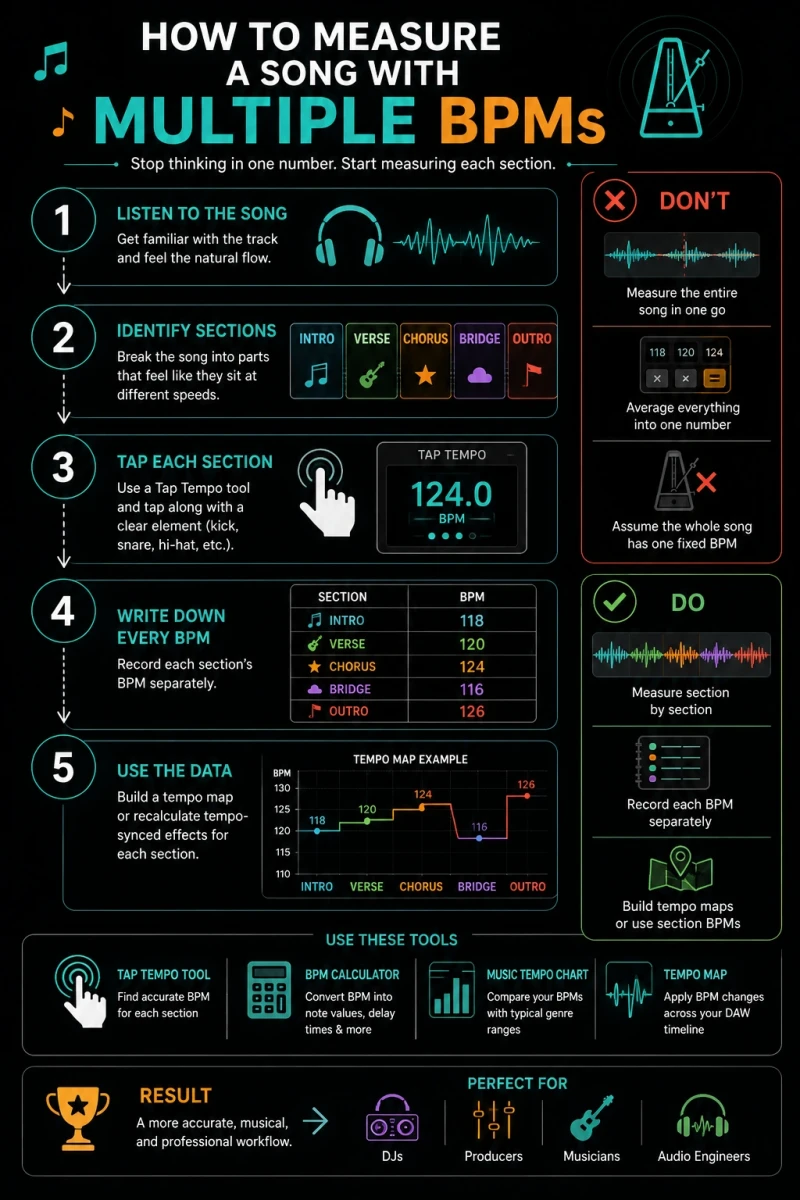
Measuring Songs with Changing BPM
The most reliable way to measure a tempo-variable song is to stop treating it as one number and start treating it as several. Instead of tapping through an entire track and averaging the result, measure each distinct section on its own and record the values separately.
A practical approach looks like this:
- Identify the sections of the song that feel like they sit at different speeds (intro, verse, chorus, bridge, outro).
- Tap through each section individually using a Tap Tempo tool, focusing on a clear rhythmic element like the kick drum or snare.
- Record each section’s BPM separately rather than combining them into a single average.
- Compare the results against typical tempo ranges for the genre using a Music Tempo Chart to check whether the variation looks expected for that style.
- For production work, use the section-by-section values as the basis for a tempo map rather than forcing the whole track onto one fixed BPM.
This section-by-section method is far more useful for DJs, producers, and audio engineers than a single BPM figure, because it reflects how the song actually behaves rather than flattening it into an average that no single part of the track truly matches.
Quick Answer: Measure tempo-variable songs section by section rather than as a whole. Tap each distinct part separately, record the values individually, and use them as real data points instead of collapsing the song into one misleading average BPM.
Final Thoughts
Tempo change is not a defect in a recording; it is often the sign of a genuinely human, expressive, or carefully produced piece of music. Whether it comes from a drummer’s natural timing drift, a conductor shaping a phrase, a jazz trio building energy, or a producer intentionally automating a tempo map, variable tempo is a normal and often valuable part of how music is made.
Continue Learning
This article has been researched, written, and reviewed according to our Editorial Policy.
Frequently Asked Questions
Common questions about finding the BPM of a song.