
How Musicians Find Song Tempo by Ear
Learn how musicians find a song's pulse, estimate tempo by ear, and sharpen the skill with practical drills before checking with Tap Tempo.
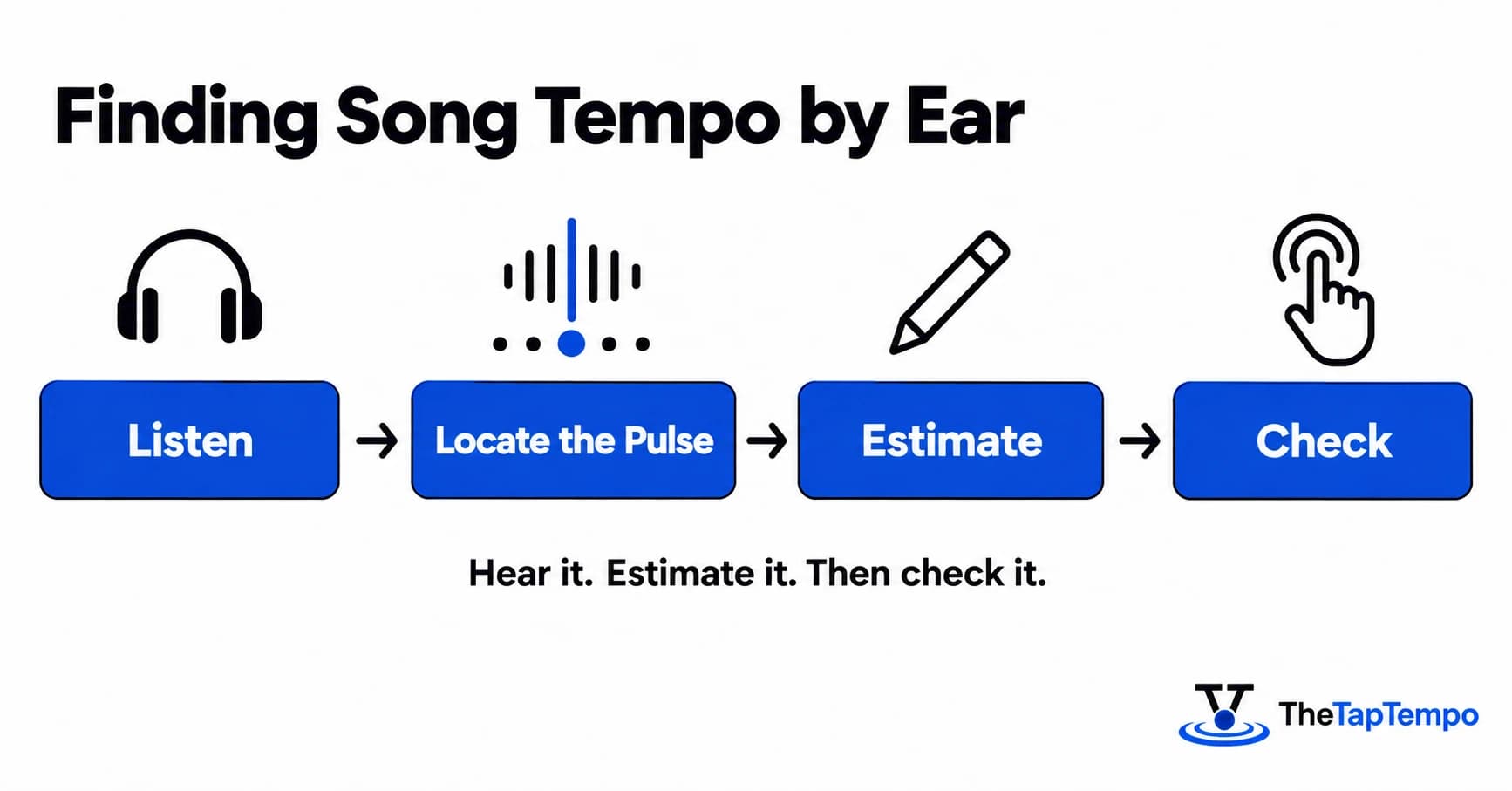
How Musicians Figure Out Song Tempo by Ear
A practical musician's workflow is to find the steady pulse, make an approximate estimate, and check it when numerical precision matters. This guide teaches that sequence for songs with a clear rhythm section, in four steps: listen, locate the pulse, estimate, check.
Hearing the beat and naming a number are separate skills. You can nod along perfectly to a groove and still have no idea whether it sits at 95 or 120. The exercises below build both skills in order, and the final step uses our free Tap Tempo tool as a check on your own tapping.
Songs without drums or percussion, such as solo piano or acoustic ballads, fall outside the scope of this guide.
Quick Answer: Can musicians hear BPM? Some musicians can make useful approximate estimates, but exact BPM recognition across unfamiliar songs should not be assumed. A realistic goal is to follow the pulse reliably and estimate its speed within a sensible range.
Why Tempo Recognition Matters
Tempo recognition is the ability to sense how fast a piece of music moves and to describe that speed, either relatively ("faster than the last song") or approximately ("somewhere near 100"). Musicians use it in situations such as joining a rehearsal without a count-in, transcribing a song for a band, or setting up a session that matches a reference recording. It does not require naming an exact number every time.
Picture a guitarist handed a recording the night before a gig. There is no chart and no time to open software. A musician with a reliable sense of tempo can play the first verse, settle on a pulse, and arrive at a workable count-in without any software. That count-in is still an estimate, and it is worth checking when precision matters.
Research finds differences in rhythm perception and production associated with musical experience. A 2016 comparative study by Matthews and colleagues tested 42 musicians and 14 non-musicians on tempo perception and production tasks, and the musicians performed better as a group. Differences between instrument groups were not significant on most measures, so the study does not support the common claim that drummers automatically judge tempo best. The study did not test the practice routine in this article, so it does not establish that routine's effectiveness.
An approximate tempo sense also helps you question unexpected tool readings. An app that reports 70 for a song you felt at 140 is not necessarily broken. It may be showing a different beat level, and your own sense of the pulse gives you a reason to investigate.
Listening for the Pulse

The pulse is the steady beat a listener would naturally tap a foot to, and finding it comes before any estimate of tempo. In music with a rhythm section, the pulse is usually shaped by the interaction of kick drum, snare, and bass, even when other instruments play faster or slower patterns. Your task is to find a steady beat level that fits the overall groove.
"Tap the beat" is the standard advice, but it skips the hard part: choosing which beat. A song can offer several valid candidates at once. Kick and snare suggest one rate, the hi-hat suggests a faster one, and a slow bass line suggests a slower one. Pick one level and stay with it.
Separate pulse from subdivisions

Subdivisions are the faster notes that sit between pulses, such as hi-hat eighths, shaker sixteenths, or a busy vocal. They shape how energetic a song feels, but they are not the beat you count. A song with constant hi-hat sixteenth notes can feel faster than a sparse song at exactly the same tempo.
Counting Techniques
Counting helps you maintain a pulse you have already chosen and notice when your beat level shifts. Counting alone does not produce a numerical BPM estimate without a time reference or a calibrated tempo reference.
Count the pulse, not every note
Start on an obvious point in a stable phrase, and count evenly with your chosen pulse. Keep counting for several bars, then ask whether the count still felt natural at the end. If the count becomes strained, check whether you changed beat levels, followed a fill, or simply lost synchronization.
Practice Exercises
The following routine starts with simple comparisons and moves toward numerical estimates. These drills are proposed practice activities, not a validated training program.
Drill 4: Estimate, tap, then reveal
This is the core drill. Write your estimate before you touch any tool. Then check your tapping with Tap Tempo, and only afterward reveal the known tempo of the loop if you have one. Record all three numbers in a log.
Checking Your Accuracy
Checking your accuracy means comparing three separate numbers: your guess, your tapped estimate, and, when you have it, the known source tempo. Each tells you something different.
Test your ear by checking your estimate with our free Tap Tempo tool.
Continue Learning
- How Accurate Is Tap Tempo?
- How to Practice with a Metronome
- Measure Numbers in Music: Why Bars Matter During Rehearsals
- Speaker Delay Explained: Live Sound & PA System Guide
FAQ
Do I need to identify exact BPM to be a competent musician?
No. Being able to follow and maintain the intended pulse matters more here than naming an exact number without help.
Is tempo recognition the same as absolute pitch?
No. Absolute pitch concerns identifying pitch without an external reference. This article concerns perceiving and estimating musical speed.
Does playing drums automatically make someone better at this?
Not necessarily. The 2016 comparative study found no significant differences between instrument groups on most measures, although musicians as a group outperformed non-musicians.
Sources
This article has been researched, written, and reviewed according to our Editorial Policy.
Frequently Asked Questions
Common questions about finding the BPM of a song.